
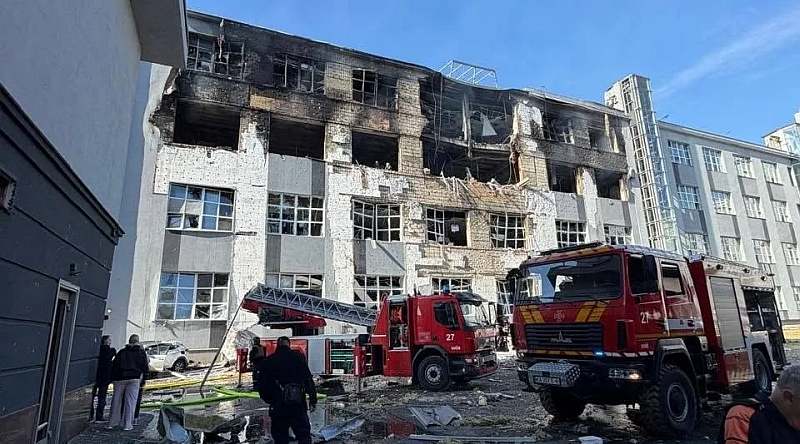

Attacking Ukrainian data centers to deprive Ukrainians of the internet is about as senseless as attacking gas stations to leave Ukraine without fuel.
Russia will achieve neither the first nor the second.
There are thousands of gas stations in Ukraine. Even massive strikes on them cannot stop fuel supply. Fuel mainly comes from abroad, and if needed, vehicles can be refueled from tanks, mobile refueling complexes, and other temporary points.
The same goes for the internet.
Ukrainian internet fundamentally differs from Russian. It is decentralized. Thousands of independent providers, numerous fiber optic routes to Europe, traffic exchange points, and backup channels create a system where the destruction of a single data center does not mean the destruction of the network. Traffic will divert through other routes, and other nodes will take over the load.
In Russia, it is the opposite. They have been building the so-called “sovereign internet” for years — a hierarchical system that the state can centrally control through large main operators and Roskomnadzor equipment.
Therefore, a simple question arises.
If it is impossible to turn off the Ukrainian internet by hitting data centers or to leave Ukraine without fuel by hitting gas stations, why do the Russians spend hundreds of drones on this?
They are not so foolish as to not understand this.
The goal is different.
Thanks to mass drone production and cooperation with China, Russia has gained the ability to launch a huge number of relatively cheap drones at Ukraine regularly. And for this weapon, it’s not only about finding targets. It’s about creating meaning.
Endlessly telling its society that every “Epicenter” or “Nova Poshta” branch stores weapons, and every mobile operator facility is a military target, becomes increasingly absurd.
Therefore, the main target becomes not the data center or the gas station.
The main target is our fear.
Fear that there will be no fuel tomorrow.
Fear that the internet will disappear tomorrow.
Fear that everyday life will stop functioning.
And ultimately — fear that Ukraine supposedly still won’t withstand.
This fear is what Russia tries to sow not only among Ukrainians. It’s also aimed at our allies: look, they say, Ukraine is exhausting itself, its infrastructure is collapsing, resistance is futile, so pressure Kyiv into accepting Russian conditions.
This is a continuation of the war by other means.
When Russia cannot achieve its goals on the front, and Ukrainian soldiers disrupt its plans, Moscow tries to transfer the war into people’s minds. A cheap drone is meant to destroy not only a building. It’s supposed to destroy the sense of stability.
That is why conversations about “total blackout,” “internet collapse,” “fuel shortage,” and the future “state collapse” emerge so quickly after the strikes.
There will be no collapse.
There will be damage. Buildings and infrastructure will be destroyed. The most terrible part is that peaceful people will die and suffer.
But Ukraine will not be left without the internet or fuel. And the state will not cease to exist.
Because the true target of these attacks is not our servers or our gas stations. The true target is our confidence that we will endure.
And that is what we cannot afford to give to the enemy.
On the cover: Consequences of the damage to the Cosmonova data center. Photo: Cosmonova
