
The broadcast with a well-known Estonian politician and diplomat in the Moscow studio of Radio Liberty was not expected to be scandalous—until the moment when one of the listeners asked the guest about the authoritarian tendencies in pre-war Estonia. The reaction was very sharp—the guest perceived this question as a provocation at a time when official Russian propaganda was lying about events in Estonia at every turn.
However, this reaction did not negate the truth—at the time of the Soviet occupation, Estonia and the neighboring Baltic countries of Latvia and Lithuania were not democracies but were classic authoritarian regimes with dissolved parliaments, arrested political opponents, and degraded public life. All decisions in each of these countries were made by one person, confident in the correctness of their calculations, often unable to assess the level of threats, and primarily interested in maintaining their own power.
Of course, compared to all the horror that began after the Bolshevik and Nazi occupation, the time of Konstantin Päts in Estonia, Antanas Smetona in Lithuania, and Kārlis Ulmanis in Latvia began to seem to contemporaries like a true golden age—all the more so because Päts and Ulmanis died a martyr’s death as hostages of the Soviet regime.
However, this does not negate the very fact of underestimating the danger and misunderstanding the intentions of the Kremlin.
There are many examples of mistakes, and the most significant among them was the agreement to the formation of Soviet bases in the Baltic countries back in 1939. After the Soviet occupation, it prevailed that the Baltic leaders simply had no chance to resist Stalin’s dictate. But in truth, they did not resist much, for they believed that the Soviet dictator would protect them from Hitler—the possibility of becoming a German province seemed a much more serious threat in 1939 than becoming a Soviet republic. As a result, the occupation troops were in the future occupied countries even before the occupation. It was a real trap, and the leaders were told about it, but they were accustomed to ignoring an alternative point of view.
Another significant mistake was legitimizing the occupation. For example, President of Latvia Kārlis Ulmanis demanded that his compatriots “stay in their places” and emphasized that he himself remained the head of state. This was not true—Ulmanis lost power and was forced to approve the puppet government of Latvia. But he continued to be considered the formal head of state until the pseudo-elections to the so-called People’s Seimas, which adopted the decision to join the USSR.
One might, of course, think that the Baltic dictators had no choice — but that’s not true. The Latvian army was larger and stronger, for example, than the Finnish army — but to have the courage to resist, a national consensus was needed, which is much easier to achieve in a democratic country. Therefore, the Finns managed to defend themselves in much more unfavorable conditions. But Ulmanis and the Estonian president Päts did not believe that resistance would make sense. Lithuanian President Smetona, who single-handedly led the country for 14 years and was considered the nation’s leader, actually demanded to fight — not from the people, but from his colleagues. However, he did not receive support from his own regime and decided to emigrate. Acting President of Lithuania Antanas Merkys, however, acted like Ulmanis and legitimized the occupation government.
We do not know whether the Baltic leaders could have stopped Stalin, but in democratic societies and with honest dialogue with the nation, in the context of united efforts of the Baltic countries (which signed a never-implemented alliance agreement), they would have had a much better chance. At least the Baltic countries might not have become Soviet republics, which would have excluded the possibility of demographic occupation in the post-war years. However, all this is conjecture. History took a different path.
And for Ukrainians, the most important thing is not to follow this path again. In a society where many people grew up during Soviet authoritarianism, there is still no clear understanding that a regime of personal power is always a path to mistakes and defeats. Yes, there may be successful decisions, like in a lottery. But when there’s no system of checks, when there are no alternative opinions, when there is no understanding of national unity as searching for compromise and the right solution, collapse is predictable. And yes, in such a power system we have lived for many years — and may continue to live until the end of the war, which in this case, may not necessarily end in our favor.
No, competent decisions, a functioning parliament, and a responsible government cannot be replaced by flashy speeches, magazine covers, and belief in one’s abilities. All this may have a short-term effect — and then leads to growing mistrust and new mistakes. No applause replaces the system of state governance — even when all European parliaments and Congress applaud you. Of course, in peacetime, these applause can be made part of your image, along with roads and promises. But in war, only soldiers and iron matter. If there are not enough people and weapons, if wrong decisions are made, if professionalism is replaced by loyalty, and loyalty leads to corruption, applause and promises will not help.
The Baltic countries lost their freedom for a long 50 years, but after its restoration, their citizens gratefully remembered their last ‘own’ presidents and decided not to focus on the authoritarian nature of their regimes. If Ukraine stands, we will talk about the mistakes, not the successes of Ukraine’s sixth president — I have no doubt about the luck of the Ukrainian people.
But that’s much better than being killed in a Chekist prison and remembered half a century later as the last leader of a free country.
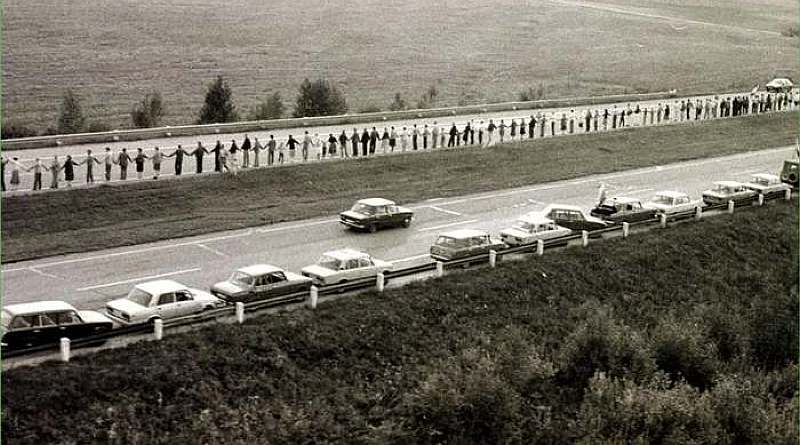
On the cover: A human chain during the peaceful protest action “Baltic Way,” which took place on August 23, 1989. About 2 million people in Estonia, Latvia, and Lithuania joined hands. The length of the continuous chain reached nearly 670 kilometers, connecting Tallinn, Riga, and Vilnius. The action was timed to the 50th anniversary of the signing of the Molotov–Ribbentrop Pact, to declare the desire for independence from the USSR. Photo from open sources.
