
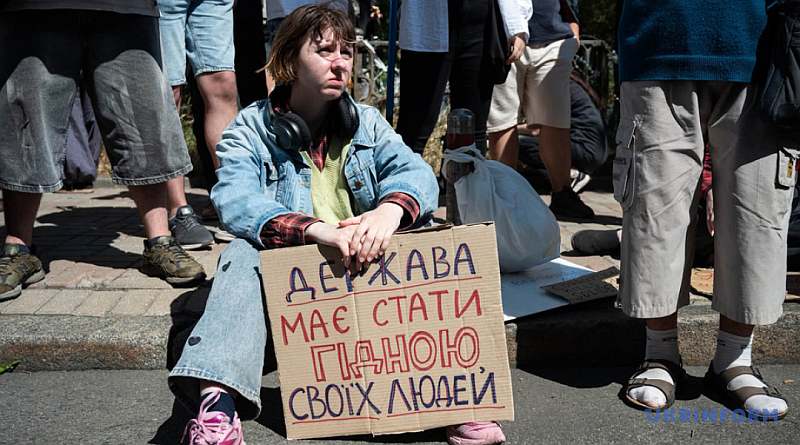
Are they still protesting? Imagine that! The cardboard Maidan does not intend to cease its activities. On Sunday evening in several cities, new, conditionally massive actions took place again. A month ago, in the first days of the protests, angry but cheerful activists achieved unheard-of success: they managed to remove Syrsky as a representative and symbol of the Soviet military school. The change of the Armed Forces commander during the war under street pressure—I think this precedent deserves to be included in history textbooks. As an example of successful “direct democracy.” Successful?
In the first years of the full-scale war, any protest actions, even simple expressions of disagreement, were tabooed from within society. It was believed that we did not have the right to rock the boat. Not only going out into the streets but just criticizing the military leadership, including the Supreme Commander, seemed unacceptable. Individual speeches of certain public figures like MP Bezuhla sounded like outright sabotage. Even constant remarks by the reputably impeccable Butusov were perceived as borderline. Not long ago, Babel’s investigation regarding “Skelia” was called a diversion.
Time, casualties, and fatigue have significantly changed the rules. Last year’s “Cardboard Maidan” already allowed a focus on the protest core in Ukraine: a liberated, sharp-tongued, and sufficiently educated youth capable of not just understanding the difference between the powers of NABU and the State Bureau of Investigation but also assessing the consequences of changes in their subordination. Let’s be honest, this is somewhat opposite to the frivolous majority that falls for new faces and promises of quick peace, at least as we imagine it. Over the past year, Mindich added some spice to the protest lexicon and allowed for a shift from local, more or less clearly defined demands to generalizations.
The danger for the authorities in such performances with slogans that one might want to collect does not seem that great. As of today, the majority of the population, I guarantee, has managed to forget about the gathering in Franka Square and does not consider it politically decisive. I suspect that minor media scandals, of which there are plenty, have somewhat overshadowed them in public attention. Our fortune is that the Ukrainian president depends on the applause of the street, so to speak, “as a matter of life,” and cannot ignore organized gatherings of people under his windows. It worked last year, it worked this year too, but to what extent—that requires a closer look.
The latest statements by informal leaders of Maidan 5.0 do not provide a clear understanding of the ultimate goal of the prolonged movement. The key issue in Ukraine’s relations with its government is the lack of communication, claims Dmytro Kozyatynsky, a veteran medic and one of the factual initiators of both last year’s and the current paper flash mobs. The agenda announced for the latest march last Sunday was once again the return of Fedorov to the Ministry of Defense and dialogue once more… But to say that the government does not communicate with society at all would be an exaggeration, more precisely, an understatement. The President regularly issues video addresses, the Office’s opinion is constantly broadcast in the media, and there’s a network of office bots functioning overall. Whether this constitutes a dialogue is a test of one’s sense of humor. As for Fedorov personally, judging by his own statements on various platforms, he has his own scenario, and it is not certain that his defenders have adequately inquired about the plans of their object of defense.
It’s important to remember that the causes and deep meanings of mass protests very rarely coincide with the immediate reason. Yes, the “fifth Maidan” helped to push long-overdue and extensively overdue personnel changes in the Armed Forces, shift the focus to the value of life and the dignity of the warrior, and this should already be recognized as a significant success. This could have been concluded with a sense of achieved goal and fulfilled duty. However, the true driving force of the protest has been and remains the bitter dissatisfaction with the state of affairs in the country in general. This time, the demands of the premium audience coincide with the requests of the broad masses, although they are hard to rationally describe. Public control, as seen by the activists, is largely an unattainable illusion, due to the lack of competence, tools, or constant organization among the masses. The romanticism of Maidan ultimately implies direct democracy, which is a path that is not very effective, albeit tempting.
Ordinary traditional protest demonstrations are commonplace in any democratic country. They are a legitimate and sometimes effective way to draw attention to a particular issue, so this practice should only be welcomed. It is worse when such actions are named with a significant, pardon the expression, sacred word for us like “Maidan,” thus acquiring an extraordinary status of a nationwide uprising. Ukrainians, perhaps on an epigenetic level, remember the practices of overthrowing hetmans by rebellious Cossacks, not to mention uprisings without limits. However, precisely because of this, the desire of ordinary people to directly influence political reality on a daily basis carries destructive potential.
Maidan, as a purely domestic technology, is effective because it is an extraordinary event, ultima ratio populi. It would be desirable to prevent the devaluation of this strong means, not to mention its trivialization. Like all my friends and acquaintances, I am delighted by the witty means of paper agitation, and I am not made to blush by the unconventional amount of obscene language. I would simply like the creative potential of the street not to gradually turn into an imitation—like the famous “Speakers’ Corner” in London’s Hyde Park at one extreme, or a convenient polit-technological illusion at the opposite.
Perhaps I’m old-fashioned, but it seems to me that all the tools we’re trying for the first time have long been in use. Niccolò Machiavelli is a genius not because he engaged in refined intellectual provocations, but because he invented the universal principle of the modern state: stato. This is an order where a filter, in the form of a network of institutions, grows between the people and the ruler, objectifying whims and desires from both above and below. Over time, they developed into what we call the system of checks and balances, that is, democracy, or simply put — the correct algorithms for making political decisions.
The spontaneous collection of wishes, demands, and claims to power that we read on cardboard is sufficient building material for creating fully-fledged political parties and movements with quite clear programs, shared values, and beliefs about the means of achieving them. Given: there is an active part of society capable not only of internal grumbling but also of rallying around a certain goal; there is a more or less common set of ideas about the functions that the state should perform and its sphere of responsibility; there is an ancient, deeply hidden, yet relevant tradition of self-governance. There is finally a certain percentage of people with the appropriate temperament, education, and ambitions, who could become successful politicians — no worse than the hurried graduates of express courses for people’s deputies in Truskavets. Find: why under these conditions do we not have half a dozen full-fledged political parties instead of existing leadership projects, why is political competition limited to jostling between the Office and semi-strangled oligarchs? Why does the civic temperament dissipate into one-time actions and wars on social media pages?
Once, about ten years ago, when many thought the bloodiest episodes of the war were already over, all hopes for a bright future were accompanied by the refrain: “The guys will come and bring order.” Today it is clear that veterans returning from hell need protection and order themselves. Without a full-fledged stato, which today is impossible without real grassroots politics, there is no hope for this, nor for the return of those who sought refuge abroad in 2022, nor for economic recovery, nor for a humane state. And without this… what are you even talking about?
In the header: A protest at the Rada for Fedorov’s reinstatement in the Ministry of Defense, 08/19/2026. Photo: Yevhen Kotenko, Danylo Antonyuk, Ukrinform
