
Donald Hill / Translation iPress
Donald Gill writes in his weekly review that Ukraine is increasingly systematically targeting logistics, energy, oil refining, and military infrastructure in occupied territories and deep within Russia, forcing the enemy to strengthen air defenses and restructure supply chains. Meanwhile, the effectiveness of Ukrainian long-range strikes depends on the ability to bypass Russian radars, long-range detection aircraft, and other countermeasures. A separate focus is on combating the Russian satellite network “Rassvet,” which could enable more precise control of strike drones. The combination of these attacks is already creating significant economic, logistical, and military costs for Russia.
Occupied Territories
The duel between a drone and a mobile fire group ended without a winner. The bullets from these machine guns have to fall somewhere, and the road is straight.
Ukraine publishes data on the number of trucks destroyed daily; other sources report the number of vehicles whose destruction is confirmed by video. But no one talks about how many medium-range strike drones are used in attacks on these trucks. Serhiy “Flash” Beskrestnov says that Russia has deployed radars, patrol interceptor drones, mobile fire groups, and electronic warfare systems along logistics routes, disrupting Starlink operations. As a result, the number of unsuccessful attacks has increased.
The 422nd regiment shows its successful attacks on Russian trucks. Except for one case when the target was changed at the last second, AI directed strikes at the trailers of the trucks, not the cabs.
August 9: an oil tanker, two cargo vessels, and five air defense system components. August 14: 27 substations, a thermal power plant, and a gas distribution station.

Russia hit four times more gas stations than Ukraine; however, Ukraine hit over 100 fuel trucks, leaving some Russian gas stations without fuel for weeks.
Madyar: “Crimea must become uninteresting and unsuitable for Putin as a military foothold. If we analyze the last five massive missile attacks on Ukraine, only single launches were made from the peninsula during simultaneous missile salvos.”
Russia
Instead of Euro-5 standard gasoline, Russian refineries will produce Euro-2, Euro-3, and Euro-4 standard fuels until July 1, 2027. Lower quality fuel will worsen engine performance, especially modern ones, but Russia is adapting.
In 13 regions, limitations on fuel purchases were lifted, indicating improved distribution and the need for new strikes on refineries. Ukraine is now trying to hit more precisely, targeting specific equipment for maximum damage. Additional strikes in August on 11 out of 34 large refineries forced some areas to reintroduce restrictions. Now Russia imports gasoline from India, Kazakhstan, Belarus, and Morocco. Sea export of Russian oil products – lubricants, asphalt, and petrochemical raw materials for plastics production – decreased by 54.7% in July.
Orsk Refinery was attacked, affecting all four AVT units. The atmospheric-vacuum tube unit heats oil and separates it into heavier liquids and lighter gases, which are used to produce various products, including bitumen, diesel, aviation fuel, and gasoline. The governor of Orenburg region announced that the refinery would not operate for six months since the key equipment was imported, and due to sanctions, its replacement will take time. The region now has restrictions on fuel purchase volumes, refueling of canisters is prohibited, and a fuel sale schedule based on the parity of vehicle license plate numbers has been introduced.
Refineries in Salavat, Tyumen, and Nizhnekamsk were also attacked. The Komsomolsk-on-Amur Refinery, located 250 km from the Pacific Ocean, caught fire by itself. At the Ust-Luga complex, gas condensate processing and hydrocracking units were destroyed.
Around the Ryazan Refinery, three new towers for “Pantsir” complexes were constructed, and at the Yaroslavl and Kstovo refineries, positions for “Pantsirs” are being built.
Rockets “Palyanytsia,” “Peklo,” “Bars,” and “Long Neptune,” as well as drones MICH, FirePoint, Ramsay, “January,” Trust, “Hariok,” “Beaver,” “February,” and “Dovbush” and unmanned boats “Sargan” and “Mamay,” struck the naval base in Novorossiysk. Three grain terminals and an S-300 radar were hit. Four warships – the project 11356 frigates “Admiral Makarov” and “Admiral Essen“, the project 21631 small missile ship “Buyan-M,” and the project 22160 patrol ship “Vasily Bykov” – were damaged to varying degrees. There are satellite images of the aftermath.
On August 7, a cargo ship was sunk. The Russian vessel, damaged on August 3, managed to reach a Turkish port.
A MiG-31 base was attacked at Savasleyka airfield; the extent of the damage is unknown.
Long-Range Strikes and Satellite Network
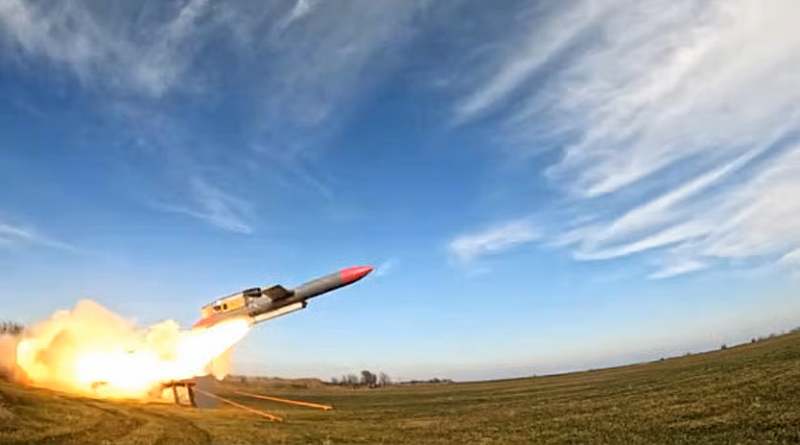
Ukrainian long-range strikes with “Flamingo” missiles faced several setbacks, yet Ukraine carried out a successful strike at a shorter distance—hitting a target 930 km away, striking the “Progress” rocket and space center in Samara with two out of five launched missiles. The second hit is visible at the beginning of the video. One missile was intercepted near Voronezh, and two more near Saratov.
Russia is creating a satellite communication network similar to Starlink, which will enable it to control all its “Shahed” drones and deliver more precise strikes. The satellites are launched by “Soyuz” rockets produced in Samara. Ukraine twice unsuccessfully attempted to attack the launch site in the Arkhangelsk region; however, Samara is the only production site for these rockets.

In June 2023, Russia launched three experimental prototypes of the “Rassvet” system. Three upgraded prototypes were launched in May 2024. After Russia was disconnected from Starlink in February 2026, it launched the first batch of 16 operational satellites in March. Another 16 satellites were launched in July, but they are not yet operational. The current incomplete network covers only part of Ukraine for a portion of the day, but the area and duration of coverage will increase as new “Rassvet” satellites are activated. Together with the prototypes, 37 satellites are operational; one has failed. Continuous and stable data transmission requires 200-250 satellites. The plan is to deploy 730 satellites by 2030 and 900 by 2035.

The recent failures of “Flamingo” attacks were largely explained by Russian A-50 aircraft, whose onboard radars allow them to look down and see targets inaccessible to ground radars due to terrain. Importantly, at the time of missile launch, there were no A-50s in the air. With only four such aircraft, Russia cannot constantly keep one in the sky. The timing of the attack suggests that Ukraine either anticipated a pause in the regular patrol schedule or has the ability to track in real-time whether an A-50 is airborne, being ready to launch missiles at short notice. After reaching the position, preparing the “Flamingo” for launch takes 20–40 minutes, and the missile covers a distance of 1,000 km in just over an hour. On the final segment of its flight, it traveled along the Volga to avoid detection by ground radars. It was reported that during this time all four A-50s were airborne to detect and intercept “Flamingo” missiles.

Russian analysis of events

“Flamingo” tries to fly low even when the route does not pass over a river, hoping that the terrain will block the radio waves of ground radars. Once, “Flamingo” already crashed into a pole, so it is possible that other missiles could also collide with terrain elements or obstacles. Ukrainian drones, in particular, have crashed into construction cranes.
Sabotage, Logistics, and Internal Issues
The Main Intelligence Directorate of Ukraine announced that they destroyed a train in Siberia carrying North Korean ballistic missiles and ammunition. A remotely controlled explosive caused detonation of the warheads, destroyed the train, and inflicted serious damage on the infrastructure.
In November 2025, a section of the railway near Sosnovka in Siberia was destroyed. In October 2025, sabotage damaged three lines of the Moscow ring oil product pipeline, which were protected by drone nets.
A military-industrial enterprise, the “Kamensky” plant, was attacked, resulting in a fire, but the extent of the damage was not reported. The enterprise produces solid rocket fuel for multiple launch rocket systems and cruise missiles, including “Oniks” and “Tsirkon”.
Wildberries facilities in Voronezh were destroyed, and in Chishmy in Bashkortostan – burned down. A facility in Tver suffered surface damage. The largest Wildberries complex in Koledino near Moscow was attacked again – a third attack seems unnecessary. A logistics warehouse 20 km away in Domodedovo burned down. Both targets were located inside the outer ring of Moscow’s air defense.
The commander of the only submarine of the Ukrainian Navy in 2014 defected to Russia. Last week he was killed in Sevastopol: he was passing by a trash bin in which a bomb was planted.
“Russian Railways” planned to raise tariffs in October, but due to a lack of funds, they are already increasing freight tariffs by 8.5% and passenger tariffs by 9.2%. After the October increase, the total tariff increase since 2022 will reach 56%. Freight volumes continue to decline. The government denied the company additional funding, so it will lay off 6,000 employees.
In April, Chinese workers building a refinery installation at a Russian plant in the Far East protested over unpaid wages. There are no reports indicating they received the money. Last week, 1,000 Chinese builders demanded salary arrears to be paid at the Baltic Chemical and Gas Complex in the Leningrad region.
The political party “Yabloko”, which advocates for a ceasefire and peace, was banned from participating in the September elections. The official reason cited was copyright violations, though the rights holders did not object. A vote for “Yabloko” would be perceived as disapproval of Putin. The party faced criticism for not condemning the war, but one of its members, who publicly spoke about Russian war crimes in 2022, was sentenced to seven years in prison, while another was recently arrested, after which he fled the country.
iPress Comment: Why the Kremlin removed “Yabloko” from the elections
“Yabloko” is one of Russia’s oldest democratic parties. It emerged in 1993 as an electoral bloc of economist Grigory Yavlinsky, former state controller Yuri Boldyrev, and diplomat Vladimir Lukin. The name was formed from the first letters of their last names. In the 1990s, “Yabloko” had a faction in the State Duma and was considered the main parliamentary force of the liberal opposition. However, after the 2003 elections, the party lost its representation at the federal level, retaining only a few deputies in the regions.
Despite its political weakness, after the full-scale invasion of Ukraine began, “Yabloko” remained the only officially registered party in Russia consistently calling for an end to the war. On February 24, 2022, the party’s federal political committee called the war against Ukraine “the gravest crime” and expressed categorical protest. Subsequently, under the threat of criminal prosecution for anti-war statements, the party focused its public rhetoric on the immediate cessation of hostilities, diplomacy, release of political prisoners, and prevention of nuclear war.
With slogans like “Yabloko,” the party planned to run in the State Duma elections in 2026. Its short program included demands for peace, freedom, and “life without fear.” The party proposed a federal list of 275 candidates and an additional 137 contenders in single-member districts. It was supported by calls from Yulia Navalnaya, Ilya Yashin, and Vladimir Kara-Murza. On social media, videos unexpectedly gained popularity in which young people held apples, danced to songs about apples, and urged voting for the party. The leadership of “Yabloko” claimed it did not order or pay for this campaign.
For the Kremlin, the danger was not that “Yabloko” might win. The results of Russian elections are determined by administrative control, censorship, the exclusion of competitors, and falsifications. However, even such elections can show how many citizens truly want an end to the war. Voting for “Yabloko” could turn into the only available form of legal protest and a kind of plebiscite on the continuation of hostilities.
Initially, the authorities likely expected the party to gain a negligible percentage, supposedly demonstrating a lack of anti-war sentiment. But the campaign’s popularity among young people and public support from opposition figures made this scenario risky. Then, the pro-Kremlin party “Rodina” joined in removing “Yabloko.” It filed a lawsuit, accusing competitors of copyright infringement, exceeding campaign spending, using foreign funding, and distributing allegedly illegal materials.
The story with a photograph of a tank in a sunflower field was especially significant. Its use was cited as one of the copyright violations. However, the defense provided the court with an agreement from JSC “Kommersant,” which confirmed that “Yabloko” had officially acquired the right to use the photo. The copyright holder made no claims against the party. Some other illustrations, according to “Yabloko” representatives, were created using ChatGPT. Lawyers emphasized that Russian law does not recognize artificial intelligence as an author, and thus such an image has no author whose rights the party could infringe.
These arguments did not help. On August 10, the Supreme Court of Russia canceled the registration of “Yabloko’s” federal list, and on August 17, it rejected the appeal. Several dozen people who came to support the party near the court were detained by the police. Formal complaints about photos and campaign expenses became a convenient legal pretext for a political decision made in advance.
The removal of the party from the elections was accompanied by pressure on its members. “Yabloko” leader Nikolai Rybakov was disqualified from running due to an administrative fine of 1500 rubles for a post expressing condolences after Alexei Navalny’s death. The image in that post was deemed a demonstration of “extremist symbolism” by the court. Former Moscow City Duma deputy Maxim Kruglov was sentenced to seven years in prison for posts about Russian war crimes. And on August 17, the day “Yabloko’s” appeal was considered, one of the party’s most prominent politicians, Lev Shlosberg, was sentenced to 11 years and one month in prison for anti-war speeches and publications.
As noted by Cathy Young in The Bulwark, the real danger of Russia’s “fake elections” to the regime itself lies in the fact that even controlled voting can sometimes allow the public to see the extent of discontent. “Yabloko” was removed not because the party could come to power, but because its result could show how many Russian citizens do not want the continuation of the war. The Kremlin decided not to falsify this number, but not to allow it to be counted at all.
In the cover image: Launch of the “Flamingo” missile. Photo: Fire Point
