
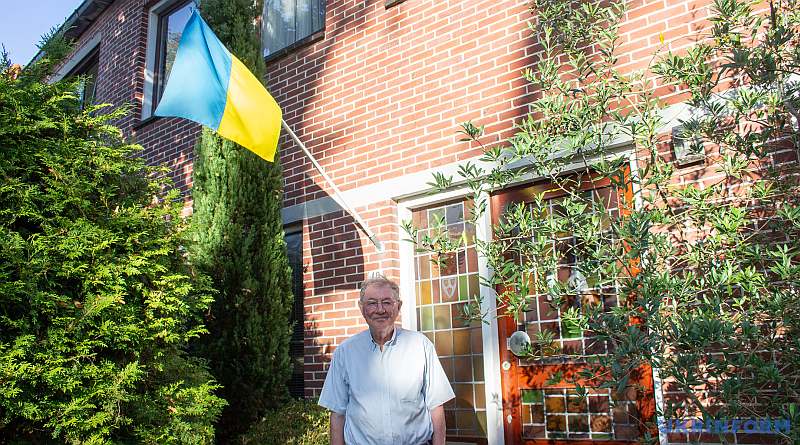
Iryna Drabok, The Hague / Ukrinform
The Ukrainian flag flies above Robert Serry’s house in the Netherlands. It was here, in his home, that an exclusive interview took place with Ukrinform’s correspondent in The Hague. For the former diplomat, our flag is not just a symbol of solidarity; it is a sign of a long-standing personal connection with Ukraine.
Robert Serry remembers Ukraine in the early 1990s well—a country that, after decades of Soviet domination, gained independence and opened a new page in its history. He became the first Dutch ambassador to Ukraine after the declaration of independence and was at the forefront of Ukrainian-Dutch relations.
His diplomatic career includes work at the UN Security Council, NATO, and the Middle East, where he served as a special representative of the UN Secretary-General Ban Ki-moon.
In March 2014, during the annexation of Crimea, Robert Serry found himself at the center of events when he was detained in Simferopol by armed men in Russian uniforms, after which he was forced to leave the peninsula. This experience became one of his most acute personal testimonies of the beginning of Russian aggression against Ukraine.
Today, after another trip to Ukraine, Robert Serry shares his vision of the war, the prospects for peace, and the role of international support. He also talks about the activities of the Open Door Ukraine foundation, which helps Ukrainians rebuild homes and communities destroyed by the war.
So, in the Ukrinform interview, he discusses how Ukraine has changed over more than thirty years, why its experience is important for all of Europe today, how the West perceives Ukraine’s internal processes, the role of the Netherlands and NATO in supporting Kyiv, and what, according to the former ambassador, are the possible scenarios for ending the war against Ukraine.
UKRAINE IS A COUNTRY THAT WILL CHANGE EUROPE
– Thank you sincerely for the opportunity to talk with you. More than thirty years have passed since the historic day of the adoption of the Act of Declaration of Independence of Ukraine. You were one of the first Western diplomats to start working in Kyiv. Please tell us about your first visit to Ukraine, the atmosphere of the early 1990s, and how you became the first ambassador of the Netherlands to independent Ukraine.
– In 1992, I was appointed the first Extraordinary and Plenipotentiary Ambassador of the Netherlands to Ukraine. This was not my first visit to Kyiv. I first arrived back in 1980, when I was working as the second secretary at the Dutch embassy in Moscow. I was sent for a very special reason, which I will never forget.
I was sent to Kyiv in 1980 because a professor at the Taras Shevchenko National University of Kyiv was interested in the Frisian language and asked to send him some books. They were provided by the Frisian Academy in my country. You probably know that the Frisian language is a separate language, not a dialect?
– Yes. In the archives of the city of Leeuwarden—the capital of the Dutch province of Friesland—you can find many historical documents and even works by Lesya Ukrainka translated into Frisian.
– Yes, yes, of course. So there was great interest from Professor Yuriy Zhluktenko, who, unfortunately, is no longer with us, and he wanted to get those books. I was given two full suitcases of books. And when you are the second secretary, you are often tasked with such special assignments. I was sent to Kyiv to deliver these books to the professor. I remember how I was received in that beautiful red building of Shevchenko University in Kyiv, and how we had a brief conversation. By the way, I noticed that the professor was not alone – there were a few other people sitting next to him. Only later, when I returned to Kyiv as the first Dutch ambassador, did I find out that the KGB had to authorize the transfer of these books to the university, and two professors had to be allowed to use them. Those were the times.
And I must say that in 1980, the Dutch Embassy in Moscow knew that Ukrainians who were participants in the liberation movement were being massively sent to the GULAG camps, but of course, we could not imagine at that time that just ten years later, the Soviet Union would collapse, and Ukraine would become an independent state, which it remains.
So years later, arriving in Kyiv as an ambassador, I again stayed at the same Dnipro Hotel where I had stayed back in 1980. That was also where the Netherlands’ first temporary embassy in Ukraine was located. It was set up in two suites of this hotel. So, that was my first acquaintance with Ukraine.
– How did this period change you personally? And could you share memories of life in Kyiv in the early 1990s, how you discovered Ukrainian culture and people?
– Yes, it really changed me, and quite profoundly. Not immediately, but, as you know, I am married to a Ukrainian, also Iryna, a translator who then worked freelance with our embassy. That’s how we met.
I must say that even then I began to realize that I had been appointed to a country that would change Europe. Not in the tragic sense as it is happening now, but I immediately felt that Ukraine would have immense significance for European security, that an independent Ukraine would be the best counterbalance to Russian imperialism.
In your turbulent and often tragic history, processes were already taking place, which eventually gave Ukraine the opportunity in 1991, when such an opportunity arose, to proclaim itself as an independent European state.
The importance of what happened, I began to particularly feel while traveling through an independent Ukraine again. I saw that not only in the West, where the Ukrainian national movement was traditionally stronger, but also in other regions there was something that united the whole country, there was a distinct identity.
Moreover, I must confess that I somewhat fell in love with Ukraine. It is a beautiful country with enormous potential. I also saw how strong the legacy of the Soviet system remained, and understood that Ukraine would need time for deep changes. This is what we observed in the following years.
At the same time, I did not expect that relations between Russia and Ukraine would turn into a war, such a terrible war that is ongoing now. On the contrary, those were more optimistic times when it seemed that a certain compromise could be reached between Russia and Ukraine. Those were the Yeltsin years, which allowed many problems between the Russian Federation and the already independent Ukraine to be resolved. Remember the Black Sea Fleet, Crimea, and other issues that were then settled as a result of negotiations.
And, of course, we cannot overlook the most important topic for all of us – the nuclear weapons that remained on the territory of Ukraine after the collapse of the USSR. This issue was at the forefront of the attention of Western partners, particularly the United States, and ultimately agreements were reached to resolve it.
Looking back, one might ask: was that decision the right one? But at that time, choices were very limited. Firstly, Ukraine did not actually control these nuclear forces, as command was based in Moscow, not Kyiv. Secondly, Ukraine’s cooperation with the West, the IMF, and the World Bank also depended on the decision to relinquish these weapons. All this took place under very complex circumstances. And here, the United States played a significantly more important role than European countries.
But the main difference between Ukraine and the Russian Federation is that after gaining independence, Ukrainians wanted to preserve it at any cost.
In Russia, unfortunately, the opposite happened: disappointment with the changes, as the Yeltsin period also meant the failure of Russia’s economic and democratic transformation. And then came Putin with a completely different vision. And, by the way, Putin is not the only one in Russia who believes that Ukrainians are so-called Little Russians.
UKRAINE LEFT IN A GREY ZONE BETWEEN PUTIN AND NATO
– How much, in your opinion, does the responsibility for the war against Ukraine extend beyond Putin himself to include Russian political elites, state institutions, and part of society? What are the consequences for seeking peace after the war?
– It’s much deeper than that. In Russia, there is a sense that it has lost something it believes rightfully belongs to it. This is also connected to claims on the heritage of Kyivan Rus, which I find absurd. When someone claims to be the sole legitimate heir of events that happened so long ago, it always seems very problematic to me, especially when Russia uses it as an argument to renew its claims on Ukraine.
This is what Putin did, but he is not the only one. If you look at many people in Russia, this feeling is truly present there.
So, in a way, this war could have been inevitable if Russian leadership under Putin aimed to bring Ukraine back under Moscow’s control and restore the empire. In that case, a full-fledged invasion seems like a natural consequence of this policy.
However, I never looked at this crisis in that way. As someone who later worked with NATO and the UN, I sincerely hoped that such a large-scale war could be avoided.
– After the annexation of Crimea, many in Ukraine expected a large-scale war. Some experts believe that the tragedy of MH17 temporarily halted further escalation by Russia. Do you agree with this, and how do you think the Kremlin evaluated the West’s reaction to the downing of MH17?
– First of all, regarding Crimea. By the way, I was somewhat personally involved in those events. I was appointed as the Special Representative of the UN Secretary-General in the Middle East. I was an advisor to UN Secretary-General Ban Ki-moon. He knew about my Ukrainian background and dispatched me to Kyiv to help prevent further escalation. As you know, we did not succeed.
Then I was sent to Crimea. And there I was met by so-called green men – armed men without insignia.
They wanted to forcibly take me to the airport, effectively deport me. I refused. It’s a long story, which can be read in my book “Ukraine Has Not Yet Perished”. It was events like these that made me feel the need to write this book, as many things happened then in which I was directly involved.
Today, looking back, it’s easy to say that Crimea marked the beginning of the war.
Now we know that this war actually started in 2014, and I think few would disagree with that.
However, at that time the West perceived the situation entirely differently.
The U.S. President at the time was Barack Obama, and he did not want to face another major international crisis. The Americans tried to contain the escalation of Maidan for as long as possible. Even after Yanukovych fled, they were still trying to establish his whereabouts and what had happened.
This, to some extent, is indicative of subsequent events. Ukraine was also persuaded not to use force in Crimea due to significant concerns about what Putin might do. Ukraine was very weak, particularly militarily.
Now regarding MH17. Did it give Ukraine more time? Possibly. But I’m not sure. The MH17 tragedy really opened the eyes of many people, especially in the Netherlands, as many of our citizens perished.
Undoubtedly, MH17 drew the world’s attention to Ukraine. However, I am not sure if this meant a radical change in Western policy. Sanctions did become more tangible: in Brussels, a package of restrictions had long been prepared and had not reached consensus, but after MH17 this package was finally agreed upon.
However, if we look at further events, especially the Minsk process, it is evident that the West tried to find a political settlement rather than prepare for a large-scale war.
– How would you define NATO’s role in this story? Is it about a strategic mistake by the West that gave the Kremlin a sense of leeway?
– We did not realize what Putin’s intentions really were. Look at what happened in 2008. After the Munich Conference, the NATO Bucharest Summit occurred with that notorious “non-decision.” Ukraine did not receive a Membership Action Plan in the Alliance.
NATO then said that Ukraine might one day become a member of the Alliance, but no concrete path to membership was offered.
In reality, this meant that Ukraine was left in a kind of gray zone between Putin and NATO. And Putin decided that Ukraine was his “backyard.” After that, as you know, he went to Georgia, and then he decided to go to Ukraine. Therefore, although I categorically reject the thesis that NATO is responsible for this war – it’s not true, all responsibility lies with Putin – at the same time, NATO did play some role in this drama.
If NATO in 2008 had given a clearer response to Ukraine’s aspirations to join the Alliance, I think this war might not have happened.
But Western thinking at that time was different. Ukraine remained to some extent terra incognita – a country that no one knew what to do with.
Ukraine was asking for EU membership, asking for NATO membership, but it was not taken seriously enough. There were partly objective reasons for this: corruption, the state’s internal problems. At that moment, the country was truly not ready for such steps.
UKRAINE HAS TRUMP CARDS THAT NO ONE SAW A YEAR AGO
– And now, in your opinion, is Ukraine ready?
– Yes. Perhaps the greatest irony of this war and what Putin started is that he made Ukraine ready. Four years ago, no one believed that Ukraine could resist Russia. Let’s not forget that back then, Ukraine was almost perceived as a needy state, constantly asking for help, EU membership, and much more. Over these years, everything has changed.
Today, Ukraine has trump cards. This is yet another irony of this war. A year ago, Trump told Zelensky: “You don’t have any trump cards.” And today, Ukraine does have them.
With our support, it not only takes care of its own security but also the security of the Netherlands and the whole of Europe.
This became possible because you managed to turn this war into a new type of war. In my opinion, almost miraculously, Ukraine found itself among the leaders in drone warfare: in the air, at sea, and on land. Without this, you would not have survived. And this is your trump card, as it concerns the technologies of future warfare.
– How can this trump card help Ukraine with the USA?
– Today, Ukrainian technologies are already used, for example, to protect American bases in Saudi Arabia from Iranian attacks. So, you truly have trump cards.
But that does not mean I am very optimistic about the situation. Ukraine has been enduring a war that takes lives for five years. You know that in July, I spent a month in Kyiv and saw how dramatically the security situation has changed even in the capital.
Unfortunately, this is partly a consequence of your successes. You deliver serious blows to Russian territory: its energy infrastructure, logistics chains, and other critical targets. And Putin responds with massive ballistic missile strikes, targeting almost any object in Ukraine, including civilians in Kyiv.
A situation has long developed between Ukraine and Russia, known in conflict theory as a mutually hurting stalemate. It is a situation in war where neither side can achieve victory by force, and continued confrontation brings both participants increasingly unacceptable losses.
For both Ukraine and Russia, continuing this war is essentially madness because its cost is enormous. Ukraine is unlikely to reclaim all its territory, but Russia is also unable to achieve the goals it started this war with, such as establishing power in Kyiv. It hasn’t even been able to fully capture Donbas.
So, we see a kind of stalemate: Ukraine wins in some areas, Russia in others, but overall, the front has largely stabilized.
Meanwhile, a very fierce air war continues, which may still influence the outcome to some extent, but at an extremely high cost to both sides.
In such a situation, a third party should intervene and say: “The war must be stopped.” And here arises the question: who is capable of doing this? In my opinion, that party could still be Donald Trump, as he is perhaps the only one who potentially has leverage over Moscow.
I do not want this to sound overly optimistic, but I have not yet lost hope that by the end of the year, Trump will make another attempt. You know that he has tried several times before, but back then, most of the pressure was on Ukraine, particularly demanding territorial concessions. I hope he has learned from those mistakes.
Now there exists a 20-point plan agreed upon by Europe, Ukraine, and the USA that could become the basis for serious negotiations to end the war, provided that Trump truly presents it to Putin and says: “Now or never.”
I mention this also because Trump has started, what I believe, another senseless war – in Iran. Partly because of this, Ukraine now does not have enough Patriot interceptors to shoot down Russian ballistic missiles.
But even if Trump assured Zelensky that Ukraine could begin producing these interceptors and other systems independently, it would not help now as it would take years.
I learned that Zelensky said European countries have supplied Ukraine with only about a third of the necessary Patriot interceptors and other missile defense systems.
This is a very serious problem, and it also concerns trust in Europe, its ability to continue supporting Ukraine for as long as needed. We have entered a new dangerous phase of the war.
That’s why, in my opinion, finding a way to avoid the fifth winter of war is even more important.
I haven’t completely lost hope, as the US midterm elections are approaching. What can Trump now show his voters? He has already spoiled the situation, effectively lost in the story with Iran. Whatever happens next, it will be difficult to present as a victory.
Trump promised to stop the war in Ukraine in 24 hours. And what can he show on the eve of the midterm elections? That’s why I still think he will try again.
But Putin has things to lose. We started with an almost incredible conclusion: the war has turned Ukraine from a state that asked for help into a state that has its own trump cards, which has become indispensable for European and thus our security. These are the main changes in recent years. But, of course, I understand what price Ukraine has paid. Almost all of this beautiful country has become a theater of war. The suffering of people, future rebuilding, and the return of veterans are all enormous burdens.
– How do Ukraine’s partners perceive the protests regarding NABU and SAP, and the resignation of Mykhailo Fedorov? Do such internal political conflicts affect the level of trust in Ukraine during the war?
– I see that along with the war in Ukraine, another conflict is ongoing – internal political. I mean recent events, particularly the story with Fedorov, and earlier the situation where Zelensky had to dismiss Yermak, the situation regarding NABU and SAP.
Yes, to some extent this indeed causes discomfort. But at the same time, it shows me that the spirit of Maidan remains alive. Everything began with the Maidan – you wanted to become a country independent from Putin’s Russia.
And when decisions are made that, in the opinion of society, contradict this spirit, people react. But at the same time, it shows that Ukraine is a democracy.
In essence, the fact that society continues to openly debate and protest even during the war indicates the resilience of the democratic impulse born of Maidan. At the same time, of course, your opponents, and not only in Moscow, use this. In Moscow, they are definitely trying to maximize this in their propaganda. And this is especially noticeable in populist right-wing circles here in the Netherlands, as well as in other European countries.
UKRAINE HAS THE STRONGEST ARMY IN EUROPE – AND THIS CHANGES SECURITY RULES
– What do you think is the current situation with Russian propaganda in the Netherlands? Has it increased, or have the Russians become quieter?
– That’s a good question.
In my opinion, Russian propaganda is now ineffective because most people in the Netherlands understand what’s happening – Ukraine is fighting for its survival, and there is genuine sympathy for it.
I would like it to be not only sympathy but also more active support, primarily military. I truly believe that Russian propaganda now has only limited influence.
At the same time, there is another important point that Ukraine should closely monitor. We talked about Trump and America. The United States is now a deeply divided country. There is the MAGA movement. But the MAGA movement also exists in the Netherlands, as you know, and in other countries, including important ones like the United Kingdom, France, and even Germany. For example, “Alternative for Germany” – AfD.
If such movements come to power, it would be a huge risk for Ukraine. At the same time, I believe Ukraine should also establish contacts with these political forces.
Italy is an example of a country where a populist movement came to power, but at the same time, good relations with the EU and Ukraine were maintained. Meloni and Zelensky became friends.
– Do you think Mark Rutte is not only a leader in NATO today but also one of the few European politicians capable of having an effective dialogue with Donald Trump in Ukraine’s interests? Is it true that he effectively pressured the US regarding the F-16?
– To his credit, Rutte was prime minister for a very long time, including during the MH17 tragedy. He says himself that this changed his attitude, although I think not immediately and not entirely. Like Merkel, Macron, and others, he long believed that a major war would not happen.
Let us not forget that the Netherlands remained an important trading partner with Russia before the full-scale war. But it must be acknowledged – the war changed him. It made him a convinced supporter of Ukraine, and the Netherlands became one of your greatest allies. I am proud to say this.
You mentioned the F-16 – yes, it’s true that Rutte had to actively promote this decision, along with Mette Frederiksen, whom I also have great respect for. Denmark and the Netherlands indeed did much more than many other EU countries.
As for Rutte’s current role as NATO Secretary General, honestly, I do not envy him. If the current divide between America and Europe deepens, the question arises – what will NATO mean at all? The alliance must inevitably become a more European organization. Incidentally, the Americans demand this as well. This is a significant responsibility for Rutte, and I believe he is in his place.
At the same time, it seems to me that sometimes he went too far with his praise of Trump, turning, as some said, into his “whisperer.” The justification is that someone had to maintain contact with Trump, and this was in Ukraine’s interest. I know that many Ukrainians, along with Zelensky, see it this way and perhaps not without reason.
But as a European, when I see some European leaders speaking and acting just to please the new “emperor” in Washington, I think that’s too much.
– What does Ukraine mean for NATO and European security today?
– In my book, I even express the opinion that Ukraine could become more crucial for European security than NATO’s Article 5. This is a very serious thesis. It means that Article 5 will no longer be as reliable a guarantee as before. And this has serious consequences:
Europe must take much greater responsibility for its own security. And it is impossible to do this without Ukraine. Today, you have the strongest army in Europe.
That’s why I say that Ukraine has become so important to us. In Europe, this is increasingly realized, although not enough yet.
THE WAR WILL MOST LIKELY END WITH A CEASEFIRE, NOT PEACE
– After the end of your diplomatic career, you became one of Ukraine’s most active friends. Today you are also involved in reconstruction. Tell us about your support for Ukraine.
– First of all, something happened to me in 2022. Before that, I was a diplomat. I have already talked about trying to promote the de-escalation of the crisis. But when the full-scale war began, considering my close ties with Ukraine, something changed in me.
My wife’s parents still live in an apartment on the 24th floor in one of the districts of Kyiv and watch all the destruction around.
So, of course, something changed in me.
Let me tell you a very personal story. We were so worried about my wife’s parents that we begged them to come to the Netherlands. We even sent our children to the Polish border to pick them up. But they refused.
I then called my father-in-law Anatolii a fool. I told him, “You’re crazy.” And he replied, “Kyiv will not fall. And we are not going anywhere.” Iryna’s mother said the same.
For me, this was the first very strong personal signal that Ukrainians would fight.
I no longer wanted to remain just a diplomat; I wanted to do concrete things.
Thus, Open Door Ukraine (a Dutch charity foundation, founded in December 2018, – ed.) began to play an important role in the early recovery and reconstruction of Ukraine. And now I can say with some pride that we have implemented about 35 major projects aimed at helping Ukrainians restore property destroyed by the war.
It all started with helping to restore the roof of a modern apartment building in Irpin, destroyed by Russian shelling in the first weeks of the war. We launched a fundraising campaign in the Netherlands under the slogan: “Let’s help Ukrainians have a roof over their heads!”
We not only helped repair damaged apartment buildings in Irpin and other cities, including Balakliia, but also facilitated the restoration of critically important social infrastructure in war-affected rural areas, such as a school in Trostianets in the Sumy region and a maternity hospital in Vilniansk in Zaporizhzhia.
Due to the war, many villages across Ukraine were also destroyed. One example is Novoselivka near Chernihiv. There, we have already helped seven or eight residents rebuild their homes.
Today, using modern modular and circular construction technologies, we have launched the Build Back Bio project, funded by the Dutch government. A production line for making house panels has been delivered from the Netherlands, using straw as insulation material, which is plentiful in Ukraine.
Now our activities have significantly expanded, and our goal is to help vulnerable people who have lost their homes due to the war, especially in areas where fighting has occurred. We are also developing a completely new product and concept. As part of this project, we will be able to offer people who have lost their homes compact houses of 44 or 66 square meters. We are working closely with active territorial communities and organizations that help Ukrainians cope with the consequences of these losses.
I would also like to note that initially all this started only thanks to the funds we received from caring people in the Netherlands. And now, thanks to a grant from the Dutch government, we are working on a larger-scale project that will allow us to rebuild hundreds of houses. These are precisely our ambitions.
– What amount are we talking about?
– The support we and our partners received from the Dutch government is 4 million euros. This is public information. In addition, we received significant support from organizations such as Oxfam and the Dutch fund Stichting Vluchteling. I would say these funds amount to at least another 1 million euros.
We have also received and continue to receive numerous private donations totaling several million euros. This is what has allowed us to continue our work.
So, in total, we managed to raise approximately 7–8 million euros. Now we want to significantly scale up our activities since we have gained considerable experience and already have a well-formed concept.
And, of course, we are also looking for larger donors who could support our work and help us scale it.
– What scenarios for ending the war are possible, in your opinion?
– Let’s start with the unlikely options. If the war stops, and I hope for that, as we already talked about a mutually painful deadlock, it will most likely end with a ceasefire, not peace. This is a very important distinction.
I find it unlikely that after everything that has happened, Russia and Ukraine can conclude a full-fledged peace treaty. The best hope is for a sustainable ceasefire.
If we look at historical examples, major wars have often ended with a ceasefire rather than peace, like between North and South Korea or between India and Pakistan. I am particularly interested in the example of India and Pakistan, where a non-aggression pact was concluded after the war.
I think such a non-aggression agreement would be very important for Ukraine if it seeks EU membership, and in the future, possibly NATO. These organizations cannot accept a state that reserves the right to resume war. Therefore, it is about committing to resolve territorial disputes only by peaceful means.
This should not be a new “Minsk.” In “Minsk,” Ukraine was required to make unilateral concessions, constitutional changes, and so forth.
I really hope the war doesn’t end with a repeat of the “Minsk scenario.”
Instead, a truly controlled ceasefire is needed. One of the main lessons of “Minsk” for me is that a weak monitoring mechanism makes any truce fragile. Therefore, any future ceasefire regime must be truly reliable.
After that, the war stops. And I am less pessimistic than others that Russia will sooner or later start a new war. But on one condition – Ukraine and its army must remain strong. This is something that cannot be lost.
My book became a kind of personal history of this war. It starts in 2014, when I was directly involved in the events as a UN representative. I talk about Maidan and my own experience in Crimea at the beginning of Russian aggression.
It goes on to discuss my participation in unofficial contacts between Russian and Ukrainian experts – attempts to maintain dialogue at a time when political channels were increasingly breaking down.
After 2022, I often traveled to Ukraine.
I witnessed too much human pain and destruction and at the same time the strength and dignity of Ukrainians, to imprint this not only in my memory.
That’s why the need arose to document everything.
The third part of the book is dedicated to attempts to end the war – negotiations that truly intensified in 2025. I even called this period “the year of wasted peace negotiations,” referring in particular to Donald Trump’s approach to seeking peace.
I believe that I was quite close to many events to sincerely share my observations and conclusions. In a sense, this is a living book, writing it continues along with history itself. I hope to add a new chapter by the end of this year – perhaps after a ceasefire. This is my cautious, yet sincere hope. And maybe this is where we can end our conversation.
Photo: Iryna Drabok
