
Victoria Veselova / Radio Liberty
The consequences of the intensification of hostilities between Russia and Ukraine have reached the resorts of Russian-occupied Crimea. Previously, the war could only be felt indirectly through the shortage of Russian tourists, but now it has become more evident: local beaches are turning into battlefields. Several such incidents occurred in Crimea in August. How the war reached Crimean beaches is detailed in the Radio Liberty Crimea.Realities project material.
Vacationing in frontline Crimea had already raised questions among those who could calculate risks. However, the Moscow-controlled local authorities continued to invite Russian tourists despite everything. They did the same this year, when Ukraine’s Defense Forces intensified strikes not only on Russian military targets but also on its logistics.
The worsening fuel and energy crisis has fully highlighted the problems of the Crimean Peninsula.

Thus, in the headlines of Russian media dedicated to vacations in Crimea, more and more question marks are appearing. And Russian bloggers, including the Z-community, en masse dissuaded tourists from traveling to the peninsula even before the holiday season.
The holiday season, now in its fifth year under the full-scale invasion of Ukraine by Russia, showed: Crimea has finally ceased to be the “safe resort” that many Russian tourists considered it to be. Now, gunfire can be heard on Crimean beaches, armed Russian soldiers roam, and people are being evacuated due to the threat of strikes.
“Naval parade”, UAVs and evacuation
Many Russian media and travel blogs advised tourists during the hostilities between Russia and Ukraine to choose the resorts of the Southern coast of Crimea for their vacations. It was claimed that everything was “calm” there – unlike Sevastopol or the western coast of the peninsula.
However, this year, this recommendation played a cruel joke on vacationers: explosions and “arrivals” began to be recorded even in Greater Yalta. The strikes by the Ukrainian Defense Forces here target both military facilities and infrastructure.
In July and August, local infrastructure and electrical substations were attacked, leaving resort areas without power for extended periods.
A separate commotion was caused by the appearance of an unmanned boat in the waters of Yalta’s seaport, which Ukraine uses to strike Russian naval military targets.
At the beginning of August, Russian authorities in Crimea reported an attack by a naval drone on the Yalta port. According to their information, one such drone was allegedly damaged and ended up on the shore, where it was being defused.
In connection with this, officials evacuated the territory of Primorsky Park – one of the most popular places among vacationers in Yalta.
They urged local residents and visitors of the resort city to leave open areas due to the danger of UAVs and to “take cover in recessed rooms, basements, parking garages, lower floors of solid structures, inner rooms behind load-bearing walls, as far from windows as possible.”
The “Group 13” special unit of the Main Intelligence Directorate of Ukraine’s Ministry of Defense claimed responsibility for this incident, stating that they “conducted a parade of Magura combat naval platforms” on the eve of Yalta Day.
Two days later, near the Yalta hotel “Mriya” in Opolznevoe, a Ukrainian UAV was shot down, causing a forest fire, reports the pro-Ukrainian public “Crimean Wind.”
Following this, the hotel announced the cancellation of events planned for August 15–16, as “safety is paramount.”
Shooting and Russian Military on Beaches
The presence of Russian military personnel in the resort areas of Crimea has also become much more noticeable. In August, an armed Russian serviceman was spotted on the beach in Yevpatoria, strolling along the shoreline right among the vacationers.
A significant portion of the resorts in western Crimea are closed to visitors – Russian forces are based there. Their firing position appeared right on the Saky – Yevpatoria highway before the resort season.

Thus, Russian troops are preparing for a possible Ukrainian landing in Crimea, claim the Ukrainian Armed Forces, not ruling out such a scenario.
The beaches of Sevastopol are also restless. Russian military facilities and city infrastructure are regularly attacked by the Ukrainian Defense Forces, and the operation of local mobile firing groups can be heard right from the coast.
“In Sevastopol, the shelling is intense – boom-bang! Cafes are empty. People scattered from the beach,” – described the situation a witness in August (caution, offensive language!).
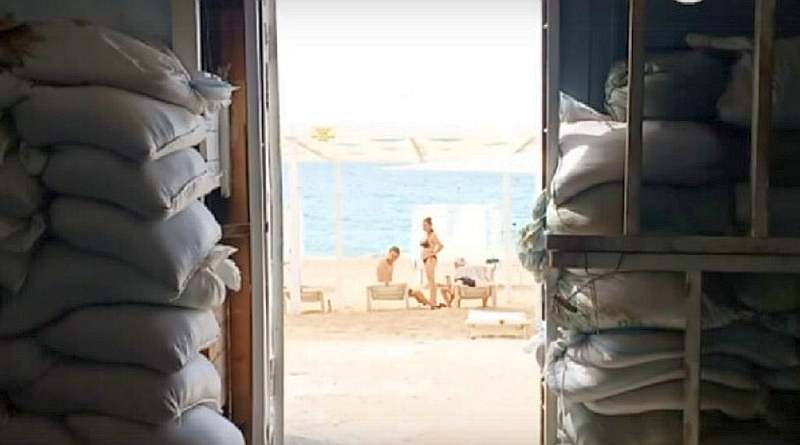
Mass deaths and injuries of vacationers have already occurred in the region: in June 2024, missile fragments fell on the “Uchkuevka” beach near Sevastopol.

Due to this, Russian pro-war bloggers criticized the authorities for their inability to protect Crimea and its population from the Ukrainian Armed Forces’ missile strikes. Nevertheless, the “Uchkuevka” beach continued to welcome vacationers – people still come there now.
The war deprives Crimea of prospects
Such incidents clearly indicate that a full-fledged tourist season in Crimea during the war is impossible. While at the beginning of the year, according to Russian tour operators, the peninsula was among the most popular destinations for tourists from Russia, by July, there were mass cancellations of vacation bookings in the region.
This new reality hits the tourism business and the economy of occupied Crimea as a whole.

On August 5, the Crimean parliament controlled by the Russian Federation announced state support for the resort business: enterprises will be paid three minimum wage amounts for each employee. The main condition is to retain at least 80% of the staff by June 1, 2027.
This kind of subsidiary assistance has become an annual practice. Since 2022, the Russian authorities have announced the allocation of at least 10 billion rubles for payments to the Crimean tourism business. However, these subsidies have not reversed the negative trend. In the context of war, the resort business in occupied Crimea survives only thanks to federal subsidies, suffering losses year after year—even despite the occupancy of sanatoriums and hotels by Russian budget holders.
The exception was 2025, when tourists from Russia massively flocked to Crimea: many of Russia’s Black Sea resorts were closed due to oil pollution on the coast after Russian fuel tanker disasters.
The Crimean tourism industry also had high hopes for earnings this year, but the realities of the current season did not meet expectations.
In the cover photo: View from the shelter installed on the Sevastopol beach “Uchkuevka” during Russia’s full-scale invasion of Ukraine, July 2024. Photo: Occupiers’ media
Source
Copyright © 2021 RFE/RL, Inc. Reprinted with permission from Radio Free Europe / Radio Liberty
