
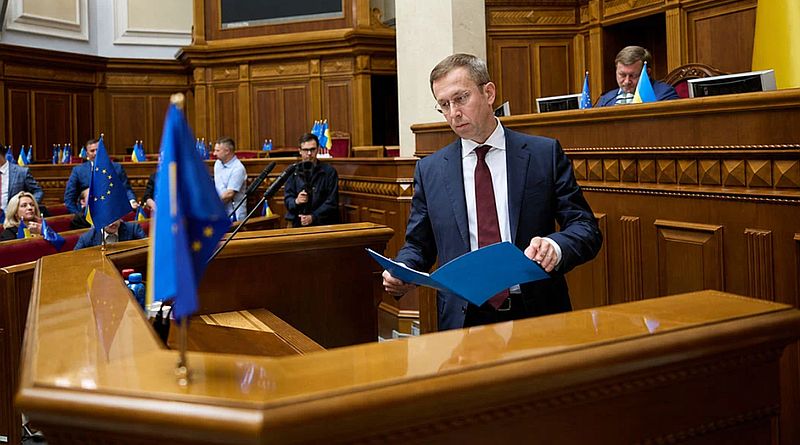
The new Cabinet faces numerous complex economic challenges. Let’s explore the priorities Koretsky has set for himself and his government’s tasks in the context of current economic realities.
Unexpected Changes
The second half of 2026 finds Ukraine in a typically contradictory economic situation. On one hand, we have finally started receiving promised aid from the EU, and during the NATO summit in Ankara, we were assured of a total of 140 billion euros over 2026–2027. However, at the beginning of the year, our economy shifted into a state of decline: in the first quarter, the gross domestic product (GDP) shrank by 0.5%.
The unexpected change of the Prime Minister and numerous members of the government has sparked many theories about the reasons for such a move. The main one is the desire to better prepare the economy for the coming winter, which may be even tougher for Ukraine against the backdrop of intensified hostilities. Allegedly, for these reasons, Serhiy Koretsky was appointed head of the government — a manager with successful experience in both state (Naftogaz, Ukrnafta) and private (Kontinium, WOG) energy companies.
Economic Priorities of the New Government
Apparently, the change in government was no less surprising for the new ministers, as the new Cabinet’s program has not yet been published. Koretsky promises to present it by August 5. During his speech in the Verkhovna Rada, he emphasized the following priorities:
- full support for the Armed Forces of Ukraine and scaling up the Ukrainian defense-industrial complex (DIC);
- fulfillment of all state social obligations, ensuring timely payment of pensions, social assistance, and funding of state services;
- preparing the country for the next heating season, supporting businesses to maintain economic resilience;
- strengthening interaction with international partners, attracting additional resources, and effectively using international aid.
While answering questions from deputies, Koretsky shared his vision for the development of Ukrainian business. He believes that “our businesses do not have sufficient access to capital. We will work with the Ministry of Economy to provide more lending opportunities.” The low level of access to financial capital, according to the Prime Minister, is the main obstacle to creating new jobs and bringing Ukrainians back to work amid the demographic crisis.
Koretsky noted that “infusing the economic system,” meaning with financial resources, “will ensure an inflow of investments, the launch of new projects, and the creation of jobs, which will directly impact the improvement of citizens’ welfare.”
The first structural decision of the new Prime Minister was the reinstatement of the Ministry of Agrarian Policy and Food, which had been merged with the Ministry of Economy last year. The Ministry will be headed by Taras Vysotsky, who was previously the deputy minister of the economy.
In turn, the new head of the reformed Ministry of Economy and Environment will be Oleksandr Kravchenko, the managing partner of McKinsey & Company’s Ukrainian office. Oksana Ferchuk (former Deputy Minister of Defense) will head the Ministry of Digital Transformation, and Mykola Kalashnyk (head of Kyiv’s OVA) — the Ministry of Restoration, Infrastructure, and Transport.
Kalashnyk has already received tasks from President Zelensky, who expressed dissatisfaction with the implementation of “resilience plans.” These involve protecting critical infrastructure, installing additional power generation to supply heating and water facilities, sewage, and others. For example, this year, Kyiv planned to spend 61.6 billion UAH on protecting 57 objects.
The rest of the economic block ministers — Finance Minister Serhiy Marchenko and Energy Minister Denys Shmyhal — retained their positions from the Svyrydenko government.
Breaking the Compensation Model
The new Prime Minister spoke about many general things, but what actions should the government take according to the current economic realities? Former Economy Minister Bohdan Danylyshyn argues that Ukraine should seek an alternative to the compensation economic model: “Lost production is compensated by imports, budget deficits by external aid, currency gaps by NBU interventions, credit deficits by state subsidies, and worker shortages by wages detached from productivity. The system allows for survival but doesn’t create foundations for development. This is the main challenge for the new government.”
Indeed, the Ukrainian economy is currently overwhelmed by these imbalances, as confirmed by macro indicators. In the fifth year of the war, the state is the main driver of the national economy: state budget expenditures already exceed 60% of GDP, the budget deficit without grants approaches 25% of GDP, and the state debt has exceeded 100% of GDP.
Overall, for a country at war, this is a typical situation, but in our case, there are two major problems. Firstly, a significant part of the expenditure goes to imports (primarily defense purchases). Secondly, the cost of servicing the debt is extremely high. Since the National Bank maintains the interest rate at a high level (15%), the state continues to pay significant interest on government domestic loan bonds (GDLBs) and bank deposit certificates.
In turn, high rates lead to the problem of expensive loans, which Koretsky mentioned, pointing to the lack of monetary capital for Ukrainian business. The private sector of the economy (both population and business) has accumulated almost 10 trillion UAH in savings, but the volume of bank loans is only 1.3 trillion UAH. Until banks fulfill their main task (transforming savings into investments), the state is forced to create a parallel system of preferential lending. Currently, it accounts for about a quarter of the Hryvnia loan portfolio.
The key to overcoming these imbalances is creating favorable conditions that encourage domestic investment. Clearly, the National Bank does not want to achieve this through a sharp reduction in rates, fearing an increase in inflation. Therefore, instead of creating its own credit mechanism, the Cabinet should work on a system of insuring loans against military risks to encourage banks to increase their loan portfolio on terms acceptable for businesses. This will be the first step toward the global goal of increasing the investment level.
Special attention should be given to the most dynamic sector — the defense industry. The main task for Koretsky and his team should be the sensible and gradual lifting of restrictions on military technology manufacturers. Firstly, they need to be allowed to work with civilian sectors (for example, agriculture). Secondly, their export opportunities should be expanded, as the demand for Ukrainian developments is currently extremely high. The main goal is to partially free the defense industry from dependence solely on government orders.
From Stability to Development
Since 2022, the Cabinet of Ministers under various prime ministers has managed to establish an economic management model that ensures stability (primarily thanks to the help of partners) but does not create sufficient incentives for development. And although the conditions of total war of attrition, to put it mildly, do not favor this, the government under Koretsky should move in the direction of development.
A strong national economy is as essential a component of defense capability as a strong military. No matter how much funding we receive from partners, only competent economic policy will allow us to successfully resist the aggressor for a long time. We hope the new government will wisely manage the available resources and find an alternative to the current compensatory model.
Cover image: Prime Minister of Ukraine Serhiy Koretsky. Photo: V. Sarakhan/Tyzhden
