
Fabian Hoffmann / iPress Translation
Researcher at the University of Oslo, Fabian Hoffmann, analyzes a series of Ukrainian drone strikes on the logistics centers of the company Wildberries at the end of July 2026 as a manifestation of a deeper transformation in the very nature of the Ukrainian state. He draws a parallel with Charles Tilly’s classic thesis that war makes the state, and proposes a modern version of this formula: the state makes the missile, and the missile makes the state. He argues that the ability to deliver deep strikes has given Ukraine a new form of agency on the international stage – including the ability to independently set targets and negotiate on its own behalf, without alignment with the West. Hoffmann emphasizes that this newfound agency can hardly be annulled by a peace agreement, as it concerns recognition, not just technical capability.
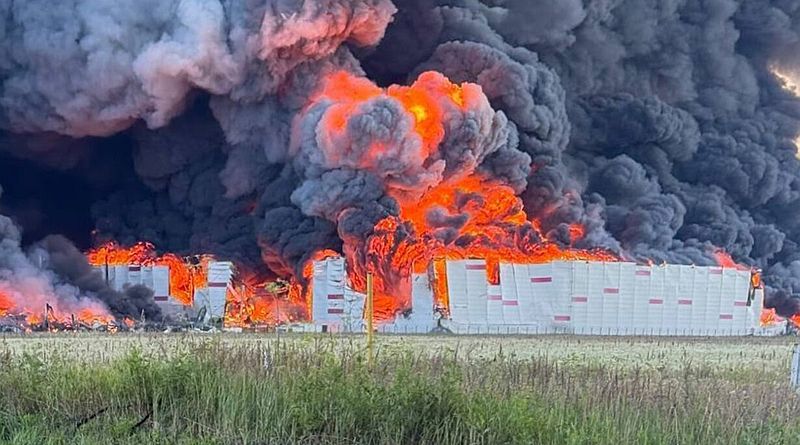
During July 18–24, Ukrainian drones delivered a series of strikes on several Wildberries logistics centers, Russia’s largest online retailer. According to Russian analysts’ estimates, economic losses amounted to up to $1.3 billion, while according to some estimates, the value of destroyed goods was even higher.
These attacks have intensified Ukraine’s already growing long-range strike campaign. However, beyond the logic of attrition, they indicate the transformation of the Ukrainian state’s very nature. Historian Charles Tilly once formulated the thesis that war makes the state, and the state makes war.
The Ukrainian experience seems to offer a modern version of this formula: the state makes the missile, and the missile makes the state. This formula is authored by Benjamin Tallis (a former senior research fellow at the German Council on Foreign Relations, now head of strategic analysis at the defense company Helsing and co-founder and chairman of the board of the Democratic Strategy Initiative – iPress). The capacity to deliver deep strikes has not only expanded Ukraine’s military capabilities – it has, in several senses, transformed Ukraine itself as an international actor.
The State Creates a Missile
The first part of this story is industrial, and I have already detailed it earlier. At the start of the war, one of Ukraine’s priorities was to develop and enhance its ability to carry out deep strikes. What began in 2022 as an urgent program to adapt existing “Neptune” anti-ship cruise missiles for ground targets has, by mid-2026, evolved into what can rightfully be called one of the world’s most powerful and diverse arsenals for conducting deep strikes.
The 19th Separate Missile Brigade, which in 2022 was launching targets at a distance of no more than 120 kilometers using hastily repaired and previously decommissioned Soviet ballistic missiles “Tochka-U,” now launches cruise missiles and long-range drones at targets thousands of kilometers away.
Of course, creating such an arsenal required more than just producing missiles. It required an industrial base, a bureaucratic planning apparatus, target identification infrastructure and procedures, as well as funding mechanisms. All of this is the material prerequisite created by the Ukrainian state. More interestingly, what this system has, in turn, created.
The Missile Creates the State
Deep strikes—especially on the scale achieved by Ukraine—provide what Thomas Schelling (American economist, Nobel laureate in Economics in 2005 for enhancing the understanding of conflict and cooperation through game theory analysis – iPress) once called the “capacity to cause pain.” A state capable of convincingly and consistently threatening an opponent’s economy with little recourse for defense or retaliation belongs to a different category of actors within the international system.
The closest historical analogy here is probably nuclear weapons. They created a separate social category—“nuclear-armed state”—which exists thanks to recognition and changes the attitude of all other entities towards states in this category. Ukraine, of course, has not suddenly become a great power or something like a nuclear-armed state. However, a qualitatively different phenomenon has emerged—perhaps less dramatic, but still significant. The sovereign capability to deliver deep strikes has given Ukraine a level of recognition and subjectivity it previously lacked.
Equally important is how the Ukrainian arsenal for deep strikes affects Russia—not only the capabilities of its state but also the perceptions Russians and Ukrainians have of themselves. As commentators have rightly noted, strikes on Wildberries destroy the last illusion of comfortable peaceful life for Russian society. It is becoming increasingly important not just that Ukraine is capable of striking, but that it intends to strike. Destruction, which at the beginning of the war occurred only in one direction, by the fourth year of the war occurs in both. The Ukrainian deep strike campaign directly undermines the Russian society’s perception of itself as strong, protected, and inviolable, as well as its sense of superiority over others, especially over Ukraine.
That is why this argument does not depend on the assessment of the damage caused by the strikes. Within the approach proposed here, how much the strikes actually undermine military logistics, supply chains, or the overall capability of the Russian state has secondary importance. Ukrainian deep strikes have a constitutive effect, and it persists as long as Ukraine visibly demonstrates it possesses and uses this capability, regardless of how quickly destroyed warehouses are rebuilt or a damaged refinery is restored.
The State Created by a Missile
This constitutive effect has quite specific, observable consequences.
The policy of “permissions” seems to have been left in the past forever. The campaign against Wildberries, it appears, was planned, justified, and carried out independently by Kyiv. Permission was not sought from any Western capital. Zelensky publicly took responsibility for choosing the targets, stating that these facilities supply components for the production of Russian drones. Moreover, the cause-and-effect relationship even reversed: the EU imposed sanctions on Wildberries’ banking division only after the start of the Ukrainian strike campaign, meaning this time Western policy followed the list of targets defined in Kyiv. For most of the war, such a sequence of events would have been hard to imagine.
More specifically, this campaign is presented as a tool of coercion, intended to force Moscow to come to the negotiating table: the pain is inflicted today, and relief is offered tomorrow in exchange for concessions. The ability to inflict and withhold pain is a key factor that transforms Ukraine into a party in negotiations about the future of Ukraine itself, Europe, and the world at large, rather than an object of these negotiations. Throughout most of the war, Ukraine’s future was determined – or at least fears existed that it would be determined – by the reactions of Western capitals to how Russia manipulated risk. Now Ukraine itself can manipulate this risk. Ukraine has transformed from a state undergoing coercion to a state that applies it.
There is, of course, a certain irony in this transformation. It was Russia’s full-scale aggression that created Ukraine’s need for means to strike deep and ultimately laid the foundation for what Ukraine is today. And it was the West’s refusal, and at times its inability, to meet this need, particularly by providing the political permission to independently choose targets, that significantly accelerated the development of Ukraine’s own long-range drone and missile programs, ensuring that Ukraine would eventually achieve sovereign capacity in the fullest sense of the word. Thus, Moscow, Berlin, and Washington are co-authors of both Ukraine’s missile arsenal and the state Ukraine has become, albeit in different ways and to varying degrees.
The Missile at the Negotiating Table
This transformation has implications at the negotiating table as well. Military capabilities can be limited on paper, and production scales can, in principle, be agreed upon. However, subjectivity is much harder to regulate. If the international system has already recognized a state as possessing the ability to inflict pain, such recognition is unlikely to be revoked by any treaty. Any agreement intended to limit Ukraine’s arsenal for deep strikes would, by the very fact of negotiating over it, confirm the status this arsenal has created and which Russia will seek to limit.
This is worth considering in light of the increasing pressure to end the war through negotiations. The Ukraine that will sit at these negotiations is significantly different from the state that Russia attacked in 2022: it is now an independent missile state that retains the capacity to inflict pain and negotiates on its own behalf. Russia will have to negotiate with a missile on the table – and with the state that missile has created.
