
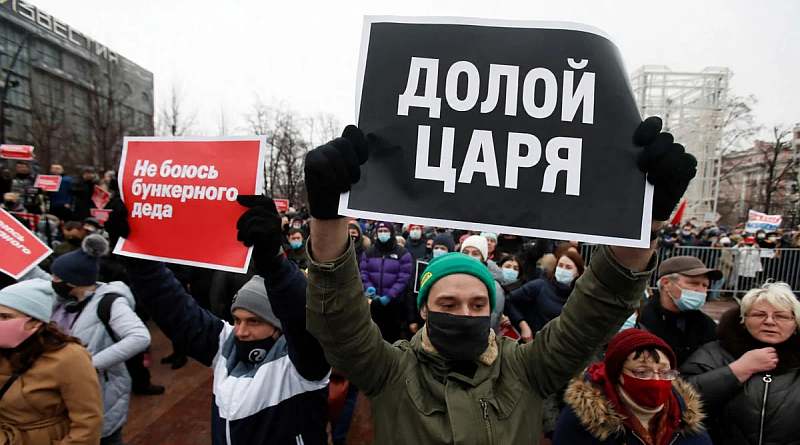

The Communist Party of the Russian Federation recently held a sanctioned event in Moscow, officially dedicated to the tragic events of October 1993, when the House of Soviets was shot at.
Initially, the event followed the usual scenario, as the leader of the communists, Gennady Zyuganov, and other official speakers delivered traditional speeches criticizing Russia’s first president, Boris Yeltsin, and Western countries. However, the situation quickly changed when activists from the Yabloko party and other independent opposition forces joined the demonstration.
Some of the gathered citizens unexpectedly began chanting political slogans clearly outside the agenda agreed upon by the authorities. The protesters loudly demanded the release of political prisoners, the cessation of the ruling party’s activities, which many citizens call a party of crooks and thieves, and openly shouted “Down with the Tsar!”
Such calls demonstrated that even at events controlled by the systemic opposition, there is a deep public dissatisfaction with the existing authoritarian regime.
The reaction of law enforcement was swift, as representatives of the security forces are not accustomed to tolerating direct attacks against the current leadership of the country.
Russian Telegram channels reported on mass detentions, resulting in about 60 people being apprehended by the police and taken to the stations.
This incident vividly illustrates the paradoxical reality of modern political life, where the authorities fear any manifestations of real dissent. Even the communist party leadership, which has been imitating opposition activity for years to maintain its privileged position in parliament, proved unable to control its own supporters.
Ordinary people who came to mourn historical victims quickly shifted the focus to the pressing issues of today, created by the unchangeable power.
It is hard not to notice how much the Kremlin elite is afraid of simple slogans that demand change.
When the crowd chants phrases about overthrowing monarchical rule, officials understand the real scale of the accumulated social discontent in society. The authoritarian system has been built over decades, but any attempts by citizens to voice the truth about the state of affairs in the country are harshly suppressed by security forces.
Each such arrest proves that the political space in the country is completely cleansed of free thought, and the law is used exclusively to protect the interests of the ruling elite.
The organizers of the rally tried to distance themselves from the radical participants, but such maneuvers only highlight the cowardice of the systemic opposition.
The public sees the falseness of official politics, so discontent breaks even at those rallies that are pre-approved by officials. While the state machinery continues to suppress any sprouts of freedom, citizens are increasingly aware of the need for radical changes. Repression only temporarily restrains public protest, which will eventually find new forms of its inevitable expression.
