
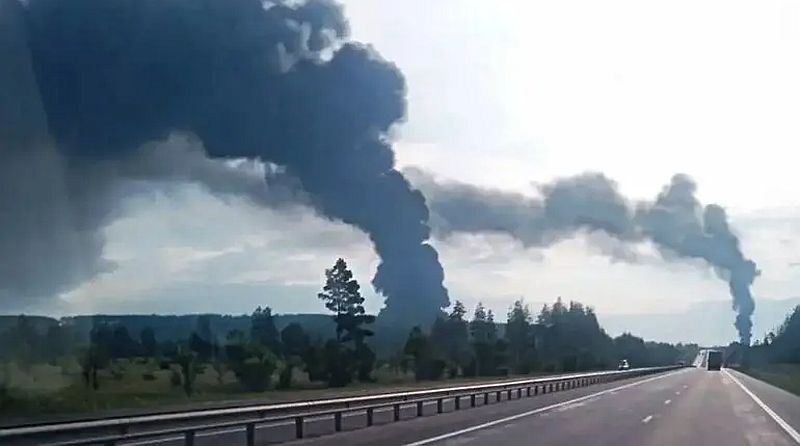

In the context of fires at Wildberries warehouses, some of the spoiled Ukrainian public began to express indignation and demand traditional strikes on oil infrastructure.
On July 21/22, something happened at an oil depot in Armavir (Krasnodar region), but no one particularly noticed.
But on July 22/23, everyone noticed. Because a small oil refinery and oil depot in Novospasskoye (Ulyanovsk region), as well as LPTS “Subkhankulovo” (Bashkortostan) caught fire and smoked. Let’s talk about LPTS because there’s an interesting context.
1. What is the essence of the fuel crisis in Russia?
Russia produces about as much high-octane gasoline as it consumes – around 40-45 million tons. Therefore, disabling more than 10% of gasoline production capacity automatically creates a deficit.
At the same time, Russia produces more than twice as much diesel (~90 million tons) as it consumes (~40 million tons). Russia exported half of the produced diesel. Disruption of diesel production chains is not an immediate deficit but initially a logistics issue.
As a solution to the problem, the Russian Government stopped diesel exports and is figuring out how to redirect fuel flows to meet consumer demands.
Who mainly consumes diesel? Farmers. The army. Railways. Utilities. Auto carriers, etc.
In total: during the peak diesel consumption due to the harvest campaign, farmers and the army become situational competitors in the narrow neck of logistics.
How will Russian authorities solve the problem, considering that the army is a priority, but for farmers, this is the most important period of the year?
Recently, Russian Minister of Agriculture Oksana Lut outlined the approach in an interview with “Vesti.” The Ministry of Agriculture collected information about all agricultural producers and processors, determined how much fuel each needs monthly until the end of the year, verified the data at the regional level, and transferred it to the Ministry of Energy.
The Ministry of Energy should assign tasks to the main IOC (Gazprom Neft, Rosneft, Lukoil…) to guarantee regions fuel supply limits for harvesting, planting, and other tasks. The plan is clear, now it needs to be implemented.
This is what I wrote about some time ago. In terms of diesel, the focus is on distribution and logistics. And gasoline consumers will have to manage for now.
2. How is diesel logistics organized? Very roughly and schematically.
Oil refineries produce diesel and accumulate it in tanks. From the refinery tanks, the fuel conditionally has three main routes to the consumer:
• The most troublesome – by tanker truck (road transport);
• The most practical and flexible – by railway tank car;
• The most extensive – via petroleum product pipeline.
During Putin’s reign, Russia augmented the Soviet legacy in the transportation of oil products. They transformed or rebuilt pipelines, pumping stations, storage tank farms, and ports.
The driving force behind this work was the company “Transneft,” which implemented two projects: “North” – linking pipelines with fuel to Baltic ports, and “South” – doing the same through Novorossiysk.
By 2014, Russians had woven a web of main oil product pipelines (MNPP) from Western Siberia to the port of Primorsk (Leningrad region).
The key points of the system are the Omsk Refinery, the Ufa group of refineries in Bashkortostan, “Taneko” and TAIF-NK in Tatarstan, Lukoil’s plants in Perm and Nizhny Novgorod, the Yaroslavl Refinery, and “KirishiNefteOrgSintez” (Leningrad region).
This is a kind of circulatory system where the pipes act as vessels, with a “distributed heart” in the form of pumping stations – LPDS/GPS/NPS with pumps and tank parks. The stations set the rhythm, maintaining the pressure of the diesel flow in the pipes.
To enhance the capacity of the pipes, the system was constantly upgraded. New NPS were integrated to shorten the distance between pumps, tank volumes were increased, automation was implemented, etc.
Since it is difficult to completely shut down all refineries regarding diesel, they try to protect them; another way to impair the supply to Russian occupation forces is the disruption of logistics.
The most evident method is dismantling oil depots near combat zones, so Russians can’t accumulate or maneuver fuel for the army’s interests. This leaves them with only the option to hustle with fuel trucks over the longest possible transport routes. Attention is focused particularly on the southern regions of the Russian Federation, where competition between the army and agrarians can be easily created.
Simultaneously, the pipeline system is also being targeted to weaken the flow.
3. How does this look in practice recently?
In July, the SBU dismantled a hub in the Stavropol region, where 5 oil depots are concentrated. Four of them were affected to some extent. There’s a good railway junction there, allowing diesel to be transferred from anywhere. Now Stavropol farmers will have to exert more effort. The logic of striking the oil depot in Armavir falls into the same category.
But this is tactical. A long-term strategy is underway parallelly.
On July 8, the SBU visited the LPDS “Cherkassy” in Bashkortostan. This is a monstrous hub near Ufa (1500 km from Ukraine), receiving oil products from Ufa refineries and also Gazprom Neftekhim Salavat (visited by SSO on July 14), and the Perm, Omsk, and Antipinsky (Tyumen) refineries. It services 6 main oil product pipelines.
On July 23, friendly drones visited the LPDS “Subkhankulovo” (about 150 km west of LPDS “Cherkassy,” with LPDS “Yazykovo” situated between them).
LPDS “Subkhankulovo” was established in 1977 as purely an oil pumping station. Its primary mission was to pump oil extracted by the oil and gas producing enterprises (NGDU) “Oktyabrskneft” and “Tuymazneft” to Ufa refineries, as well as maintain crude oil flows in various directions.
Later, under Putin, it underwent serious modernization and gained the additional role of an “oil product” station. A second site was opened, linking diesel pipelines, and in two phases (2005, 2011), a separate tank park for oil products with a capacity of 100,000 cubic meters (10 tanks of 10,000 each) was constructed.
Now this station is a key hub, transferring diesel from Omsk, Ufa, and other plants to Almetyevsk (Tatarstan), where diesel from the Nizhnekamsk refineries of Tatarstan and Perm is added to the flow. That is, the pipeline from Subkhankulovo ends at the port of Primorsk on the Baltic Sea (1920 km).
As a result of the visit, at least one tank is initially on fire. Another one, which was struck, is probably empty and did not catch fire. This immediately reduces capacity by 10%. Moreover, this is a route that supplies the capital region of Russia.
The effects of such strikes accumulate, and the Russians cannot repair everything at an advanced pace. Gaps arise…
4. Regarding Novospasskoye – two objects are on fire there: an oil refinery and an oil depot (in the picture).
The refinery processed about 600,000 tons of oil, producing fuel oil, straight-run gasoline, and diesel, and was mainly export-oriented (supplying initially processed raw materials). Now similar plants are being refocused on the domestic market. As we can see, this will not be possible, and it will not help in the crisis.


