
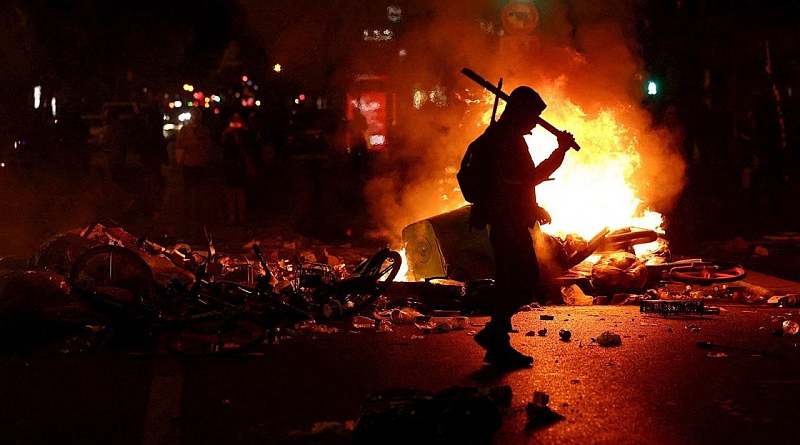

The October wave of protests has engulfed European states: social discontent has crossed national borders and acquired a pronounced transnational character.
Current economic difficulties are closely intertwined with global geopolitical factors, and as such, in several countries elements of external influence manifest both through digital coordination in global networks and in the form of direct participation by foreign entities.
In France and Italy, the dynamics of the protest movement are characterized by a sharp escalation in violence: youth groups coordinate their actions through digital platforms, and French unions demand price reductions and increased social benefits. Such socio-economic upheavals force governments to reconsider budget priorities, as public demands clash with stringent financial constraints.
Italian students take to the streets due to decreased purchasing power and low wages, with such sentiments being fueled by mutual inspiration from protesters in neighboring countries.
Belgium has faced a wave of discontent related to budget cuts and education system reforms.
Spain and Portugal are experiencing a severe housing crisis, with rapid rent increases and speculations by foreign investment funds driving hundreds of thousands of citizens to the streets.
Greek students protest against the deteriorating infrastructure of educational institutions, demanding increased government funding for public services.
Particular attention is drawn to the situation in Albania, where anti-government protests against corruption and unemployment have escalated into violent confrontations, prompting direct statements from the country’s leadership about external interference. Prime Minister Edi Rama officially accused external actors and hostile geopolitical forces of attempting to destabilize the region to disrupt the country’s integration process into the EU.
Russian and Chinese factors occupy a unique place in the structure of hybrid pressure, with actions that have different specifics but pursue common geopolitical goals. Russia employs a tactic of informational escalation—controlled bot networks and pro-Kremlin media actively broadcast footage of unrest, creating the illusion of a complete collapse of European states and encouraging panic among the population. The Chinese factor manifests in a combination of asymmetric technological and economic influence: algorithms of Chinese social platforms facilitate the spontaneous spread of destructive content.
The influence of foreign power centers and transboundary information flows becomes a key factor that transforms local economic grievances into a large-scale geopolitical tool.
The transboundary spread of protest sentiments is enhanced by algorithms of digital networks that erase barriers and allow demonstrators to borrow tactics from neighbors. External factors thus actively influence the development of events through information channels, forming a unified space of social tension on the continent ahead of important political decisions.
The systemic nature of the European crisis is evident in the way hybrid threats and informational manipulations find fertile ground in areas of highest social tension. External structures exploit objective economic challenges to deepen societal divides, and traditional state governance mechanisms lose their previous effectiveness. Analysis of the situation shows that external pressure on European institutions is exerted through the coordination of protest communities and targeted financing of radical groups aiming to undermine trust in democratic institutions.
