

Information on the current losses of the Russian Federation due to sanctions as of 07/04/2026.
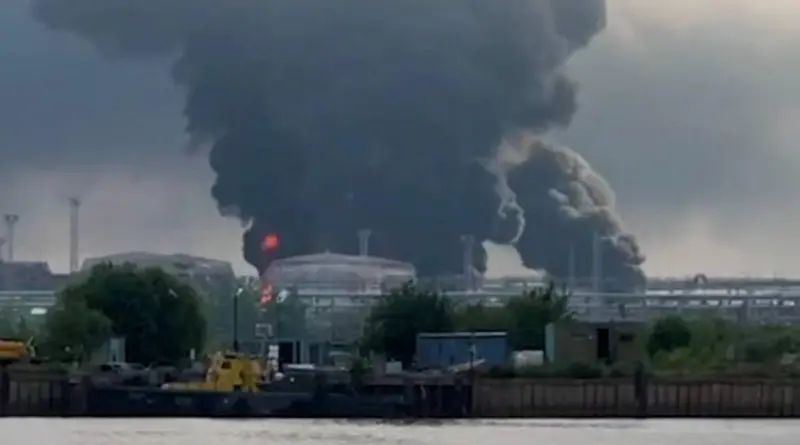
1. On the night of July 4, our drones attacked the oil terminal in Saint Petersburg.
– A series of explosions occurred in the port area, followed by a large fire at the facility. Thick black smoke rose over the site.
– The Saint Petersburg oil terminal is one of the largest on the Baltic Sea. Its annual throughput capacity is 12.5 million tons, and the tank farm includes 31 tanks with a total volume of 324,000 cubic meters.
– The terminal handles crude oil, petroleum products, liquefied gas, and other liquid cargoes.
– The attack came less than a month after the previous strike on the same terminal. Then, Ukrainian forces also hit the facility, which is an important element of Russia’s fuel and export infrastructure.
2. On the night of July 4, the Ukrainian Defense Forces struck one of the key bases of the Russian Baltic Fleet in Kronstadt. This was reported by the General Staff of the Armed Forces of Ukraine.
– According to Ukrainian military data, the attack resulted in a hit on the facility with a subsequent fire on the port’s premises. The extent of the damage is being clarified.
– The headquarters of the Leningrad Naval Base is located in Kronstadt, where the Baltic Fleet’s warships are stationed and undergo repair and maintenance.
– The UAV Forces of the Armed Forces of Ukraine reported that the base ensures control of the sea approaches to Saint Petersburg. This is not the first attack on Kronstadt.
– In June, Ukrainian drones had already attacked the naval base. According to the Ukrainian side, the corvette “Boykiy,” used to escort Russia’s “shadow fleet” tankers, was hit at that time.
3. The largest oil refinery of “Lukoil” — “Nizhegorodnefteorgsintez” (NORSI) — completely stopped oil processing on July 2 after an attack by Ukrainian drones.
– During the strike, the main oil primary processing unit AVT-6, which accounted for 53% of the plant’s production capacity, was damaged.
– Another unit, AVT-5, which accounts for 25% of the plant’s capacity, was taken out of operation due to the previous attack on June 24. The damage to these two key units led to the complete shutdown of the refinery, which is the fourth most powerful in Russia and the second largest in gasoline production.
– NORSI processes about 15 million tons of oil per year and supplies fuel, particularly to the Moscow region.
– Following the shutdown, the enterprise ceased wholesale sales of gasoline and diesel fuel on the St. Petersburg International Commodity Exchange.
4. The strikes on refineries cost the Russian budget over a trillion rubles in compensation to oil companies.
– Due to damage to refineries from Ukrainian strikes, the Russian government has been paying record compensations to oil companies for the third consecutive month.
– In June, the federal budget transferred 312.5 billion rubles to oil companies: 210.6 billion rubles under the damping mechanism and another 101.9 billion rubles in reversed excises.
– In May, the amount of payments was 357.3 billion rubles, in April — 359.3 billion rubles. In total, over the past three months, Russian oil companies have received 1.029 trillion rubles in compensation from the budget.
– The main reason for such a sharp increase in payments was problems with oil refining after a series of drone attacks on refineries. Meanwhile, this significantly reduces budget revenues.
– In June, Russia received 968 billion rubles in mineral extraction tax, but almost every third ruble was returned to oil companies in subsidies.
– At the end of the first half of the year, revenue from the oil and gas sector fell by 23% to 3.66 trillion rubles, the lowest since 2020.
– Significant additional expenses are also expected to restore the damaged facilities. The repair of the Moscow refinery, which was halted until 2027 after two attacks, is estimated at about 1 billion dollars.
5. Russia begins importing aviation fuel from Japan amid a fuel crisis.
– Russia is preparing to import its first batch of aviation kerosene from Japan after starting gasoline purchases in India. In the first half of July, at least 200,000 barrels of aviation fuel will be shipped from the Japanese port of Chiba, to be delivered to Russia through South Korea and a network of intermediaries.
– Despite Russian authorities’ claims of no aviation fuel shortage, market problems are worsening after a series of Ukrainian strikes on refineries. In June, Russia’s oil refining volumes fell to the lowest level in over 20 years, leading to shortages of certain types of fuel.
– In mid-June, several major Russian airports, including Makhachkala, Mineralnye Vody, Krasnodar, Astrakhan, and Nizhny Novgorod, implemented restrictions on refueling aircraft. By the end of the month, the airline “Azimuth” also reported an acute shortage of jet fuel.
– According to Kpler, Russian aviation fuel exports this year have more than halved — to about 13,000 barrels per day from 30,000 barrels per day last year, with the main export destination still being Turkey.
6. Russia’s services sector downturn deepens: new orders decrease at the fastest rate since late 2022.
– In June, the downturn in Russia’s services sector intensified. According to an S&P Global survey, the business activity index (PMI) fell to 48.2 points from 48.7 in May. A value below 50 indicates a contraction in economic activity.
– Service volumes have been decreasing for the fourth consecutive month, with the pace of decline being the fastest since September 2025. Companies attribute this to weak customer demand and a further reduction in new orders.
– New orders have been declining for the third consecutive month, with the rate of decline being the highest since December 2022. Survey participants associate this with a drop in customers’ purchasing power and a deterioration in their financial situation.
7. The EU increased imports of Russian LNG by 17% since the start of the year.
– In June, European Union countries increased imports of Russian liquefied natural gas (LNG) by 10% year-on-year to 2.169 billion cubic meters. In March, deliveries reached a historic high since 2019 at 2.459 billion cubic meters.
– By the end of the first half of 2026, EU countries purchased 13.412 billion cubic meters of Russian LNG, 17.4% more than in the same period last year.
– Meanwhile, LNG deliveries from Qatar nearly stopped, while imports from the USA and Trinidad and Tobago increased by 3.4% from January to June.
– As of April 25, 2026, the EU has a ban on purchasing Russian LNG under short-term contracts. From January 1, 2027, restrictions will also apply to long-term agreements.
– Exceptions still remain for existing contracts of France’s TotalEnergies, Germany’s SEFE, and Spain’s Naturgy, but the re-export of such gas to third countries will also be prohibited.
In the image: After an attack by Ukrainian drones on 07/04/2026, the Petersburg oil terminal is burning. Photo: social networks
