
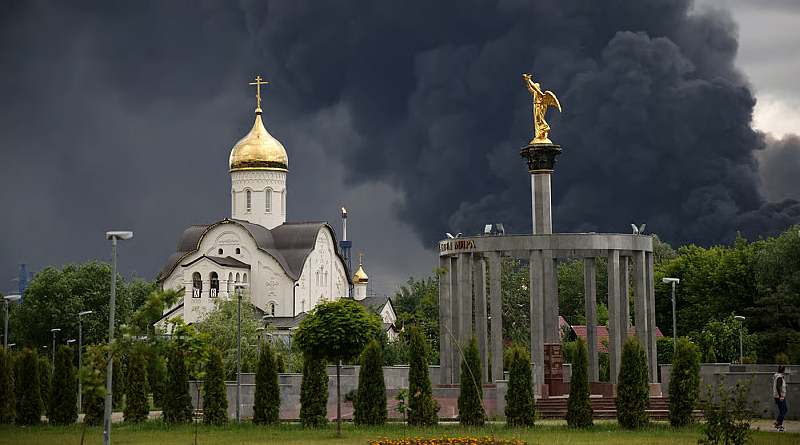
The black sky of fires over Moscow will now forever remain one of the main illustrations of the Russian-Ukrainian war. And these fires will be remembered by the Russians far more than any other events of the past twelve years. More than the pompous “annexation” of Crimea. More than the invasion of February 24. And even more than the fire over St. Petersburg.
Because unprotected Moscow, even if the black scorched area is currently limited to distant Kapotnya, which most residents of the Russian capital recall only when discussing “how they live there,” is an almost primal feeling of a lack of safety for the entire country. By definition, there should be “nothing like that” in Moscow: if “something like that” happens, it is the first symptom of disease for the entire country, it is a demonstration that living is becoming dangerous anywhere in Russia.
Putin himself understands this perfectly well. To strengthen his influence and seize power, the security services used the war in the Caucasus and received a real mandate for “restoring order” precisely against the backdrop of explosions in the same residential areas of Moscow, in the “collective Kapotnya.” Well, after the hostage capture in the theater center on Dubrovka, Putin could do whatever he pleased both in the Caucasus and with his populace (mainly non-Moscow, by the way). He always used any danger, any escalation to strengthen authoritarianism and a “soft transition” to totalitarianism. Here, the most effective tool became not Chechen but rather the Ukrainian war.
But the paradox of the situation is that back in 1999, when Moscow houses in the godforsaken Pechatniki and on Kashirskoye Highway were exploding, Putin could both create a deficit of security and demonstrate that the desired stability was being restored – just trust the strong hands of the students of “Iron Felix”. Now this valve is no longer opened by him. What, of course, can he counter these strikes with? No strike on Kyiv or Odesa, no capture of yet another city in Donbas will return to Muscovites, and hence to all Russians, who traditionally look to Moscow, the sense of confidence in tomorrow. It turns out that in 2000, Putin gave them this feeling of security, earlier destroyed by the security services, and in 2026 he took it away.
Putin, with his mania for constructing traps, has now fallen into another – for himself. He does not want to end the Russian-Ukrainian war, as he may fear the final collapse of his imperial project, not to mention the return from the front of an almost million-strong bandit army of mercenaries, against whose rampage his security forces may prove powerless. And he cannot continue to wage war for long, because further strikes on Moscow, primarily on Moscow, of course, will destroy the image of the Russian dictatorship itself and its guarantee to society. It turns out that in any scenario, Putin consumes himself.
And here we return to Russia’s eternal excess, to the inability to stop in time. The power of a great state is actually not in the application of force, but in the prospect of applying force: then there remains a feeling that if Goliath only raises his hand, something irreparable can happen. But even if force is applied and the desired result is not quickly achieved, there is also an option to end the war – and then there remains the illusion that not all forces and resources were used, that it was just a lightning-fast special operation, but if a real long war began, then you would see Goliath with all his capabilities. But even if you continue longer and achieve nothing, you can still pause, at least to preserve, if not prestige, then at least economic prospects (which, after all, Donald Trump did with Iran).
Putin did neither the first, nor the second, nor the third. He attacked, he did not stop after the blitzkrieg’s failure, he did not stop even when it became clear that the war was gradually destroying and consuming his economy. He waited for strikes on Moscow – and still does not calm down. He excessively believes not even in his own decisions, but in time, believes that if you stupidly bang your head against the wall for many years in a row, you can see a conquered Ukraine and the “real” Russian Empire.
Maybe. But only in your own head, which starts playing its own tune after such a number of insane hits. In reality, there is the burnt Moscow factory, strikes on Russia, an almost severed Crimea, and troops that in the fifth year of the war continue to fight in Donbas. And even if you imagine that he still has enough resources and opportunities for a long time to hit his head against the wall, there will be nothing else besides these blows.
Cover image: Smoke rises over an oil refinery and the Church of St. John of Kronstadt in the Kapotnya district after an attack by a Ukrainian drone, Moscow, Russia, June 18, 2026. Photo from open sources
