The opening of the “Fundamentals” section (“cluster”) in the EU accession negotiations is a very important stage. If only because it has launched a mechanism to monitor reform progress.
It is also important that the assessment (“screening”) of readiness for another five sections has been initiated: they are checking readiness for their opening.
But it is important to remember: sections are hard to open, but even harder to “close” and confirm that necessary changes have been made and their quality meets standards.
This last part is very important. Because in the EU, they won’t let you adopt “just anything” without reading and discussion, and demand to “finally name a date.” They will offer convenient working conditions, just as in the EU, focusing on people and results.
Regarding “Fundamentals,” they proposed a whole new advance preparation procedure (“forload”). Only 10 points of anti-corruption changes were agreed upon, announced in the Kachka-Kos statement in December… and surprisingly saw that zero were implemented.
Now reforms are embedded in memorandums for funding allocation. Can’t do it yourself? We’ll include “conditionality”: money in exchange for reforms.
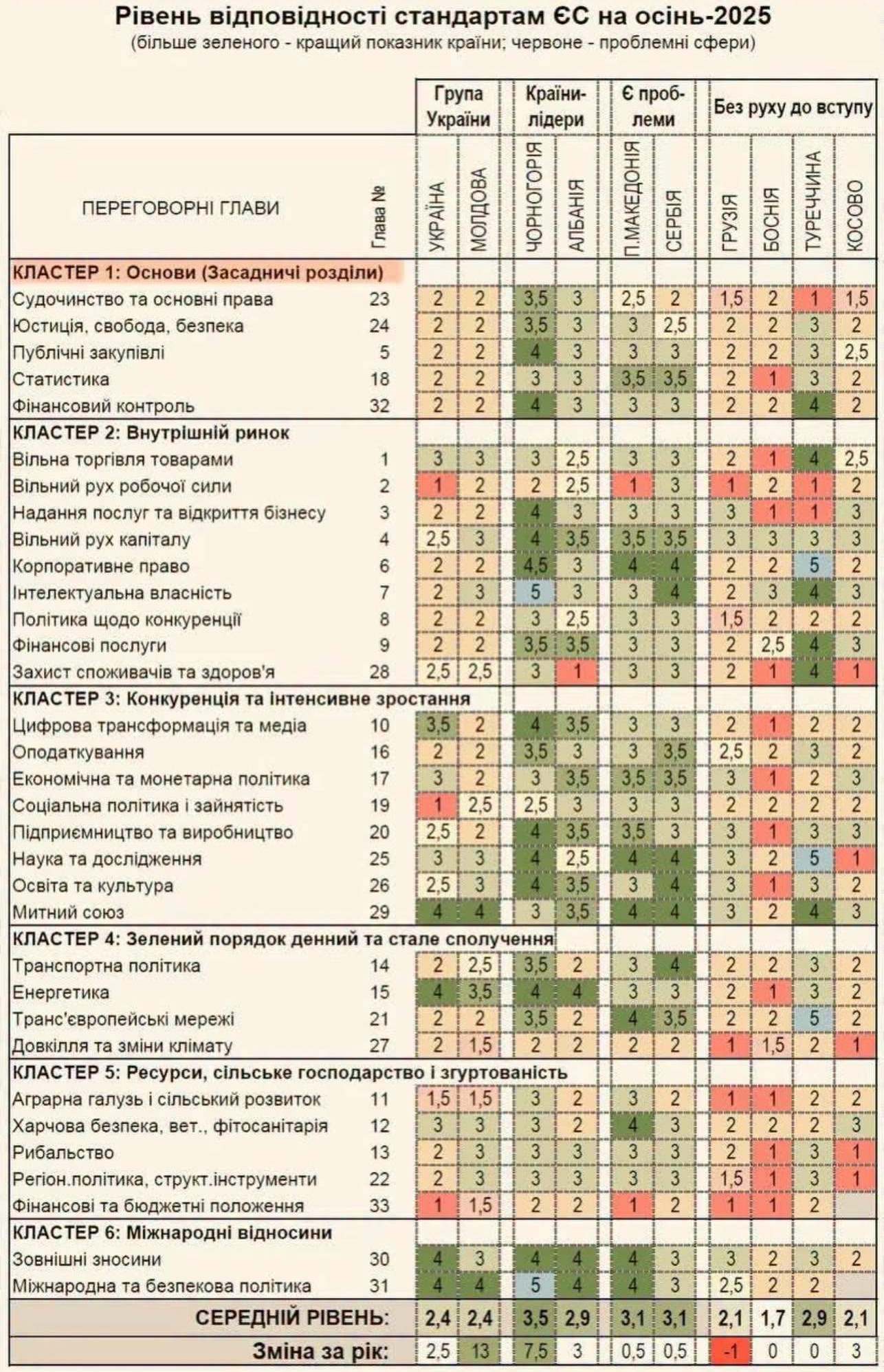
If that doesn’t work, they’ll gladly push it aside and start focusing on “easier” Moldova, Albania, the Balkans… Peter Magyar is already hinting that it is “unfair” to drag Ukraine ahead of the Balkans. And all the failures of the Ukrainian government will fuel such sentiments.
We have to carve out our future ourselves. Through work—together, combining all forces. That’s the only way it works.
Otherwise, we may lose a historic chance. And it will not matter at all whom the government blames in its flashy videos.
Ukrainians are not shedding blood for enduring imitation instead of returning to the European home.
I took an illustration with Ukraine’s progress evaluations compared to other candidates from Valerii Pekar.
To achieve an acceptable result—work and work.