
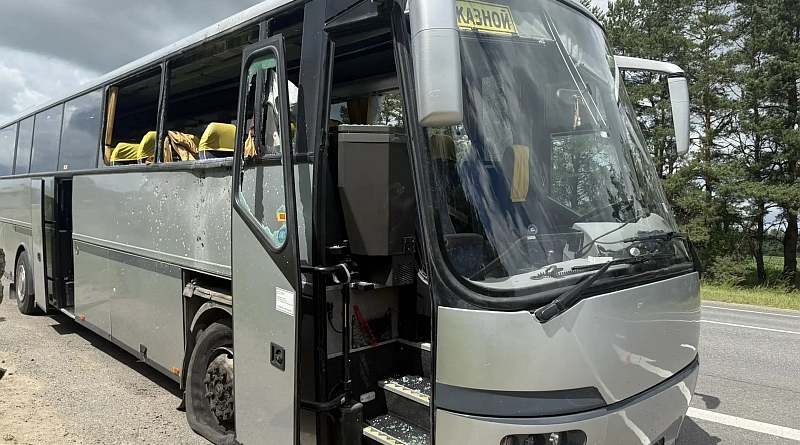

A shocking piece of news is spreading across Russian propaganda platforms – a Ukrainian drone hit a bus with children traveling from Belarus to rest in Gelendzhik!
The strike occurred when the bus was traveling on the A-240 highway in the Pochep district of the Bryansk region. Reportedly, a woman escorting was killed, six people were injured, including four teenagers.
Of course, even without any forensic results or the completion of investigative actions, the Russian side hysterically accuses Ukraine of the strike, and photos and videos of the attacked bus spread across news feeds. And, honestly, they would have been better off not publishing these photos, as it’s just an admission of guilt!
But let’s take it step by step.
But before dissecting this provocation organized by the Russian side – meaning there is no intrigue as I reveal my cards right away – I want to note that I don’t understand what tourist buses are still doing in Russia, a country at war and where active hostilities are taking place? Sending children to Russia, to Gelendzhik, what irresponsible parents!
As of today, the entire Russian territory is a zone of hostilities and potential risks for anyone there!
Now let’s return to the tragedy in the Bryansk region.
Firstly, I want you to understand what the A-240 highway and the Pochep district are. It’s more than 60 km from the borders with Ukraine. This is a very important point for further understanding why we are dealing with a Russian provocation.
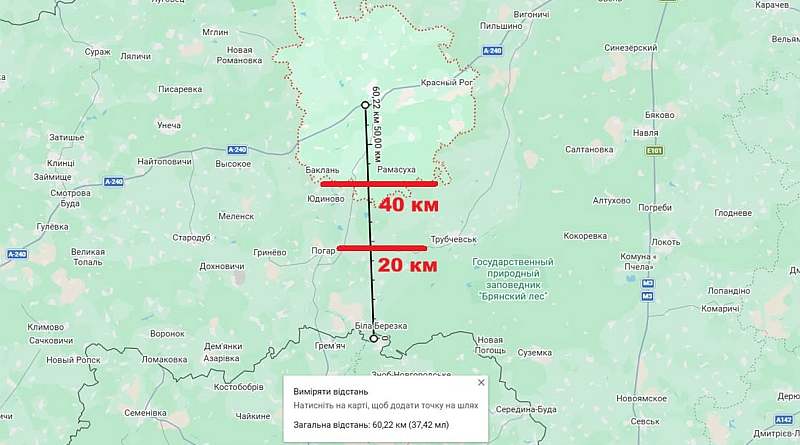
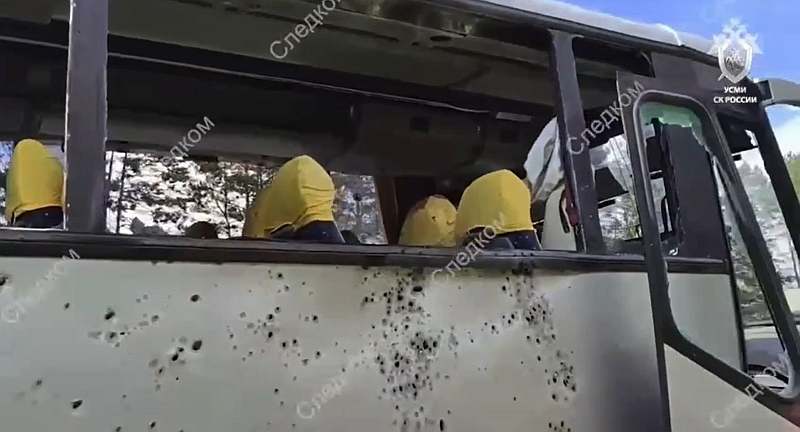
Secondly, pay attention to the photo of the damaged bus. By the nature of the damages, a conclusion can be made that it was a low-power FPV drone. Not a mid-strike drone like, for instance, the Hornet, but a low-power means of destruction. And this is the most interesting part!
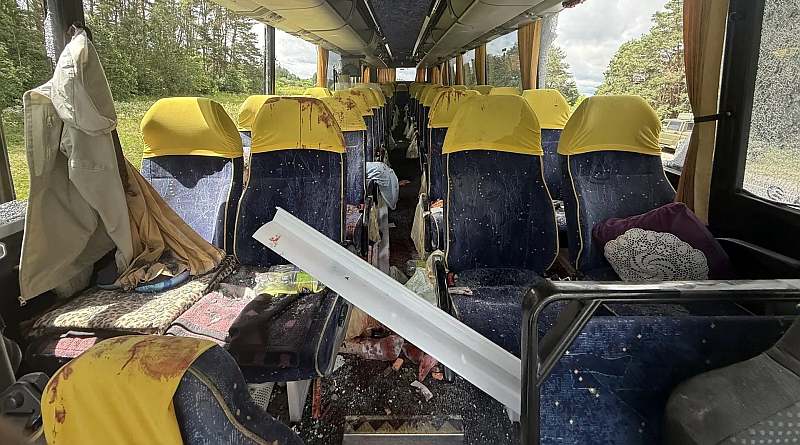
An FPV drone flies distances up to 20 km, and on fiber optics, on average, up to 40 km. Moreover, the drone is launched from a closed position for the operator’s safety, which means, with a safe zone taken into account, at least another 5 km.
Thus, a Ukrainian FPV drone could not have flown from Ukraine’s territory and struck a bus more than 60 km from the border, as it would have needed to cover more than 65 km.
So, logically, if it were a fiber-optic drone, it should have been launched approximately from the Pogar district of the Bryansk region, the villages of Pogar or Trubchevsk, and if it was a regular FPV drone, its launch would have had to be from the Pochep district of the Bryansk region itself!
I don’t recall Ukraine controlling such an area and depth of the Bryansk region today. And if we imagine the penetration of some DRG, they would have had to overcome 20 to 40 km of a well-patrolled and controlled zone in the Bryansk region. And for what? To strike a school bus with an FPV drone? Although the same could have been achieved with a middle-strike drone…
Thirdly, non-technical aspects. Just recently, the so-called President of Belarus, Alexander Lukashenko, gave an interview in which he apologized to Volodymyr Zelensky and assured the President of Ukraine that Minsk does not plan to attack our country. This interview was apparently painfully received in the Kremlin and they could very well have attempted to put Lukashenko in his place with such a provocational terrorist act.
After all, after the strike on the bus with children and the Russian side’s claims that Ukrainians did it, Lukashenko would have to react. Both in the context of his recent statements and in the context of the apparent intention of the Russian side to use this provocation not so much to demonize Ukraine but to draw Belarus into the war against Ukraine.
So.
A bus with Belarusian children, traveling for vacation to a warring country on a dangerous route, is attacked by an allegedly Ukrainian drone, which could not have flown from Ukrainian territory to the attack site, and this happened right after Lukashenko’s peace-making statements towards Ukraine.
The Russian side, without even conducting a thorough investigation, immediately began blaming Ukraine for everything, although, if an investigation had been conducted, there would have been a great risk of implicating themselves…
Traveling to Russia is dangerous not only because it is a combat zone, but also because, against your will, you could at any moment become a victim of a Russian provocation intended for one purpose or another.
General Staff of the Armed Forces of Ukraine: “We emphasize that during the specified period, the Defense Forces of Ukraine did not use unmanned aerial vehicles against targets in the Bryansk region.”
Bryansk bus from Yenakiieve. Lukashenko. Traber.
I will now show you where the attack was prepared.
Everything is done so disgracefully and stereotypically that it’s even disgusting to write about it. However, it is important to depict the entire context because the Russians have created an informational vortex and are pulling Lukashenko into it.
First about the buses.
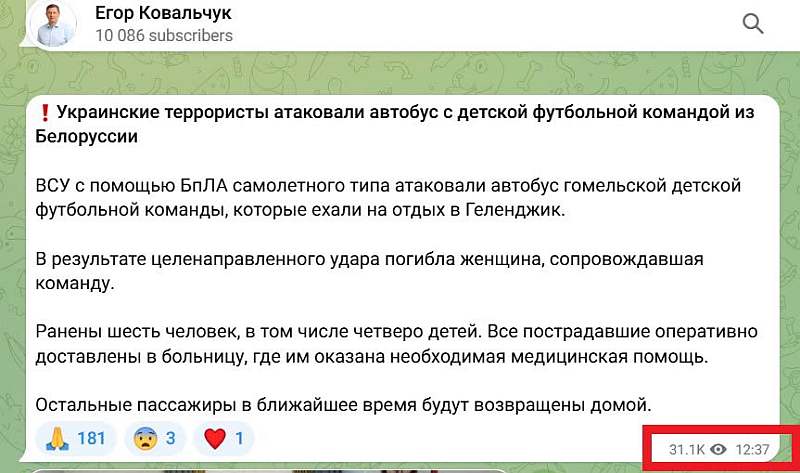
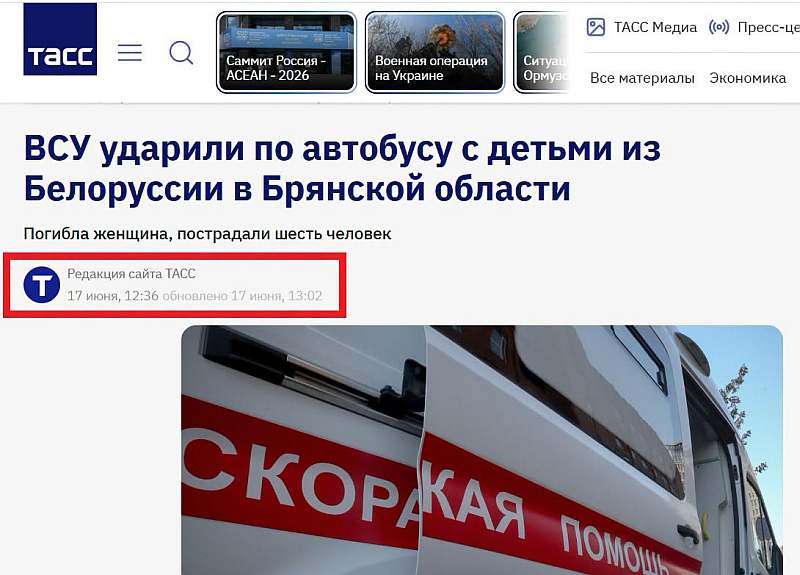
1. Event: On June 17 at around 12:30, the acting governor of the Bryansk region, Egor Kovalchuk, publishes a statement claiming that the Armed Forces of Ukraine allegedly attacked a bus with a children’s football team from Gomel using a DRONE AIRCRAFT TYPE (!!!) heading for a vacation in Gelendzhik. It is reported that a woman died and 6 people were injured, including 4 children.
Later, there are clarifications: there were 2 buses, carrying 88 people, but they were not from Gomel, but from Rechytsa—children athletes (football players, dancers…) with parents and coaches.
In the evening on the “First Information” channel (Belarus), a synchronous broadcast is given with Yuri Anufriev, director of DYUSSH No. 2 of the Rechytsa district, who says that around 11 o’clock (!) one of the coaches on the buses called and reported that an attack had occurred.
That is, according to public statements by the involved parties, about an hour and a half passed between the incident and the disclosure of the information by the Russian (!) side. Obviously, the presentation was coordinated: reported from Bryansk to Moscow—received the go-ahead—launched.
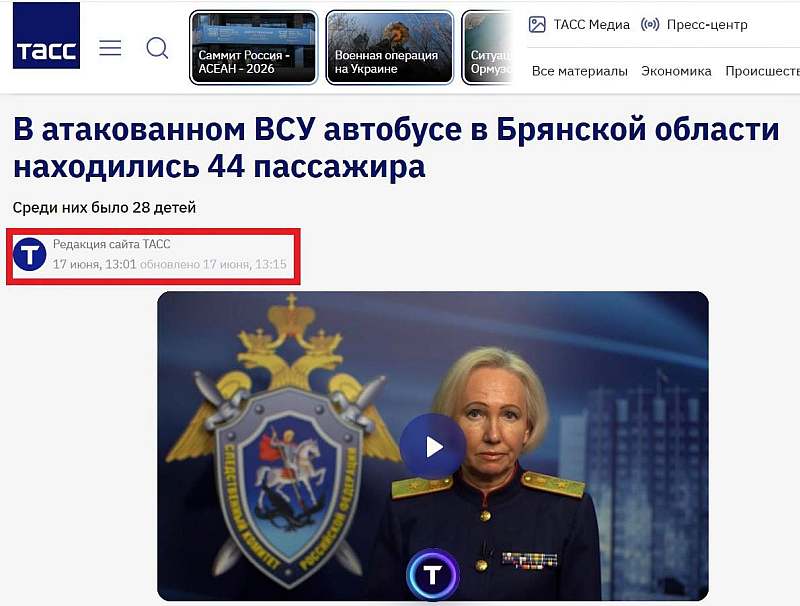
2. Simultaneously with Kovalchuk (but with a reference to him), TASS and other federal Russian media begin to spread information about the incident. This confirms: the launch was synchronized after approval.
Literally: TASS releases the news with a reference to Kovalchuk’s “Max” one minute before Kovalchuk manages to duplicate the news in his telegram.
About 25 minutes after Kovalchuk’s message (exactly at 13:00, TASS releases at 13:01), they start spreading a video comment (!!!, and it needs to be recorded, the text of the sync drafted) from the Investigative Committee of the Russian Federation on the initiation of a criminal case under the article “terrorist act.”
Once again: the video news about the criminal case comes out 25 minutes after the first report of the incident. Here I want to add: be grateful it wasn’t 25 minutes earlier!
In Russia (!), there is a rapid escalation of two plot lines:
• Officials claim that the Ukrainian Armed Forces allegedly committed a war crime, involving civilians and children, necessitating an international response;
• Various “experts” “explain” why the Ukrainian Armed Forces supposedly attacked a passenger bus in broad daylight (!) — because Ukrainian Nazis allegedly want to drag Belarus into the war! The most extreme claims suggest that the Ukrainian Armed Forces specifically tracked this bus to stage a provocation!
But in the evening, the same acting governor Kovalchuk gives a statement to the media, saying that the A-240 highway is a busy transit road, etc.
And we know how content from busy highways surfaces in the event of a drone attack around 11 AM (!!!). There are always witnesses of at least the aftermaths, different angles, etc. Even when a simple traffic accident occurs, content appears.
However, the coverage of this incident indicates that the site of the occurrence was quickly isolated, with approved photos and filtered visual content being broadcast.
In summary, some incident occurred on Russian territory (the material aspect is controlled by the Russians). The primary source of the information is official Russian (i.e., might lie about anything). It immediately frames it — allegedly Ukrainian Armed Forces, allegedly a plane-type drone (!!!). The information campaign is managed by Russia. And it does so in a much more aggressive tone than Belarus, which plays the role of a subordinate object…
3. A paradoxical fact: there is still no reaction from the First Lady of Russia, Alexandra Lukashenko, to the incident.
Even Putin, who was at the ASEAN forum in Kazan on his first (!) regional trip in a long time, personally called the Russian Minister of Health a couple of hours later and gave commands. Yet, Lukashenko remains silent.
It was indirectly highlighted that Lukashenko ordered the return of the injured to Belarus for assistance, but nothing is known about his assessment of the situation.
Belarusian observers note that Grigorovych has a tradition of not appearing in public on Wednesdays. However, today the media scene was simply schizophrenic: the airwaves were filled with news from the Bryansk region about the bus with children, while Lukashenko supposedly listened to some formal reports on crops and milking.
When comparing Belarusian and Russian news feeds, it becomes very clear: Belarusians relayed Russian inputs for several hours, after which details from Rechytsa, Gomel, and specific positions emerged.
The Belarusian Foreign Ministry, generally repeating the nonsense about the Ukrainian Armed Forces, at the level of a third-tier spokesperson, demanded “comprehensive explanations” from Ukraine. Other officials literally said that caution should be exercised when traveling to Russia, especially in areas adjacent to the conflict zone.
Ukraine’s reaction is known.
As soon as the speculations started, Ombudsman Dmytro Lubinets contacted the Belarusian side and dismissed the nonsense, offering help in the investigation. The General Staff denied even theoretical Ukrainian involvement.
At 18:06, Lukashenko is expected to make a public statement.
Some passengers have already returned to Belarus, and their role will somehow be played up. So far, I haven’t found a single eyewitness comment (!) stating there was a drone. They say: there was an explosion, yes. About the drone — that’s speculation.
4. It seems that the Russians are trapping Lukashenko.
The objective picture is as follows.
The location of the incident claimed by Russians is 50 km from Ukraine’s state border with Russia. If any of our “aircraft-type UAVs,” which are used at such distances, had struck, it would have taken out half a bus, caused a fire, more casualties, etc.
The main point is that “aircraft-type UAVs” do not disappear without a trace. Dozens of videos from the Mariupol-Melitopol highway show UAV elements after an attack (engine, fuselage remnants, etc.). Therefore, the simplest thing Russian falsifiers could have done was to IMMEDIATELY show the drone remnants. But either the executors lacked intelligence, or they rushed.
As a result, no drone traces were presented. Absolutely nothing!
They might think of “finding something in the grass,” but the value of such evidence post-factum is less than zero.
As new “inputs” arrive, the Russian propaganda version begins to crumble. For instance, in Belarus, prompted by Russians, they started broadcasting that the “aircraft-type UAV”:
1) deliberately hit the bus wheels, yet at the same time
2) was packed with shrapnel to cause more human casualties!
So was it aimed at the wheels deliberately? Or to cause as many human casualties as possible?
And the same question remains: where are the remnants of this UAV?
According to the photos published by Russians online, even in Russia, people noted that several windows at the front of the bus and the door glass were shattered, yet the large windshield remained intact.
The impact of striking elements passed through the bus with a small radius. The metal of the bus, far from armored, was riddled (from the wheel to the roof), but only minimally “torn.”
Experts’ evaluations suggest the indicated damage could be caused by:
1) A hit by an FPV drone with a small fragmentation charge (but remnants of the drone would still remain, and there are none);
2) Dropping a small fragmentation munition from a copter (it drops and flies away; explains why there are no drone traces);
3) A shot from an under-barrel or automatic grenade launcher using a VOG-type munition;
4) Using some type of small “bouncing” mine.
All these options exclude the versions of Ukraine’s involvement.
According to the photos, even a shotgun blast from a short distance seems more plausible than a Ukrainian “aircraft-type UAV.”
The military says the simplest option is usually the correct one.
Among the conditionally crude-correct options is, for example, using a VOG-25P munition from a copter or naturally “bouncing.” It could have jumped to a “window” height of the bus. The effective action radius of such a bomb is 2.5 meters, with a shrapnel spread up to 7 meters.
The most plausible version: Russians, from the very beginning controlling the bus route, hit it with some VOG. From a copter or by shot—it doesn’t matter.
Where exactly the VOG hits the passenger bus is insignificant. There will be material traces and injuries, creating an informational pretext for an “attack on children.”
And now Russians tell Lukashenka: these are your children—react, or what are you then?
6. Grygorovich will be informed by reliable people that Ukraine is not involved in this story at all, it’s a pure Russian setup. Escalating towards Kyiv is like death. Because Kyiv will respond. Lukashenka understands this well.
Russians can “kill” multiple “birds” with this attack. From managing Lukashenko to diverting attention from the murder of an opposition artist in Poland.
But the Belarusian society must realize: one of the Kremlin factions can easily attack Belarusian children (just as they are killing children in Ukraine today) to create grounds for escalation from Belarus against Ukraine. And if Lukashenko goes along, it means he has traded the lives of Belarusian children for temporary comfort.
This story clearly resonates with Lukashenko’s interview on the “Al Arabiya” channel and runs parallel to the arrest of the reputable businessman Ilya Traber in St. Petersburg. But more on that in the next episode.
Instead of a conclusion, for clarity.
7. Two weeks ago, Russian blunderers already tried to axe a story with an attack on a “peaceful bus” in Yenakiyevo. It was even dumber there.
Early in the morning of June 3, dear Russians (and not only they) witnessed a remarkable sight — a burning oil depot in the port of St. Petersburg on the first day of the St. Petersburg International Economic Forum. Pictures and videos spread across the network.
Something needed adjustment. That is, generate some other news with the construction “Ukrainians attacked St. Petersburg” so it appears in searches in all languages.
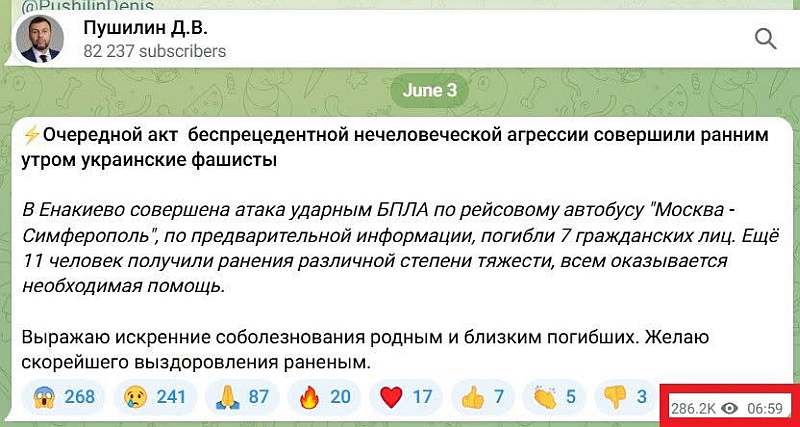
At 7:00, the temporarily alive gauleiter of the so-called “DPR,” Denis Pushilin, posted information that allegedly a Moscow-Simferopol bus was attacked in Yenakiyevo on the night of June 3. Fascists, Nazis, etc. It didn’t really take off.
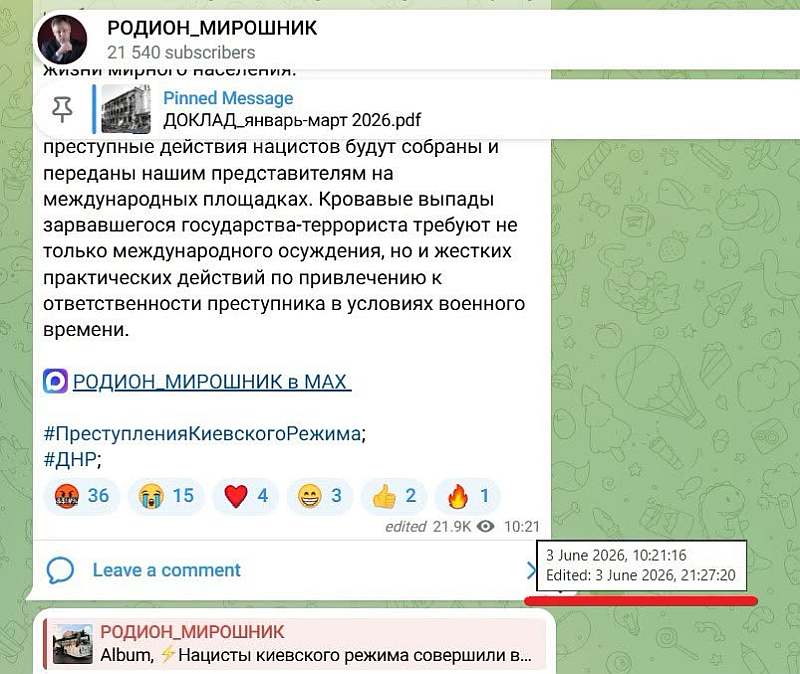
After 3.5 hours, someone activated the Luhansk monkey serving the Russians — Rodion Miroshnik, operating at the Russian Foreign Ministry.
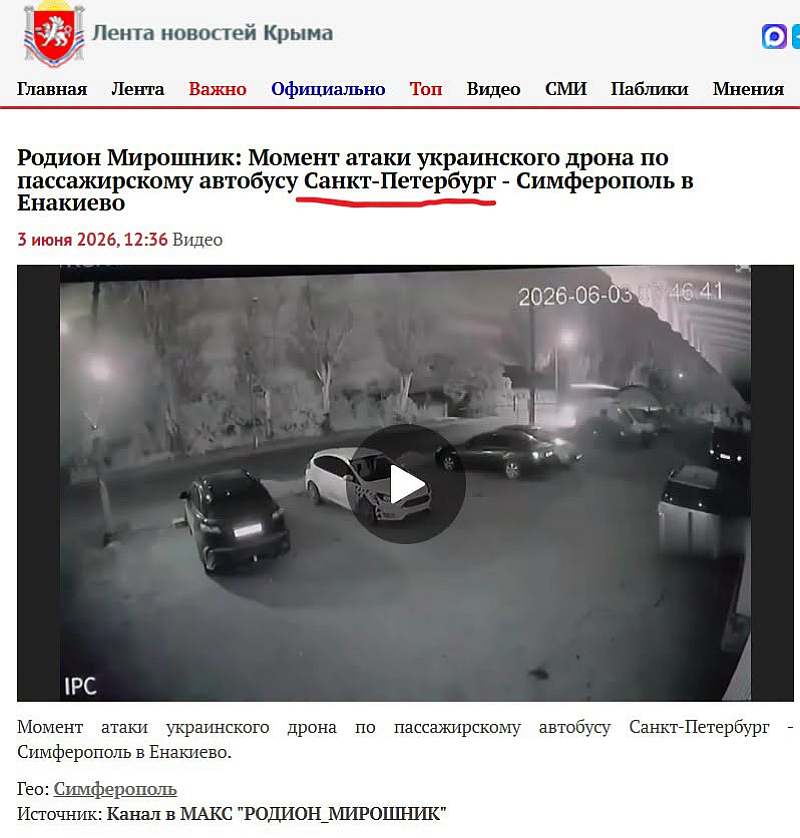
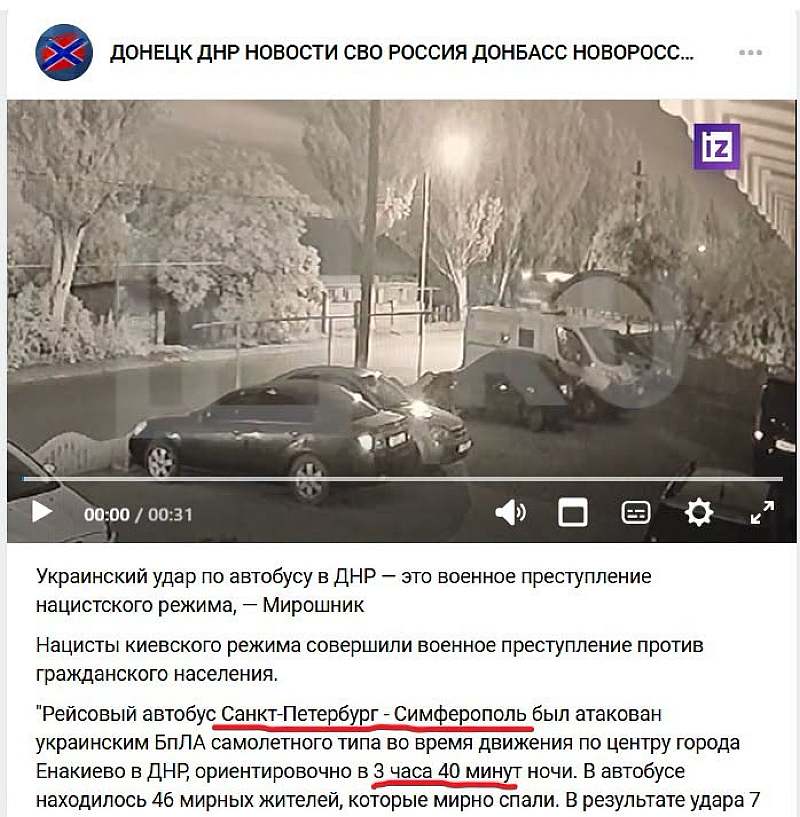
This figure at 10:21 detailed how at 03:40 (that is, deep at night) in the Yenakiyevo area, a so-called attack on a St. Petersburg-Simferopol bus by fascists and Nazis occurred. And then the traditional hysteria ensued. The Russians even posted a photo of a supposedly burned bus from the carrier “Big World.”
Miroshnik began to be widely quoted, filling search algorithms with the allegedly burned “St. Petersburg – Simferopol” bus. It appeared that Ukraine attacked not the oil depot in the St. Petersburg port, but the bus in Yenakiyevo. Traces with Miroshnik’s quote and reference to “St. Petersburg” are still on the network.
The nuance is this.
If you had visited the site of the Crimean carrier “Big World,” which owned the burned bus of unknown time and place about ten days ago, you could (!!!) have found (now gone) a route from St. Petersburg to Simferopol via Yenakiyevo. With a small clarification: this bus followed through Yenakiyevo… exactly at 15:40. Three forty, but in the afternoon.
The baboons, scripting Miroshnik’s publication text, slightly crossed wires in the head. Some report passed the information — an attack on a bus in Yenakiyevo was declared. At what time — at 3:40. Check, which buses there at this time? At 3:40? From St. Petersburg. Well, that changes everything!
So, they wrote literally at three forty, and Miroshnik proclaimed about a bus from St. Petersburg.
But soon it turned out that:
1) this is outright nonsense, it contradicts easily verifiable facts;
2) this nonsense doesn’t help overshadow the effect from the oil terminal attack in St. Petersburg;
3) it provokes questions — what kind of idiot would travel from St. Petersburg to Crimea via Yenakiyevo, Volnovakha, etc.?
Therefore, comrade Miroshnik CORRECTED his posts and changed the bus from St. Petersburg to the “Moscow – Simferopol” route, according to comrade Pushilin’s original version. Many sites also made corrections, but there is plenty of evidence online about the St. Petersburg disinformation.
More importantly: now, the carrier’s website no longer lists routes through Yenakiyevo. Whether from St. Petersburg or Moscow. They were there – now they’re not. Although the internet remembers everything. Currently, the route from Moscow goes through Khartsyzk (at 15:30) – Makiivka. So, there were no passenger buses with suitable characteristics in that area at night. That’s why Pushilin started clarifying that the bus was not coming from Moscow, but from Podolsk, carrying people from “various regions.”
In short. At night, in Yenakiyevo, some transport with military personnel got caught up. They tried to spin it as a “bus in underwear” from Moscow. Then they decided to aim higher and included St. Petersburg. But due to the incompetence of the executors, they only made it worse. They had to clean up the mess…
The same thing will happen with the attack on the bus with Belarusians in the Bryansk region. Just a reminder: this is a bus with dozens of Belarusian children, whom Russians were willing to sacrifice for an informational game.
To be continued.
* * *
On June 12, the First Lady of Russia, Alexander Lukashenko, gave an interview to the “Al-Arabiya” channel (published on June 15).
Afterward, loyal comments to the Minsk leader began circulating in the Ukrainian public space. Allegedly, he should be listened to, embraced-lifted, and given status in future settlements. Because Lukashenko is supposedly our potential voice at the table with Trump himself and can allegedly put in a good word in China! Even established Belarusian experts were distinguished in this disgrace.
I want to ask: guys, are you serious? Or did you eat too many spiked draniki?
Let’s analyze in context.
1. The mentioned interview is mainly known in Ukraine for a short quote where Lukashenko allegedly apologizes to Zelensky for rude remarks.
I advise those who want to see the whole picture to watch this conversation in full. It will take an hour from your life but spare you from illusions.
Lukashenko is a slippery, elusive ghoul who absolutely doesn’t shy away from lying and saying mutually exclusive things just minutes apart. Thus, different audiences can hear what they want.
The “Al-Arabiya” interview (a channel relocated from the UAE to Saudi Arabia) is targeted at a specific audience. Therefore, a significant portion of Lukashenko’s monologue is an anti-Israel and pro-Iranian diatribe (Israel has already expressed grievances).
Regarding the Ukrainian thematic, Lukashenko elevates himself and in detail repeats all (!) Russian theses to the Arabs.
It turns out that Ukraine attacks peaceful residents and destroys cultural monuments, not Russia. It turns out Russian troops were already in Kyiv, but Putin wanted peace and agreed to leave, only to be deceived by the Vatican and Jews. And now Russia is winning, though more slowly than desired. Therefore, they need to sit down the three of them (Russia, Belarus, Ukraine) without any intermediaries and agree.
At the same time, Lukashenko insists that there are no threats from Belarus to Ukraine and there can’t be any. He repeats exactly what he said in January-February 2022. Word for word.
After pouring dirt on Ukraine and personally denouncing Zelensky, Lukashenko apologizes in the spirit of: “Are you offended?! Well, sorry!”. This rustic trick is so worn out that it’s strange to react to it.
To those who melted from Grygorych’s charisma, let me remind you what Lukashenko didn’t mention:
• The Lukashenko regime is part of the Union State and twice an official military ally of Russia (within the Union State and the CSTO);
• The Belarusian military-industrial complex is fully integrated into supporting the Russian army; they produce what kills Ukrainians;
• Minsk actively participates in Russian missile and drone attacks on Ukraine, providing support with retransmitters and communication;
• Belarus supplies fuel to Russia from its two refineries;
• Sites for launching Shahed drones are being equipped in Belarus.
Lukashenko avoids full-scale escalation against Ukraine not out of an excess of brotherly love, but because he realizes the danger it poses to him and his circle.
2. I don’t call Lukashenko the First Lady of Russia for nothing. He performs high representative functions under Putin and, if necessary, provides an alibi for the bunker rat (simulated calls, fake meetings, video “canned goods,” etc.).
He is an integral part of the regime, Putin’s left hand or right leg, whatever you prefer.
The right hand/left leg does not have free will. But when put in the fire, it may reflexively flinch from danger. That is what we are observing now.
In the mentioned interview, it is noticeable that Lukashenko shakes his head in an elderly manner. Health symptoms are becoming visible, which inevitably triggers (so far hidden) discussions about a replacement. Hence, perhaps, the recent fierce spin of the story about a new young love interest.
Lukashenko is most interested in physical survival and the survival of his offspring while maintaining a comfortable status. To achieve this, he needs to gather a pool of guarantors. Among these guarantors must be Ukraine because in Ukraine, nothing has been forgotten or forgiven.
No Putin, China, or the US can personally protect Lukashenko from Ukraine, no matter how much he flinches. Therefore, he is extremely interested in finding some architecture to not irritate Moscow and formally appear useful to Ukraine. To this end, he may even mimic minor nuisances toward the Kremlin.
But there is no benefit from him to Ukraine. Opportunities were there, but he missed them. Something significantly more than rhetoric is now required.
Recently, he repeatedly demonstrates that he is fully loyal to the Kremlin. So why grant him any status? Granting status to Putin’s right hand/left leg and engaging in conversations with it? Absurd.
3. Events in Russia indicate that at least part of the regime’s pillars has launched the program to “close ranks around the throne.” Not even around the tsar (who loses the appearance of being real and misses), but around the throne as a symbol of power. In this context, all disloyal and overly flexible characters are subject to reformatting.
Lukashenko is being pushed to escalate with Ukraine; he is afraid.
In June, there was a whole series of minor incidents where Russian officers and other officials in Belarus were not let in somewhere or were challenged for formal reasons (e.g., the head of the Russian sanitary train – for illegal trade in medicines and drugs). This boldness is how Lukashenko periodically measures the length of his leash.
Therefore, the attack of a Russian drone on a bus with Belarusian children is, on one hand, an educational moment so that Lukashenko doesn’t think too highly of himself. On the other hand, it is a direct limitation of maneuver and an encouragement to specific actions – attacks on Ukraine.
17.06 Lukashenko remained silent, while the Russians stirred up hysteria that suggested Minsk needed to make some drastic move.
However, Ukraine’s successful attack on the Moscow oil refinery de facto saved Lukashenko, giving him some leeway. Under such circumstances, it is inconvenient for the Kremlin to pressure him.
Therefore, today at a meeting with the military, Lukashenko presented a position that offers a chance to de-escalate without escalating further. He did not call for the troops to be on high alert and stated:
• “We are not rushing to conclusions, but we clearly state the fact that it is a drone of Ukrainian origin. It is a Ukrainian drone.” This means we are not yet claiming that Ukraine is behind the attack;
• “Many conspiracy theories” – up to and including provocation to draw Belarus into war, or even an attack from Russia.
• He instructed Alexander Volfovich, State Secretary of the Security Council of Belarus, to uncover the truth.
It seems that Lukashenko has not unconditionally accepted the Russian interpretation and will try to play this out.
He mentions: a bus driver saw several drones, one of which allegedly struck. Now they need to investigate, of course with the help of the Russians, but also by requesting Ukraine’s position.
The verbal escalation was entrusted to the Belarusian parliament, which spread an anti-Ukrainian statement in a Russian tone. Lukashenko urged Belarusians to “stay home” during “this time” and not to travel to dangerous Russian regions unless necessary, especially not with children’s groups. Ensure state supervision of such trips.
This is a marker: Lukashenko understands that – Russia attacked the children and might attack again to corner him.
4. At this point, I intended to draw some parallels with the arrest in Russia of the influential St. Petersburg businessman Ilya Traber. But I won’t go deeper. Specialists have already written about his informal status in the Russian power-business environment, as well as his insight into Putin’s background in the 1980s-90s.
Incidentally, Traber exported Belarusian fertilizers for a year and a half (end of 2022/June 2024) through the Baltic Shipyard platform in St. Petersburg, which he set up “at the request” of partners in the interests of Belarusians. But then his partnership with “Belaruskali” ended.
What’s interesting here is that Traber, like Lukashenko, was part of the circle of untouchables. Suddenly, he became “touchable.” Naturally, the defense has already kicked in, but the unpleasant feeling will remain, and it rings like an alarm.
Lukashenko is in a similarly delicate situation. The incident with Traber indicates that Minsk’s leader cannot afford any real liberties away from Moscow. He will be immediately arranged, up to removal.
Therefore, regarding Lukashenko at this stage, there is only one approach possible. It needs to be conveyed to him that the safest place for him is in a Ukrainian prison. And only active (!) repentance before any claims can mitigate his fate. He will have to choose.
Photo: social networks
