
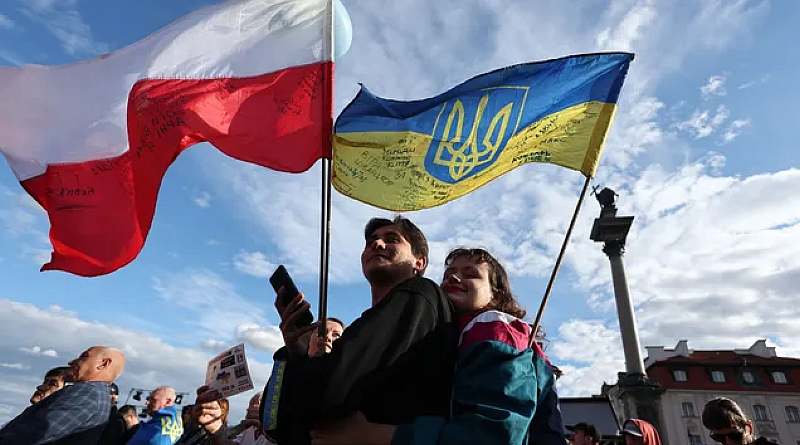
The unexpected escalation of Ukrainian-Polish relations following President Volodymyr Zelensky’s decision to name one of the military units after the Heroes of the UPA initially alarmed me with its surreal nature, which surpasses classic politics—though where can one find classic politics these days! Indeed, I was first surprised that the Order of the White Eagle became central in these events.
Unlike many who are currently debating with the Poles, I see nothing extraordinary in Warsaw’s official reaction. In my view, the diplomatic service of any country has the full right to politically evaluate the actions of a partner country, especially actions related to the latter’s interpretation of historical memory. The partner country can take these comments into account but is certainly not obliged to act upon them. This is an ordinary political signal: we perceive the past differently than you do. Moreover, I wish the Ukrainian Ministry of Foreign Affairs would react similarly when any country names objects or military units after individuals or formations associated with the murder of Ukrainians, anti-Ukrainian propaganda, etc. However, we must be aware that the world might have its own perspective on the value of these individuals or organizations for the historical memory of a particular country. This is civilized international relations practice.
The surreal situation begins with Polish President Karol Nawrocki’s threats to strip President Volodymyr Zelensky of the Order of the White Eagle. This is not an individual award for a specific person. In honoring Zelensky, Polish President Andrzej Duda honored all Ukrainians fighting the Russian invasion, transforming their country into a shield for Poland. Yes, it’s an honor for the Ukrainian president to receive such an award. But even more, it’s an honor for Poland that the president of a nation fighting against a common enemy accepted it. This order is not about Zelensky’s prestige; it’s about the prestige of the Order of the White Eagle. In awarding the Ukrainian president, the Polish president honored every Ukrainian soldier who will never return home or continues their fight for the future of Ukraine and Poland, every Ukrainian woman raising children under bombardment, every child learning lessons in an underground school. Is this not enough for you, my dear Polish friends? Do you not want to be part of this? I’m sure you do—the Polish assistance to Ukrainians and Ukraine was unprecedented. And now, the order!
The story’s further development seems even stranger. The Order’s committee held a meeting, and now we must await President Nawrocki’s decision on whether to strip the Ukrainian president of the order or not. The condition is to change the military unit’s name. Yet everyone understands that the decision to strip the order is an internal Polish affair that will not affect Zelensky—neither in domestic politics nor internationally. However, if Zelensky changes the unit’s name to preserve the award or maintain good relations with his Polish colleague, it will indeed become a domestic political issue for him. What can he choose?
I consciously do not discuss either the UPA or Volyn issues. This, like any heritage involving the deaths of thousands on both sides, is a topic for serious and important discussions. And not only historians but politicians too. I am discussing another historical issue of Polish politics—the inability to stop in time, the megalomania that prevents a realistic assessment of their capabilities and significance.
Ukrainians and Poles are united not by the Order of the White Eagle on the Ukrainian president’s chest but by the awareness of a common danger. If this awareness had been present during the times of the Polish-Lithuanian Commonwealth, perhaps Ukrainians and Poles together would not have fallen under Moscow.
Ukrainians and Poles are divided not by historical heritage. They are divided by the misunderstanding among many Polish politicians of the simple fact that if Ukraine loses, Poland will once again not survive, and no United States will help. Seriously, when we see the United States disregarding Israel’s interests to negotiate with Iran, is it hard to imagine what will happen if Poland finds itself in Israel’s place and Russia in Iran’s, having captured Ukraine?
It’s time to finally unite. We will still have the opportunity to discuss the complex past of the Polish and Ukrainian peoples if Poland and Ukraine remain on the political map of the future world. But even then, we must tell each other a simple truth: Ukrainians will not define the historical memory of Poles, and Poles will not define the historical memory of Ukrainians. We can debate, exchange assessments, but not expect the Ukrainian and Polish pantheons to converge. That’s why we must always remember those who worked for Polish-Ukrainian understanding even in dark times, and be proud of them.
By the way, I believe that these people also received their part of the Order of the White Eagle when President Duda awarded it to President Zelensky.
