
Yaroslav Trofimov, Wall Street Journal / Translation by iPress
The Wall Street Journal paints a disheartening picture for the great powers and shows how technological progress has undermined the traditional perception of their omnipotence: neither Russia was able to break Ukraine, nor the USA to force Iran into capitulation. According to the publication, in modern conditions, conquering a country whose citizens are ready to fight is practically impossible, regardless of the military potential gap. Thus, technological leveling of the battlefield is forcing China to revise its strategic calculations regarding Taiwan, and mid-sized powers such as Canada, EU countries, and Asian democracies are increasingly consolidating to resist the pressure of superpowers.
As technology equalizes forces between stronger and weaker countries, old-style expansionist wars seem to become impossible, writes chief foreign affairs correspondent Yaroslav Trofimov in the Wall Street Journal. It turns out that great powers have significantly less power than they imagined, he notes.
After coming to power last year, President Trump unapologetically promoted a vision of restructuring the international order around the US sphere of influence based on the principle of might makes right – a worldview not very different from that of Russia or China. The future seemed to be encapsulated by a line repeated for two and a half thousand years, originating from the ancient Greek historian Thucydides: “The strong do what they can, and the weak suffer what they must.”
As noted by the WSJ author, this phrase, originally placed in the mouths of Athenian aggressors who addressed the doomed inhabitants of the island of Melos in 416 B.C., took a prominent place in a speech by Canadian Prime Minister Mark Carney, which made waves at an international conference in Davos in January – at the height of Europe’s dispute with Trump over his plans to seize the Danish autonomous territory of Greenland.
But, according to Yaroslav Trofimov, it now turns out that the weak are not as weak as many thought. And the strong also cannot do whatever they please.
Despite significant expenditures of long-range munitions and the destruction of a significant part of Iran’s leadership, the US armed forces have failed to achieve a strategic victory over a mid-sized state like Iran. Tehran continues to block the Strait of Hormuz. The theocratic regime maintains firm control and the ability to fire missiles at Israel and the Gulf countries – the newest exchange of strikes happened this week.
As noted by the WSJ correspondent, Ukraine has not bowed down either. Trump stopped American aid over a year ago and exerted diplomatic pressure on Kyiv, seeking the surrender of the eastern Donetsk region – in line with his agreements with Russia at the August summit in Alaska. Despite this, Ukraine managed to turn the tide of the war against Russia: holding the frontline and delivering increasingly painful blows to Russia’s deep rear.
These events, as noted by the publication, have clearly demonstrated how technological progress—drones and significantly cheaper precision missiles—has leveled the playing field between small countries and major powers that spend hundreds of billions of dollars on their armed forces. “Ukraine stands on much firmer ground thanks to the technological advantage it has gained,” stated Latvian Foreign Minister Baiba Braže. This narrowing of the capability gap worldwide has limited what can be achieved through military force alone. China is closely observing these trends, contemplating whether it could seize Taiwan—and whether it should consider doing so.
Of course, the conflicts flaring up in different corners of the world are quite different in many ways. Ukraine is a democracy defending itself against Russia’s unprovoked invasion. Iran’s repressive regime has killed thousands of its own citizens even before the US and Israel began bombings in February, and has for decades supported armed proxy groups that destabilize the Middle East.
“However, all these wars carry a similar lesson,” said Italian Defense Minister Guido Crosetto. “The type of war we are used to, the type of war Russia had in mind in Ukraine—invading and occupying a country—is no longer conceivable. Wars last as long as a nation has resilience and the will to resist. Conquering a country whose citizens are ready to fight is impossible—even when there is a disparity in strength, as between Russia and Ukraine, or even more so between the US and Iran. It is difficult even for Israel, which has so far failed to overcome Hamas in essentially one city.”
Regime change—the goal of Russia in Ukraine and initially at least, America’s goal in Iran—can no longer be achieved solely by military force in the modern world, agrees the Chief of the Dutch General Staff, General Onno Eichelsheim. “Conquering such countries, having all the potential, whether the USA against Iran or Russia against Ukraine, is almost impossible,” WSJ quotes Eichelsheim. “And if you don’t succeed within the first two weeks—you fall into a positional quagmire from which it’s very hard to get out. If you want to achieve something, you have to act very, very quickly.”
As WSJ notes, the limitations of major powers’ capabilities are not new. Both Washington and Moscow have already suffered humiliating defeats in foreign wars. The US had to withdraw from Vietnam. Both states eventually were defeated in Afghanistan. The American experience of occupying Iraq is, to put it mildly, ambiguous.
However, according to Yaroslav Trofimov, in those cases, major powers withdrew due to prolonged and painful insurgencies that flared up after formal military victories and ultimately undermined domestic support for the war. The situation is now different. Four years of protracted war—and Russian tanks still have not reached Kyiv, and Russia’s advances on the battlefield have essentially halted. The US did not even dare to conduct a ground operation in Iran, fully aware of how many American casualties it would entail.
The revolution of drone warfare, triggered by the war between Russia and Ukraine, and Iran’s ability to create a large arsenal of precise long-range ballistic missiles have partially negated the colossal advantage of the United States in aviation and intelligence. The WSJ author believes that this has made a traditional tank breakthrough to Tehran unthinkable—like the American invasion of Iraq in 2003. The swift removal of Venezuelan dictator Nicolás Maduro in January, which at the time seemed like a harbinger of the future and sparked Trump’s appetites for Greenland and Iran, now appears more as a rare exception rather than a sign of future use of American power.
The publication emphasizes that China is closely watching all of this. “Before the war in Ukraine, people thought Russia was the second most powerful army in the world. Now, the strongest army and the ‘second army in the world’ are both involved in wars—and neither is progressing smoothly,” noted retired senior Colonel Zhou Bo, former director of the Security Cooperation Center of the Chinese Ministry of Defense, now a senior fellow at Tsinghua University in Beijing.
The main lesson for China, in his opinion, is to invite Russian experts and allow them to share their experience of modern drone warfare: “China is the largest producer of drones, but we truly do not know how to use them in combat conditions. Only those countries that have used drones on the battlefield can tell how effective they really are.”
The saying of Thucydides, which has long been an axiom of the so-called realist school of international relations, is a manifestation of crude fatalism rather than a guide to a much more complex reality, believes Singaporean scholar Bilahari Kausikan, who was the country’s ambassador to the UN. If it were true, he jokes, a small country like Singapore would have long been absorbed by its neighbors. “All countries have agency, even in difficult circumstances. But whether there is enough wisdom to recognize this agency and the ability to use it is another question,” WSJ quotes Kausikan.
Unlike Ukraine and Iran, Taiwan may not have the will to exercise this agency—as China is increasingly successfully undermining the population’s resolve to resist a possible future Chinese military operation. Having rejected the government’s rearmament program, the Taiwanese parliament, dominated by the opposition, in May approved a significantly smaller special defense spending package of 25 billion dollars, cutting, in particular, funding for the production of domestic drones and means of asymmetric warfare. The new opposition leader Cheng Li-wen visited Chinese leader Xi Jinping and took a much more conciliatory position towards Beijing, the publication writes, quoting the Singaporean scholar: “I tell my Taiwanese friends—without much success—that they have learned the wrong lesson from Ukraine. The lesson is not that democracies help other democracies. The lesson is that the Ukrainians helped themselves—and then others agreed to assist them.”
The Philippines is also embroiled in a dispute with Beijing and, if war breaks out, may face a similar problem of resolve to resist. “Our population is so shielded from the reality of conflict. What is taught is a passive, Gandhian culture of peace,” noted Philippine Defense Minister Gilbert Teodoro Jr. “But for it to make sense, a strong security and defense shell is needed to guarantee a political environment capable of defending all those who choose nonviolence.”
As noted by the WSJ, in his Davos speech, Carney, whose country Trump sometimes refers to as the future 51st state, argued that middle powers like Canada have no choice but to unite with similar countries to avoid “subjugation” by global hegemons. Since then, European countries, Asian democracies, and Canada have strengthened military, economic, and security ties—partially to reduce dependence on the US and China.
“If they unite, middle powers can oppose the large ones,” noted French political scientist Nicolas Tenzer. “None of them can do it alone, but together they have the leverage to impose solutions—whether militarily or legally within the framework of international law. There is room for action—although it does not mean it will be easy.”
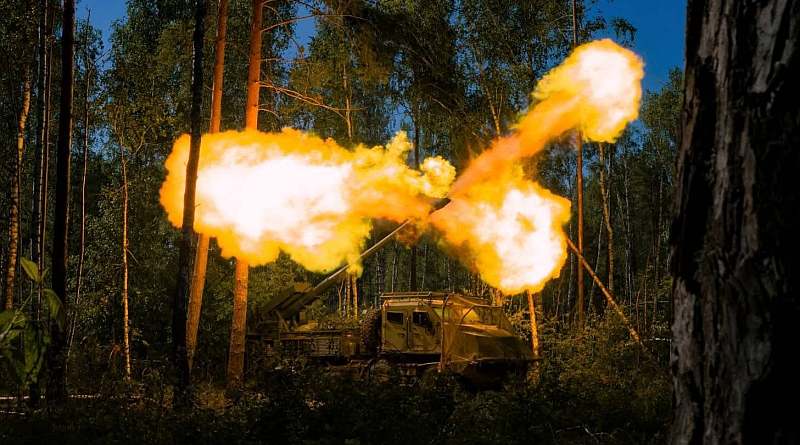
Photo: 15th Army Corps/Maxim Feofanov
