
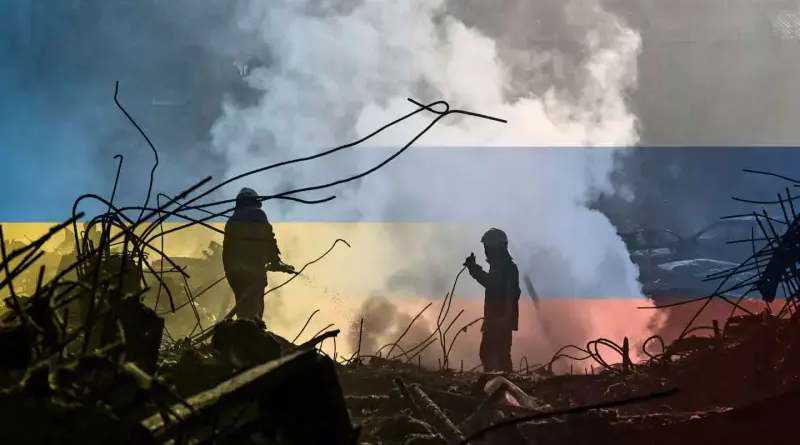

The timeline of Russia’s full-scale invasion of Ukraine has surpassed the grim milestone of 1,568 days, officially lasting longer than the entire First World War (1914–1918). For the Kremlin, which cultivated myths of “taking Kyiv in three days,” this figure is a catastrophic marker of strategic failure. Vladimir Putin, recalling the rhetoric at the SPIEF, still fundamentally avoids specifying any concrete timelines for the end of the so-called “special military operation,” dooming the people of his own country to an endless and inglorious war of attrition.
The comparison of the current conflict with the Great Patriotic War, so beloved by Kremlin propaganda, has finally lost its meaning. Structurally and psychologically, Putin’s invasion has become a direct analogue of the First World War with its classic positional stalemate. Global analytical centers, including CSIS and European defense institutes, state: the advancement of Russian troops on the front is now measured in dozens of meters per day. This is slower than during the Battle of the Somme in 1916. A technological breakthrough in the form of reconnaissance and strike drones has merely entrenched trench warfare, making any attempts at a large-scale blitzkrieg categorically impossible.
From the perspective of collective psychology, the analogy with the First World War is frighteningly accurate. The internal Russian slogan “War until the victorious end” at the beginning of the 20th century became a harbinger of the destruction of the Russian Empire. Today’s Kremlin tries to avoid collapse, similar to the tsarist regime, using totalitarian tools like draconian Criminal Code articles on “discrediting” the army. However, these measures create only a fragile imitation of public loyalty. Fear has replaced submission, as deep fatigue and “exhaustion” from the war grow within Russian society just as they did a hundred years ago.
Putin’s main problem is the inability to clearly articulate the concept of “victory.” A classical triumph with a flag over the Reichstag in the 21st century is not foreseen. In theory, victory should result in the improvement of the state’s strategic position compared to the pre-war level. But the Kremlin’s actions have led to directly opposite results. Putin’s military and intelligence services have completely failed the key declarative goals of the war.
The oft-repeated “demilitarization” of Ukraine has turned into a security collapse for Russia. A high-tech adversary has formed on Russia’s western border, capable of regularly striking military and industrial targets with missiles and drones up to the Urals. Considering Ukraine’s accelerated development of its own medium-range missile systems, Russia’s vulnerability zone expands further east—a scenario that was not even hypothetically considered before 2022!
Simultaneously, “denazification” has turned into an existential failure. Instead of “liberation,” Putin’s army has brought destruction, ensuring mutual hatred and a colossal charge of defensive ideological support for Ukrainian society for generations to come.
The current deadlock dynamics make the prospect of a “second half” after a conditional freeze almost inevitable.
Putin is stuck in a historical trap: declaring the end of the war without real achievements is tantamount to admitting defeat, while continuing the carnage means endlessly burning the country’s economic and demographic resources for meager territorial gains.
The strategy of Putin’s Kremlin has boiled down to a banal stalling in the hope of a miracle, turning Russia into a hostage of one man’s ambitions, who does not know how to exit the very meat grinder he launched.
