

The political landscape of Eastern Europe resembles a powder keg, where Alexander Lukashenko is enthusiastically waving lit matches. His recent statements about being ready to use tactical nuclear weapons (TNW) against Poland, Ukraine, and the Baltic states sound not just like another round of propaganda, but are a symptom of the deep degradation of Belarusian state sovereignty and a dangerous challenge to global security.
For a long time, the status of a non-nuclear state was a cornerstone of Minsk’s foreign policy. However, the 2022 referendum effectively legalized the deployment of Russian TNW on Belarusian soil. Belarus ceased to be a non-nuclear state, voluntarily abandoning international guarantees in exchange for the dubious role of a “nuclear outpost” for the Kremlin.
This decision transforms the country from a potential mediator, as Minsk attempted to appear in 2014-2015, into a direct military target.
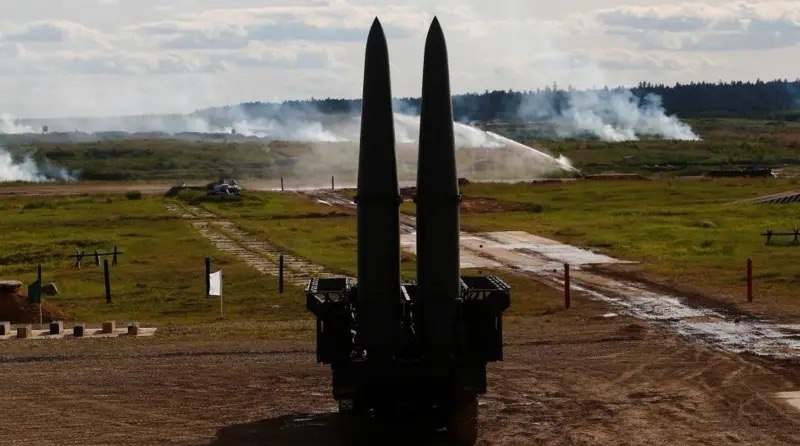
It is evident that Lukashenko’s aggressiveness is not an independent activity. Moscow actively fuels this militancy, using the Belarusian leader as a “talking head” to voice the most radical threats that the Kremlin is still uncomfortable broadcasting directly. The transfer of Iskander-M systems and the conversion of Belarusian aircraft for nuclear charges are precisely the tools not controlled by Minsk, but by the Russian General Staff. Lukashenko is merely the administrator of the “platform.”
Putin’s military adventure against Ukraine from the very beginning made the Belarusian side a full-fledged accomplice. Providing territory for the attack on Kyiv in 2022 was just the first step. Now, by playing the “nuclear card” against Warsaw, Vilnius, and Tallinn, Lukashenko finally binds the fate of his regime to the outcome of Russian aggression. For Poland, this means the necessity of accelerated rearmament. While for the Baltic states, it creates a demand for the permanent presence of NATO nuclear forces in the region.
The authoritarian regimes of Russia and Belarus create a dangerous precedent of eroding the nuclear non-proliferation regime. When nuclear weapons are used as a tool for everyday blackmail of neighbors, the entire security architecture built after the Cold War crumbles. This signals other dictatorships: “A nuclear club is the best way to make neighbors fear you.”
However, the most important analytical conclusion: Lukashenko’s nuclear blackmail itself serves as evidence of weakness. After more than four years of exhausting Putin’s war, the resources of the Russian army are not limitless. The threat of TNW emerges precisely when conventional forces are insufficient to dictate conditions.
Lukashenko also understands, looking at Russia’s entanglement in Ukraine, that his own armed forces are incapable of a large-scale operation against the technologically superior NATO forces or the battle-hardened Ukrainian army.
When arguments run out, and the economy is sustained by Russian subsidies, the only thing left is to frighten the world with a “red button” that he doesn’t even own.
Belarus’ aggressive rhetoric does not make it stronger. On the contrary, it highlights its isolation and turns it into a hostage of the Kremlin’s ambitions. Poland, Ukraine, and the Baltics take these threats seriously, but the response will likely be not appeasement of the aggressor, but further isolation of the regime and the strengthening of NATO’s eastern flank.
In the cover image: “Iskander” launcher. Photo: Occupant media
