
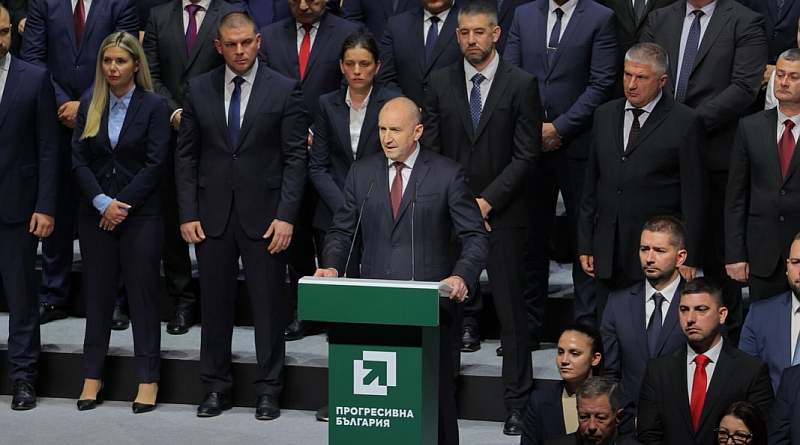

Rumen Radev has won. He won convincingly—his party, for the first time in many years, gained a real majority in Bulgaria and can form a government without coalition deals. For a country where governments changed almost every six months, this in itself is an event.
Radev has already been hastily called the new Orban. This is understandable—his pro-Russian sympathies are well-known, and his desire to find a common language with Moscow has never been a secret. But the comparison does not work, and here is why.
Orban could afford to be Orban because he had a constitutional majority and did not need anyone. Radev does not have it. To implement any serious reform—even to replace the chief prosecutor—he needs the support of the pro-European forces from the “We Continue the Change”-“Democratic Bulgaria” coalition. These are the people who, in the first months of the Russian invasion, helped Ukraine when their party was in power. They remember this. And Radev understands this too.
There is another factor that is somehow talked about less. The Bulgarian economy lives on European money. Not abstractly—specifically, from EU funds. And a person who wants to change something in their own country, not just sit in a chair, must take this into account. Fico in Slovakia is forced to cooperate with the far-right to retain power—and that is why he is more capricious in relations with Brussels than he would like to be. Radev will have no far-right partners at all. The pro-Russian “Revival” party, which until now had influence in parliament, has effectively flown out of big politics this time.
Thus, Radev finds himself in a situation where his foreign policy sympathies are known to all, but he cannot realize them. No constitutional majority, no pro-Russian allies in parliament, no possibility to ignore Brussels. He will have to be more cautious than Orban, more cautious than Fico—and meanwhile, answer the question immediately posed to him: what exactly does he offer Bulgarians, apart from sympathies towards Moscow?
And here is one detail that should not be underestimated. The Bulgarian military-industrial complex is practically working for Ukraine. It’s business. Real money. And no pro-Russian politician—we have seen this many times—has been able to go against the interests of their own industrialists and ban them from this sale. Radev will be no exception here.
So triumph is triumph. But Bulgaria did not choose Orban. It chose a person who may have wanted to become Orban but cannot.

Bulgarian citizens went to the polls for the eighth time in the last five years. This prolonged political series, a consequence of a deep institutional crisis and corruption scandals, has taken on special geopolitical significance this time. Analyzing the current campaign through the lens of data from Bulgarian sociological agencies such as BTA and Trend, as well as reports from Western think tanks, it becomes clear: Bulgaria has turned into the main proving ground for Russian hybrid expansion in Eastern Europe.
The main sensation of the April 19 elections was a new political formation centered around President Rumen Radev. According to exit polls and preliminary forecasts from the Trend agency, this movement is gaining about 32.7%, significantly outpacing the traditional leader — the center-right GERB-SDS bloc (20.4%).
Western analysts link the rise of forces oriented towards Radev not so much with their positive program, but with a certain voter fatigue from the “Euro-Atlantic” instability and skillful exploitation of pro-Russian sentiments. In a context where Bulgaria remains one of the poorest EU countries, slogans of “neutrality” and “protecting national interests from Brussels’ dictate” fall on fertile ground.
A critical analysis of this election campaign is impossible without mentioning Moscow’s unprecedented interference. According to the Bulgarian Center for the Study of Democracy (CSD), the activity of the Russian disinformation network reached its peak in the period leading up to the voting day.
The “Truth” project (part of the large-scale “Portal Kombat” operation) generated up to 6,000 manipulative articles in Bulgarian per month. The Kremlin uses a specific “content flooding” tactic to discredit pro-European coalitions as “agents of foreign influence”; to scare the population with the possible embroilment of Bulgaria in the conflict through aid to Ukraine; to artificially inflate the topic of “Ukrainian interference” in Bulgarian elections.
Moscow’s actions in Bulgaria are not just about supporting ideological allies but are a targeted destruction of statehood. The core of the Russian approach here lies in the use of a “managed chaos strategy.” Instead of offering Bulgaria a development model, the Kremlin invests in its stagnation.
As local observers say, Russian influence in Bulgaria does not come on tanks — it “seeps through the cracks” in the system: corruption, weak law enforcement, and questionable media resources. Moscow consciously supports the paralysis of the Bulgarian parliament because a weak NATO and EU ally is more advantageous to the Kremlin than a stable democratic state.
Moreover, against the backdrop of Viktor Orban’s political decline in Hungary, Moscow is clearly betting on Bulgaria as the new “Trojan horse” within the EU. If Radev succeeds in forming a government, Bulgaria risks becoming the main voice against anti-Russian sanctions and blocking further integration of Ukraine into European structures.
The elections on April 19 are not just about the distribution of seats in the 52nd National Assembly. They are a test of the resilience of Bulgarian democracy in the face of external pressure. Russia’s policy towards Sofia is deeply cynical: appealing to “historical friendship,” Moscow actually hinders the country’s modernization, keeping it in a zone of energy and information dependency.
For Bulgaria, the path to stability lies not in seeking a “new savior” with pro-Kremlin rhetoric, but in dismantling the corrupt schemes that make the country so vulnerable to external manipulation. The results of today’s vote will show whether Bulgarian society can recognize manipulation before the Kremlin’s “soft power” turns into a hard geopolitical trap.
