

Information on the current losses of Russia due to sanctions as of 04/14/2026.
1. Our drones attacked industrial facilities in Russia’s Vologda region on the morning of April 13.
– The target of the attack was the nitrogen complex of the Cherepovets enterprise “Apatit,” which is part of the chemical holding “PhosAgro.” It is one of the key centers for phosphorus fertilizer production in Russia and the largest such production site in Europe.
– According to open sources, the strike may have hit the ammonia production of the enterprise “Cherepovets-Azot,” located in the same industrial area. This is the second attack on this industrial site in the last month. The previous strike on the enterprise was recorded at the end of March.
– According to separate estimates, there may have been at least two hits on production facilities during the current attack.
– The Cherepovets chemical cluster is one of the largest centers for mineral fertilizer production in Russia. In addition to phosphorus products, they produce sulfuric acid, ammonia, and ammonium nitrate — dual-purpose substances that can be used not only in the agricultural sector but also in the military-industrial complex.
– Attacks on such enterprises have strategic significance as they strike the infrastructure supporting not only the export of fertilizers but also the supply of chemical components for Russian industry.
2. The export of Russian oil through Novorossiysk, Russia’s largest oil port on the Black Sea, remains restricted after Ukrainian drone strikes on port infrastructure.
– As seen in satellite images, at the “Sheskharis” terminal, two key berths No. 1 and No. 1a, which handled the bulk of oil transshipment, are still not operational and remain empty. Currently, shipments are carried out only through berth No. 2, which is designed for smaller Aframax class tankers with a deadweight of up to approximately 105.5 thousand tons.
– For comparison, berths No. 1 and No. 1a could accommodate both Aframax and significantly larger Suezmax class tankers with a deadweight of 170–242 thousand tons. This means the current capacity of the port for oil export is significantly reduced. Meanwhile, transshipment of oil products continues at berths No. 6 and No. 7.
– In the first quarter, about 540 thousand barrels of oil per day were exported through Novorossiysk on average, making it a key hub for Russian supplies through the Black Sea.
– After the latest attack, which happened about a week ago, shipments at the port were completely halted for several days. The Ukrainian side claimed damage to mooring equipment on at least five berths and elements of the pipeline infrastructure.
3. War and taxes are pushing small businesses in Russia to collapse.
– The increased tax pressure amid the war sharply worsens the position of small and medium businesses in Russia. Raising VAT from 20% to 22% and simultaneously lowering the threshold for its application have effectively placed hundreds of thousands of enterprises on the brink of bankruptcy.
– Despite temporary growth in energy revenues, a significant portion is directed towards financing the war, limiting the ability to support the economy. As a result, Russia’s budget deficit in the first quarter of 2026 alone doubled to 4.57 trillion rubles, surpassing the annual plan.
– The situation already has direct consequences for businesses: about 6% of entrepreneurs have closed their companies, and only a quarter maintain confidence in the future. Nearly half of entrepreneurs report worsening financial conditions, and one in five reports loss of savings.
– An additional blow was the curtailment of state support programs. According to experts, resources are being reallocated to military needs, leaving the civilian sector without necessary funding.
– As a result, small businesses, which are the foundation of the domestic economy, are under double pressure from taxes and decreased demand. This increases the risks of a wave of bankruptcies and further decline in entrepreneurial activity in Russia.
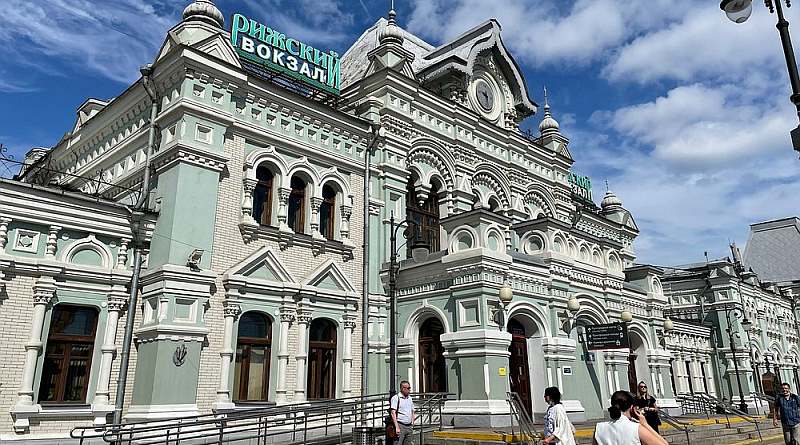
4. RZD sells a station in Moscow through “Avito” amid financial problems.
– The Russian state monopoly RZD has put the Riga station in Moscow up for sale for 4 billion rubles, posting the announcement on the “Avito” platform. This involves a historical site from the early 20th century, which has practically ceased being used for its intended purpose.
– The lot includes the station building from 1901, auxiliary facilities, and a land plot of over 13,000 sq. m. RZD explicitly states that the site has long been unused for passenger transport and is offered for “new operational purposes.”
– The sale of a significant infrastructure asset occurs amid the company’s sharply deteriorating financial condition. RZD’s debt has grown from 3 to 3.8 trillion rubles in a year, with servicing costs exceeding 500 billion rubles. Meanwhile, net profit collapsed 22 times—to only 2.3 billion rubles.
– An additional factor has been a decline in freight transport, undermining the company’s primary revenue source. As a result, RZD is forced to sell assets, including those previously considered part of strategic infrastructure.
– The sale of the station through a mass online platform underscores the depth of the problems: even state giants are resorting to emergency measures to patch financial holes, indicating systemic pressure on Russia’s economy.
5. Russia spent trillions to bypass sanctions, but economic losses only increase.
– After the start of the full-scale war, Russia spent about 10 trillion rubles ($130 billion) to circumvent Western sanctions. This is stated in a report by Latvian intelligence, which refers to internal, non-public assessments by Russian agencies themselves.
– Every year, Russia is forced to spend over $30 billion just to obtain goods that it used to buy much cheaper and directly before the war. These expenses do not account for losses from undelivered imports — meaning the real cost of sanctions is even higher.
– Sanctions have already led to the systemic degradation of key export industries. From 2021 to 2025, iron ore supplies fell by 40%, ferrous metals by 20%, chemical products by 35%, and wood and pulp by 50%.
– Even according to internal forecasts by Russian officials, these losses cannot be compensated for in the coming years. By 2030, Russia’s foreign trade is expected to decrease annually by about 5%, and total losses could reach $175 billion.
– The biggest impact comes not only from direct sanctions but also from secondary restrictions against partners, trade barriers, and tariffs. Despite this, Russia’s official rhetoric remains the opposite: the authorities continue to claim “successful adaptation” of the economy.
– Meanwhile, according to intelligence estimates, internal reports intentionally downplay the scale of the problems, leading to a distorted perception by the country’s leadership about the actual situation.
– As a result, a paradoxical situation arises: the state spends enormous resources on circumventing sanctions, loses key markets and revenues, but continues moving in the same direction, ignoring the accumulation of structural problems in the economy.
6. Russia’s oil revenues have sharply increased, but due to external factors and with limitations.
– Russia’s revenues from oil and oil product exports in March 2026 jumped to $19 billion, an increase of $9.3 billion in a month. However, this growth is situational and does not indicate a sustainable recovery of the energy sector.
– The key reason was the sharp rise in oil prices amid the war between the US and Israel with Iran and issues with tanker passage through the Strait of Hormuz. The price of Russian Urals oil rose by more than $30 per barrel in a month — to over $75.
– At the same time, physical export volumes increased slightly: combined oil and oil product deliveries added only about 0.3 million barrels per day. This means that the main increase in revenues was ensured not by increased sales but by external pricing conditions. Furthermore, even amid increased production, Russia remains below its own quota within OPEC+, lacking over 0.6 million barrels per day. This indicates limited capacity for rapid production increases.
– Additional restraining factors include attacks on port and oil and gas infrastructure, which complicate logistics and increase export risks.
– Thus, despite the short-term revenue growth, Russia’s oil sector remains dependent on external crises and price shocks, as well as facing limitations in production and export infrastructure. This makes the current improvement unstable and vulnerable to changes in the global market.
7. After the defeat of Hungarian Prime Minister Viktor Orban in the parliamentary elections, EU leadership called for using the political moment to change the decision-making mechanism in foreign policy.
– The President of the European Commission, Ursula von der Leyen, stated that the EU should shift from the principle of unanimity to qualified majority voting. According to her, such a reform would help avoid situations where individual countries block key Union decisions.
– This particularly concerns sanctions against Russia, support for Ukraine, and other foreign policy measures that have previously been repeatedly delayed due to the veto rights of certain governments.
– Von der Leyen emphasized that transitioning to a qualified majority system would help eliminate structural obstacles that have complicated the formation of a common EU position in recent years.
– She urged the member state governments to seize the current political moment and begin working on changing decision-making procedures. In recent years, the position of the Hungarian government has repeatedly caused difficulties in agreeing on new sanctions against Russia and financial aid packages for Ukraine.
– A potential abandonment of the veto right in foreign policy could significantly weaken the ability of individual states to block EU decisions, which would have direct consequences for further sanction pressure on Moscow.
8. The head of the Italian energy company Eni called on the European Union to postpone the planned ban on importing Russian liquefied natural gas (LNG).
– According to him, a complete refusal of supplies from Russia could create additional pressure on the European gas market in the coming years. The EU has already agreed on a gradual restriction of such imports: as of April 2026, restrictions on short-term contracts are to be in effect, and a full ban on Russian LNG supplies is planned for 2027.
– However, geopolitical risks complicate the market situation. Italy remains heavily dependent on gas generation. A significant portion of the country’s electricity is produced at gas-fired power plants, while domestic nuclear energy is absent, and the share of renewable sources is still insufficient for a complete replacement of fossil fuels.
– Despite such statements, the EU maintains a strategic course towards the gradual abandonment of Russian energy resources. Losing the European market could be a serious blow to Moscow.
