
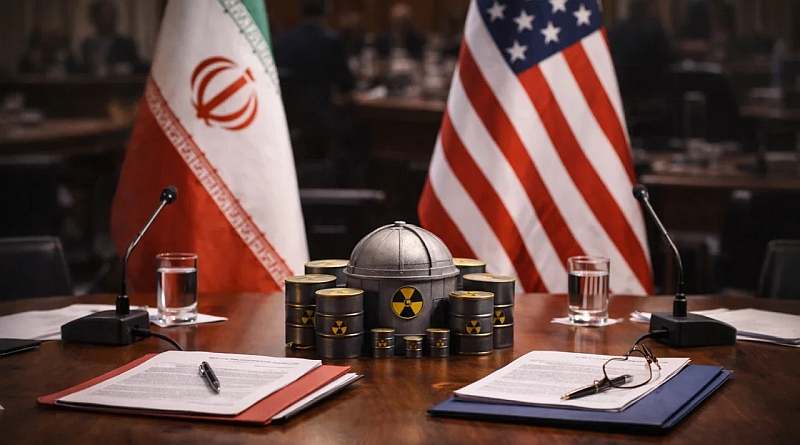

Global geopolitics has once again felt a tectonic shift that seemed impossible just a few days ago. While analysts in Washington and Jerusalem debated the scale of imminent strikes on the “Iranian civilization,” Donald Trump made a “180-degree turn” in his signature style. Instead of “fire and fury,” the world got the “Islamabad Agreement,” an unexpected deal that changes the rules of the game not only in the Middle East but also, it seems, in the corridors of the Kremlin.
President Trump, who in March threatened to wipe Kharg Island off the face of the earth, has once again demonstrated that foreign policy is something like a business case for him. The US leader made a deal after receiving an Iranian “10-point proposal.” Trump pragmatically assessed the risks of a protracted war, which could bury his campaign promises of a stable economy. Announcing a “bilateral ceasefire” on Truth, he essentially acknowledged that bargaining with Tehran is more beneficial than fighting. For Moscow, which hoped for full US entanglement in the “Iranian quagmire,” this was the first cold shower.
The main sensation was who exactly lit the torch of peace. Not Brussels, not Beijing, and certainly not Moscow. Islamabad took on the role of the “new Geneva.” Prime Minister Shahbaz Sharif and General Asim Munir demonstrated impeccable diplomacy, becoming the only working communication channel between Trump and the ayatollahs. Pakistan did not just “pass a letter”; it developed the framework of an agreement ensuring the opening of the Strait of Hormuz for shipping. As noted by Arab media, this success by Pakistan nullified Russia’s claims to the role of a key mediator in the region.
The economic impact of the truce was immediate. The oil market reacted to the news of the opening of the Strait of Hormuz with a collapse in oil prices. The price of Brent, which had recently been approaching $115, fell below $95 per barrel. Forecasts indicate that the return of Iranian oil to the legal market marks the end of the era of super-profits from the black gold shortage. For the Russian budget, designed under conditions of military inflation and high energy prices, this signal means inevitable spending cuts.
In Moscow, they are literally biting their elbows at what they have seen. The Kremlin has lost on all fronts in this situation. Russia experienced a loss of leverage, as Iran, starting dialogue with the US, no longer needs Moscow as its sole “advocate” and supplier of intelligence. It is telling how Trump openly and cynically rejected Putin’s offer of mediation, advising him to “focus on Ukraine instead.”
The entire calculation that a war in the Middle East would divert Western resources from Kyiv has crumbled. On the contrary, Washington is freeing its hands, and the “axis of evil” is cracking in the most crucial place. Iran is becoming “the beginning of the end of Russian influence in the Global South.”
Tehran chose the path of survival through a deal, leaving Russia alone with international sanctions and a protracted war against Ukraine. The trap snapped shut: an ally, much relied upon by Putin, on whom Moscow previously bet everything, chose pragmatic peace, leaving the Kremlin in the role of an outside observer of others’ success.

Well, that’s good. For a while, because nothing is over.
I’ll repeat what I wrote a couple of days ago.
1) The likelihood of agreements in the Persian Gulf remains high, regardless of what is posted online. Trolling Trump on Twitter is one thing; clearing the rubble on the ground for years after aerial bombardment is another.
2) It is beneficial for us that agreements happen. And quickly. With a small clarification: they should not overly disadvantage Europe while it is our rear.
Now, to the essence of the moment.
Many comments on the unfolding events are based on an emotional attitude towards comrade Trump. And this is somewhat justified when it comes to the political aspect. But it is categorically incorrect when the focus is on military outcomes.
In this case, preferences must be set aside, and the stopwatch, caliper, and scales should be taken up. Then, what is blurred by noise in the perception of the general public begins to emerge.
1. Let us recall what Trump and his specially trained Hegset promised in January 2025 when they reached the helm.
The main KPI for the American military machine was established as lethality. Not gender equality. Not human rights. Not “values.” But literally the ability to bring death. To decide where and how much death Washington directs.
In one year, the U.S. military conducted 3 widely known campaigns abroad (and several smaller operations: in Ecuador, increased “advisors” in Nigeria, etc.) and is currently conducting the fourth.
The first campaign was relatively unsuccessful. It took place exactly a year ago (though not everyone will remember it). This was the strike on the Houthis.
Relatively unsuccessful in that an excessively disproportionate force was concentrated for the annihilation of the Houthis. Like chasing an ant with a log, they got tired and did not fully catch up. The Houthis did not disappear but suffered significant losses and did not create any particular problems for a whole year.
The main failure of that period was the political scandal with the addition of a journalist to the chat. This led to the relegation of National Security Advisor Michael Waltz to the UN and a couple of months of turbulence for Hegset. But he held steady because he remained firm and kept to Trump’s line.
The second campaign was very successful and extremely demonstrative. The USA and Israel bombed Iran for 12 days. The Pentagon deliberately structured the operation so that everyone in the world could see: America can, from ITS own territory, at any moment fly to any point in the world, bomb everything it wants, and leave. They deliberately highlighted global dominance.
Now, the Pentagon knows a lot of practical nuances. How much time is needed for preparation. What resources are required. How much it all cost. What went off plan (we don’t know, but they do).
The third campaign was also successful and allowed them to test new options. The Americans concentrated their forces, created informational fog, secured agreements with traitors, and conducted an operation to evacuate comrade Maduro.
Now they know how much time is needed for preparation (a month). What forces, what levers. What went better/worse than planned.
So, at least twice, the American military has already demonstrated outstanding results with minimal costs.
2. The fourth campaign is in its active phase, but there is already a lot of information for analysis in the headquarters of major military powers.
The USA concentrated their forces for a month. Then conducted an operation over 5 weeks (in early March, the military cycle was announced as 5-6 weeks). They brought it to the stage of (pre)ground invasion with expanded targets for aerial attacks. They obtained continuation options. And in the process, they also extracted a pilot from the deep enemy rear (even the most stubborn dear Russians laugh at the question, “Can Russia do that?”).
Experience has been gained that cannot be bought. Costs are counted, mistakes are being analyzed.
Note, all this happened under friction (and interference) with Europeans. This will also lead to conclusions.
Now everyone sees. The USA needs:
1) political will to project power (by one procedure or another);
2) a month for preparation;
3) a specific set of troops (which is known and available);
4) $30 billion to set back an enemy the size of Iran for years.
Count on the fingers of one hand how many such potential adversaries there are in principle. And what smaller adversaries must feel.
That is, regardless of what politicians shout in broadcasts and on Twitter, if the American military machine is set in motion, a predictable result is possible in a month.
And everyone will now proceed from this. Not from the fact that the Minister of War is a tattooed alcoholic with unclear intellectual abilities and questionable personal qualities.
Imagine that tomorrow Trump goes off to play golf, Vance stays in Hungary forever breeding gray cows and making Tokay. And the control falls into the hands of someone more appealing for Trump’s opponents. A hypothetical Gavin Newsom, who appoints someone with brilliant training and the highest reputation as Secretary of Defense (renaming the Pentagon).
Will Newsom release Maduro and leave Venezuela? No. Will something from the battle-tested moments disappear? (timing, resources, tactics, etc.). No. These insights are now in the American arsenal. And “Newsom” will have the same set of troops and the same $30 billion to terrorize the ayatollahs. Hegset will disappear, but the deadly machine will remain.
3. Negotiations will certainly give us a lot of emotions. For example, Israel may contest some options on Lebanon, Houthis, etc. There might be provocations.
But write it down.
First, who exactly did the Israelis and Americans knock out in Iran?
There are several good images on this topic online. They eliminated pillars of the ayatollah regime and IRGC representatives. Iran’s army is virtually untouched. The President and government of Iran are intact, slightly bruised.
I believe this is not just a characteristic of Iran but also a lesson learned from the Iraq war, where the Americans barged in and created chaos. From which ISIS later emerged.
Washington trims the most contentious force but leaves the supports that the Iranian structure can lean on in case a decision to genuinely negotiate is made. If they trigger a widespread conflict, those supports will be cut too.
Secondly, what do the participants of the war know now?
The Americans saw where the limits of maneuvering with European partners are and what advantages Iran holds. They will take note.
The Iranians saw that in a random month, the US will be ready to knock on their window again. And this is certainly faster than the period needed to restore at least part of their defense potential.
The US can fly into Iran twice a year with the question, “how’s it going?” And each time, they can push the regime several years back until irreversible consequences begin for them.
Thus, the motivations to negotiate, despite the rhetoric, are more than substantial.
Therefore, it doesn’t matter if the US agrees to recognize Iran’s right to peaceful nuclear power or not. They will celebrate 250 years and a month later will be ready to break in again.
In Tehran (Beijing, Islamabad, Ankara, capitals of monarchies), they will proceed from this logic. And plan their actions. For example, Iran will definitely (with the help of Russia and China) accelerate the saturation of the country with MANPADS.
4. It is important for us that the signal reached the US, and it needs to be consistently reinforced.
Russia helps to kill American soldiers by providing Iran with intelligence (just as it helped to kill Americans in Afghanistan). And it will continue to do so as long as it possesses space technologies and the relevant infrastructure on the ground. The practical task is to undermine these capabilities while the regime of angry old men rules in the Russian Federation.
Russia trains dictators and terrorists worldwide in modern warfare using drones. This is clearly evident in the Persian Gulf and Lebanon. At any point where the US or its partners attempt to act by force, they will face such resistance.
This technological and knowledge mix can no longer be undone. But it is possible to sharply reduce Russia’s capabilities in this segment by effectively controlling sanction enforcement and destroying production facilities.
Then, the Russians will not be able to significantly help their enemies technically (for example, by shipping several truckloads of drones via fiber optics), nor will they be able to bribe another African country. And if the “African Corps” suddenly receives some gifts on its head, brown lines will be drawn – that’s a no-go.
I will not discuss the economic consequences of de-escalation for Russia; there are plenty of texts already. Plus, it is somewhat premature. But I will highlight the main lesson that should be learned.
There are opportunities for Russia to receive super-profits, which Russia does not control (i.e., is unable to incorporate into planning). One can react to this with dramatic hand-wringing. Being tactically upset.
There are partially burned ports and refineries. Which is tactically pleasing.
And there is the very opportunity to regularly ignite these ports and refineries. This forms a trend transitioning into strategy. This is the main point.
Ukraine has grown the ability to ignite Russian ports at CHOSEN TIMES, breaking through defenses, not relying on luck.
Russians, like Iranians, are not fools. They know how to identify what’s important. Tehran sees the story as “a month + 30 billion = local chaos.” Meanwhile, Russians see the dynamics of long-range strikes, against which they currently have no antidote. And this will affect their behavior.
You can bombard the ruins of a hypothetical Konstantinovka with Russian soldiers’ bodies, but during this time, you’ll end up with shattered ports, crippled chemical plants, and instability in the energy system. And this is not speculation – this is becoming measurable.
Such is the Strait of Hormuz, fellow citizens.
