
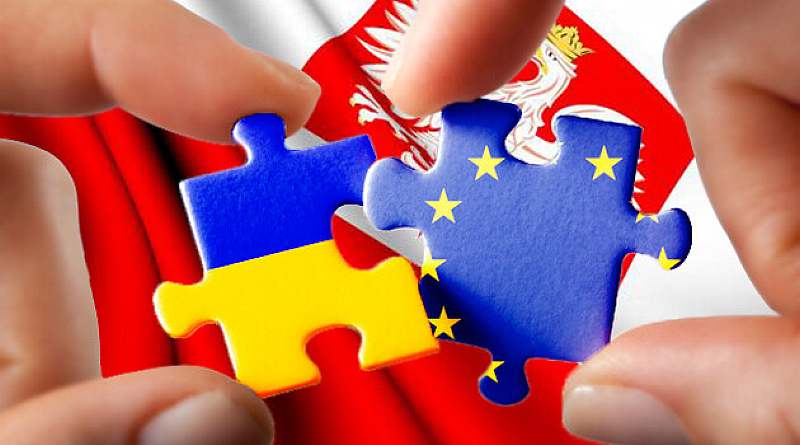
The majority of Ukrainians support Ukraine’s accession to the EU. Przemysław Żurawski vel Grajewski, a Polish political scientist from the University of Łódź and government advisor, emphasizes that the European Union, strained by four crises, is not ready to ‘swallow’ a large war-torn country. It is pragmatic to look at Brussels, the expert believes: take money from Europe, build infrastructure, adopt standards, and not lull oneself with tales of a quick paradise.
Consequences of four crises
— Volodymyr Zelensky called on the EU not to procrastinate and to set a specific date for Ukraine’s membership — 2027. Is such a prospect realistic?
The European Union is currently not fundamentally ready for a large expansion. Theoretically, it could accept small and wealthy countries, such as Norway or Switzerland. But Ukraine is a different scale of challenges for the leading European countries and their voters.
Contemporary international politics no longer works on the principle that ‘national governments will agree.’ Every decision needs to be explained to their societies and also win the next elections.
— So does the position of society play a key role?
Exactly. And European sentiments are defined by the consequences of four major crises in recent years.
The first is the eurozone debt crisis (several EU countries could not repay their state debts. — Ed.). It affected not only Greece but also Portugal, Spain, Italy, and other countries. The EU was able to support relatively small Greece, but not others, due to larger economies and greater risks.
Within the EU, two conditional camps have formed. The first is the ‘frugal’ countries led by Germany and the Netherlands, which are cautious about financial solidarity with neighbors. Their argument is simple: taxpayers do not want to cover others’ debts.
The second camp consists of the southern countries that advocate for greater financial support and partial debt sharing by everyone. This idea is actively promoted by France. Germany does not support it because it is politically unacceptable for German voters. As a result, limited decisions are made.
This creates tension between economically stronger Germany, weakened France, and indebted southern countries.
The second crisis is migration, which hit southern countries the hardest: Greece, Italy, Spain.
The third is the COVID-19 pandemic, again, particularly affecting the South.
The fourth crisis is Russia’s war against Ukraine. It hit Germany especially hard. Berlin lost access to cheap Russian gas. The European Union is divided into a ‘peace camp’ and a ‘justice camp.’ Germany and France advocate for a quick truce with Russia, even at the cost of territorial concessions from Ukraine. Poland, the Baltic states, and Scandinavia advocate for war until victory because an unpunished Russia will resume aggression. This division is not as sharp today, as it intersects with the division in the attitudes of different European countries towards US policy.
— What is the prospect of Ukraine’s accession to the EU under these conditions?
This is one of the most complex questions. By the way, the situation was complicated by the UK’s exit from the EU, as it traditionally supported the expansion of the European Union.
Instead, Germany and France prefer deepening integration rather than expansion. This position largely reflects the sentiments of their societies.
At the same time, Germany, as an export economy, faces weakening markets in Southern Europe and is forced to seek new markets outside the EU. Therefore, Berlin has been trying to develop cooperation with China. This should be considered.
Centralization and Blackmail
— Speaking about Warsaw’s policy, does the current political atmosphere in Poland create additional problems for Polish-Ukrainian relations, which are already barely surviving?
Unfortunately, a psychological situation has developed in Polish politics where supporting Ukraine can cause electoral losses for a politician. From the perspective of state interests for both Poland and Ukraine, this is a very dangerous trend.
— Does this mean Poland could easily become an obstacle to Ukraine’s path to the EU?
This is precisely what must be avoided. Otherwise, the responsibility for halting Ukraine’s European integration will be fully placed on Warsaw. There will be interested parties to divide us.
— And what is the real issue?
The real problem lies elsewhere. Ukraine is a large country, additionally greatly damaged by war. The scale itself complicates its accession to the EU. Similar discussions were held regarding Turkey. Some countries, including France, even foresaw a mechanism of referendums on the accession of large states (the President of France, according to the Constitution, is obliged to put this issue to a referendum, although the parliament can bypass the procedure with 3/5 votes. — Ed.).
Meanwhile, the European Union has powerful tools to influence candidate countries through access to financial aid. Just as with countries within the EU. For example, the Next Generation EU fund (an economic recovery instrument for EU countries totaling €806.9 billion, created in response to the crisis caused by COVID-19; funds are directed towards energy efficiency, digital transformation, public administration reform. — Ed.) can provide favorable joint loans to such countries as Greece, Italy, or Spain. In this model, the European Commission determines when and to whom to allocate funds. Poland has already faced delays in funding due to its political disputes with Brussels.
Ultimately, the trend towards centralization of the EU is strengthening — largely under the influence of the largest countries, primarily Germany.
I always advise Ukrainians: look at Europe with your own eyes, not just through Polish, German, or American lenses.
Returning to EU expansion, the main discussion today revolves around Ukraine. There are also Western Balkan countries: Montenegro, Kosovo, North Macedonia. But these are small states, and their accession does not pose large-scale challenges.
— Which countries are more interested in Ukraine’s accession to the EU?
These are the Baltic countries, Poland, part of Northern Europe, and to some extent Romania. The support for Ukraine is quite significant. At the same time, Germany and France are using this interest to promote the reform of the European Union towards greater centralization.
— What is its essence?
Simply put, it is proposed to first transition to a more integrated model of EU governance, and only then talk about expansion.
— So the expansion, by which we primarily understand Ukraine’s accession, is being used as a tool for internal EU struggles?
Of course. For some countries, this resembles political blackmail, implying that if they do not agree to abandon the principle of unanimity in EU decision-making, enlargement will not take place.
For Poland, this is a very sensitive issue. Giving up the right of veto means significantly weakening the positions of smaller and medium-sized countries. I vividly remember 2021 when Germany and France proposed resuming political dialogue with Russia at the highest level. At that time, several Central European countries opposed it. This is an example of the importance of having levers to block dangerous decisions.
Therefore, in the near future, there are still many obstacles before Ukraine joins the EU. I say this without any satisfaction, just trying to describe reality.
Pragmatism and Security
— What strategy should Ukraine choose?
Ukraine should act pragmatically: utilize the opportunities of the EU but not rush with obligations to it. If there are European programs, infrastructure projects, or funding available, they should be used. For example, developing infrastructure, rail, and road corridors between Poland and Ukraine. This will yield far-reaching results.
The European Union today is no longer what it was in the 1990s or early 2000s. Back then, the EU was experiencing economic growth and could afford large-scale support programs for new members. Today, its financial capabilities are limited.
— What other circumstances should Ukrainians consider?
A significant portion of financial aid to Ukraine is not grants that do not need to be repaid, but loans that the EU itself takes on financial markets (the EU borrows money cheaply and lends it to Ukraine as loans often at 0% interest with deferred payments for 10–35 years. This is a debt for Ukraine, although advantageous. — Ed.).
Large loans for defense and rearmament of Europe are also being discussed now. France occasionally talks about creating a “European nuclear shield,” but real military infrastructure is needed for this, not empty declarations, which there are already plenty of from both France and the entire EU.
Brussels has repeatedly stated its military ambitions, always with pitiful results. The EU lacks the material capabilities (its own army and unified command. — Ed.) to guarantee military security to its members.
The military power factor in our region is primarily Ukraine, then Poland, then Finland, but not the European Union. The psychological deterrent for Russia from expanding aggression is the military presence of the US and NATO, not the EU, which is ignored by the Kremlin.
This means that the European Union is entering a period of complex political, economic, and systemic challenges and decisions.
— Can cooperation between Kyiv and Warsaw become a base for regional security regardless of the depth of Ukraine’s integration into the EU?
Ukraine has dozens of brigades with unique modern warfare experience. Poland is also actively modernizing its army. Together, these two potentials can create a powerful deterrent factor in Central and Eastern Europe. Without such cooperation, stability in the region will be shaky.
For centuries, we lived within the political culture of the Polish-Lithuanian Commonwealth, which has its heritage — the tradition of political participation, election of power, self-government. These elements can become the basis for a modern partnership.
Of course, we need to work together on healing painful wounds. The commemoration of civilian victims, both Polish in Ukraine and Ukrainian in Poland, must be unconditional and should not depend on political fluctuations in our relations. This will be beneficial for Ukraine’s European perspective, despite the objective complexity of the process.
Przemysław Piotr Żurawski vel Grajewski is a Polish political scientist, historian, and expert in international relations and security.
He graduated from the Faculty of Philosophy and History at the University of Łódź. He defended his doctoral dissertation (1997). He obtained the degree of habilitated doctor of political science at the Institute of Political Studies of the Polish Academy of Sciences (2014).
He worked at the Ministry of National Defense of Poland (1992), was an expert at the Government Plenipotentiary for European Integration Office (1995), an expert at the European Parliament on Ukraine and Eastern policy issues (2005), and an advisor to the Minister of Foreign Affairs. Since 2015, he has been a member of the National Development Council under the President of Poland (coordinating the security and defense section).
Author of books on geopolitics, international relations, Polish Eastern policy, Ukrainian history, and security. Lecturer at the Natolin European Centre, National School of Public Administration, Centre for Political Thought, and other institutions.
