

About Ukraine, Russia, TCC, victories and defeats.
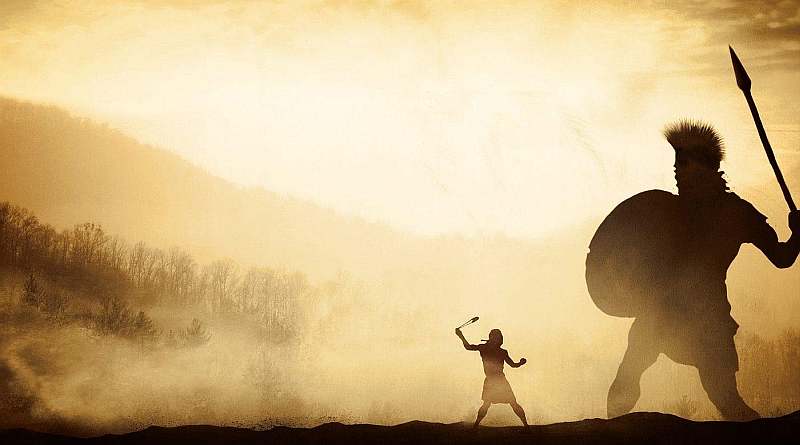
Will Ukraine survive this war as a state? Will the Ukrainian people endure? Who are we in this war — David or Goliath?
For a long time, this biblical parable had a definitive answer for us: a larger nation, Goliath — Russia, attacked the smaller Ukraine, David. And we, like David, will definitely win, because we are smarter, more inventive, and truth is on our side.
But the story is somewhat more complex.
The wars between the Philistines and Israel lasted long. The Philistines lived in cities by the sea, and the Israelites in the mountains, without sea access. Thus, the Israelites attacked the Philistines to capture their developed cities and gain access to the sea. But the Philistines not only defended themselves — they also attacked the mountain tribes of the Israelites to prevent them from uniting and creating a strong state.
Eventually, the Philistines remained a confederation of cities, while David built a strong state that won by assimilating the Philistines. They disappeared not only as state formations but also as a people.
David is the same warrior who, in his youth, as a shepherd, defeated the armor-clad Goliath in one of many battles, later becoming king. He was not “weak.” As a shepherd, he fended off predators for years with a sling — a weapon comparable to a modern pistol in speed and accuracy in the hands of a master.
Goliath was likely not a mythical giant but a well-protected warrior with the technological advantages of that time. David’s victory was not a miracle, but a result of the right strategy. He did not try to fight as a warrior — he used his strengths.
Similarly in life: when we stop mimicking the stronger and start acting in our own way, we have a chance to defeat “giants.”
We are used to comparing Ukraine with David and Russia with Goliath. But this story can be read in reverse.
Resourceful Russia may attempt to cunningly disrupt the unity of NATO and the EU and win by assimilating Ukrainians. The Philistines disappeared this way because Russia might build a more effective state machine, unite society, and find our weaknesses.
Ethically, this seems absurd: how can an aggressive “gas station” defeat the world of democratic states? But the logic of war is different: the one who is more resourceful, who can use drones against tanks and demoralize society against propaganda, wins.
In a biblical context, this story is about the triumph of the spirit over matter:
• Goliath is the world of the visible, where size and quantity matter.
• David is the world of the invisible: faith, ideas, spirit, where truth is more important than obvious circumstances.
In protracted wars, there are many victories and defeats on both sides. But in the end, the one who builds a more effective and stronger state wins.
What happened to David after his victory over Goliath?
He became a hero, and King Saul made him a commander. But later, Saul envied his popularity and expelled him. David hid in deserts, caves, and even among the Philistines. He gathered those who supported him — the team that became his army.
Meanwhile, Saul died in battle against the Philistines on Mount Gilboa, and Israel was on the verge of defeat. Saul envied the strong members of the nation and perished because he did not unite their talents but expelled and persecuted them. Still, the crisis paved the way for David to come to power. Not immediately: he became a ruler in Hebron and fought for seven and a half years to unite the state with Saul’s descendants and supporters. The state was on the brink of extinction and defeat.
Only after all the tribes of Israel recognized him, he captured Jerusalem and made it the capital. It was then that the Philistines, feeling threatened by the united state, went to war against David — and were defeated.
Approximately 20–25 years passed from David’s battle with Goliath to the moment when he united the people and became a victor.
This story can be interpreted in different ways — from historical to moral-ethical parallels.
The Ukrainian people became David when they stopped the invasion. Ukrainians, like David, stopped tanks with drones.
But now Putin is trying to act differently: influence allies, divide Europe, demoralize Ukrainian society. All this struggle with the TCC, lack of unity and army support — this is part of Russia’s asymmetric strategy, their work.
And in this way, Putin may try to win, like David.
But if we want to win, we must do what David did: build a strong state, effective governance, and a strong army. Act asymmetrically, but together.
Because in the end, it’s not the bigger one who wins. It’s the one who becomes stronger.
