
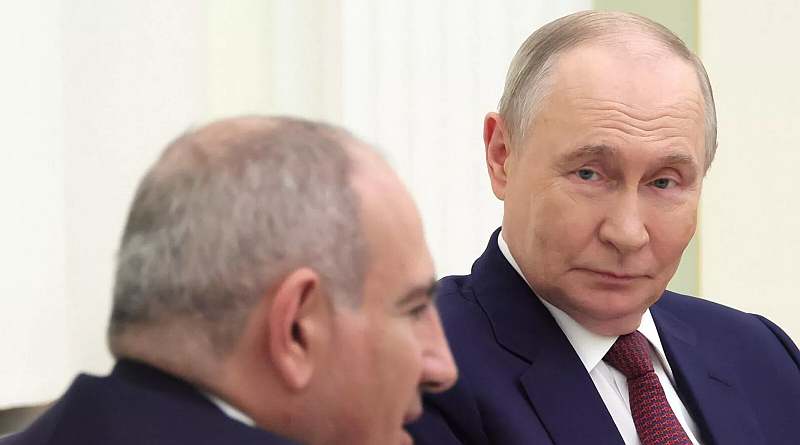

Nikol Pashinyan’s meeting with Vladimir Putin in Moscow on April 1, 2026, which official reports dryly labeled a “working visit,” in reality appears as the final act of an extended drama of Armenia’s departure from Kremlin control. Despite routine smiles in front of the cameras, the results of the talks confirm the obvious: Moscow is rapidly turning from the “arbiter” of the Caucasus region into an outside observer, whose levers of pressure no longer work.
The main outcome of Pashinyan’s visit to Moscow looks like acknowledgment that Yerevan has de facto completed its strategic pivot. While Putin once again warned Armenia against “sitting on two chairs,” trying to oppose the EEU and the EU, Pashinyan came to Moscow not for advice, but with a notification. Armenia has made a civilizational choice in favor of EU standards and NATO security. Yerevan no longer believes not only in the “Russian world,” but also in Moscow’s “umbrella,” which turned out to be leaky at critical moments.
Armenia is definitively moving away from participation in the activities of the CSTO. The Armenian Prime Minister in Moscow only underscored the formality of relations with this organization. Against the backdrop of news that NATO is actively supporting transparency and reforms in the Armenian defense sector, including through the Building Integrity program, Russian “military assistance” appears archaic. Freezing membership in the CSTO is no longer a temporary measure but a diagnosis: Russian military presence in the region is recognized as ineffective and even toxic.
While the Kremlin continued to discuss “civilizational commonality” in the old-fashioned way, Yerevan is preparing for a historic event, namely the first Armenia-EU summit, which will be held on May 4–5, 2026. The participation of Ursula von der Leyen and António Costa turns Yerevan into a new assembly point of European policy in the Caucasus. For Moscow, this is a geopolitical failure: right next to Russia, a space is being formed that lives by Western rules, where the economy is tied to Brussels’ investments, not handouts from Gazprom.
Without Armenia, Russia ceases to be a significant player in the South Caucasus. Azerbaijan and Turkey are playing their own games, and maneuvering Georgia has only temporarily departed from the Western path. Armenia was Russia’s last “anchor” in the region. Today, this anchor is lost. Putin’s ultimatums that “you cannot be in both the EU and the EEU” no longer scare Yerevan but only push it toward a faster exit from Eurasian structures, which have become a brake on national development.
One of the hidden topics of the visit was the crisis of the “North-South” transport corridor concept. Moscow hoped to use Armenian territory as a controlled hub for connecting with Iran and India. However, Armenia’s shift to a Western vector and active U.S. involvement in mediating between Yerevan and Baku put an end to Russia’s plans to control logistics. The “North-South” project in the Russian execution becomes stillborn, as Armenia prefers integration into international transport networks without FSB oversight at the borders.
The bottom line is: Pashinyan’s visit to Moscow in April 2026 is not a story about partnership. It’s about a civilized divorce. Armenia is breaking away into an independent future, leaving Russia in the grip of its imperial illusions, which no longer hold any value in the Caucasus. Moscow has lost Armenia and the entire region, and no “warnings” can turn back the hands of history. Only one question remains: how soon will Yerevan officially announce its withdrawal from the EEU after the May summit with the EU?
