
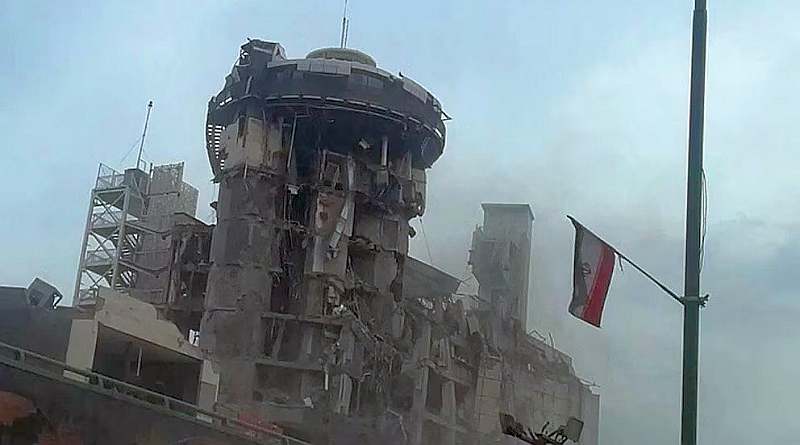

A month has passed since the start of the full-scale military campaign by the US and Israel against the Iranian regime. Putin’s propagandists are trying to portray this conflict as a “distraction of the West from Ukraine,” but the actual geopolitical landscape indicates otherwise.
For Putin, this month has been a period of shattering the last illusions about a “multipolar world,” where Moscow as an independent center could lean on Tehran’s shoulder.
The death of Ayatollah Ali Khamenei as a result of a targeted strike was not just a loss of a so-called ally for Putin but a deep psychological shock. As noted by Western analysts, the Russian autocratic leader always projects the fate of friendly dictators onto himself. After Saddam Hussein and Muammar Gaddafi, Khamenei was the last “pillar” of old-school anti-Western resistance. The death of Iran’s supreme leader and the rapid degradation of the governance system in Tehran trigger panic in the Kremlin over the inevitability of “regime change” by force, nullifying Putin’s doctrine of the inviolability of authoritarian elites.
It is also worth mentioning the prevailing myth that wars in the Middle East by default are a “gift” for Russia due to rising energy prices. However, in 2026, this logic ceased to work. Even with oil prices above $100 per barrel, Russia does not receive the expected benefits.
Firstly, there is a blockade of Russia’s “shadow fleet.” Enhanced US and EU control over violating tankers makes the export of Russian oil a logistical nightmare. Secondly, strikes by Ukraine on Russian refineries. Systematic attacks by Ukrainian drones on Russian oil refining infrastructure from Ryazan to Tatarstan deprive Moscow of the ability to export high-added-value oil products. Finally, the sanction discount: India and China, taking advantage of Moscow’s isolation, demand discounts that effectively “eat up” the entire military premium on oil prices.
In light of military policy, Iran was a key supplier of technologies for Putin’s war machine—from “Shahed” drones to ballistic missiles. Losing such a “pariah collaborator” means strategic isolation for Russia. Without Iranian support, the Russian army is forced to rely solely on its own technologically backward capabilities and dubious supplies from North Korea. Additionally, the Kremlin loses its status as a serious player in the Middle East: along with the degradation of Iran’s influence, Moscow loses the ability to blackmail the West with regional escalation.
It should be noted that for a long time, Putin tried to balance between Iran and Israel, but now the masks are off. Recent statements by Benjamin Netanyahu, in which Russia was explicitly named a “hostile country” due to its support of pro-Iranian proxies, put an end to decades of diplomacy. Israel has finally joined the camp of those ready to counteract Russian influence not only with words but also with deeds, as evidenced by the expansion of intelligence aid to Ukraine.
Interestingly, against the backdrop of the failure of the Russian military-industrial complex, the Ukrainian defense sector is demonstrating significant growth in authority. Ukraine has begun actively exporting its unique anti-drone technologies to Gulf countries (UAE, Saudi Arabia, Qatar). The Arab monarchies, long suffering from Iranian drones, see Kyiv as a reliable technological partner. This is not just commerce; it’s “drone diplomacy,” which enhances Kyiv’s international prestige and displaces Russia from its traditional arms markets.
In general, the outcome of the month’s war is disheartening for the Kremlin: instead of a “second front” that was supposed to deplete US resources, Putin has seen the destruction of his main strategic rear, the Middle Eastern soft underbelly. Russia is rapidly turning into a toxic outsider whose bets on the “axis of evil” have led to a geopolitical retreat into the club of the world’s less influential countries.
