
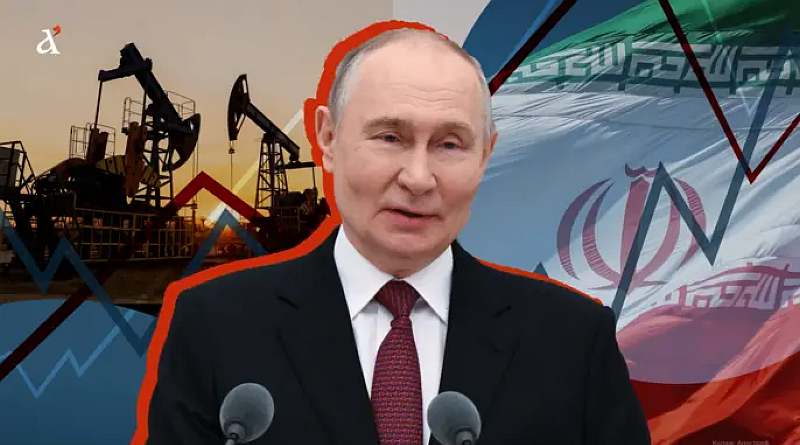

Receiving “requests” to reduce our strikes on Russia’s oil infrastructure was only a matter of time. As the war against Iran escalates, such signals will become more frequent, and we should be ready for Russian oil to be mentioned not only by our “friends” along the “Druzhba” pipeline from Hungary.
It seems that all public statements by American officials about “extremely successful negotiations” with Iran have just one goal — to lower the price of oil. Meanwhile, Iranian statements about the absence of such negotiations aim at the opposite — for oil to keep getting more expensive.
By blocking the Persian Gulf, the global market has lost about 20% of its total oil consumption. This deficit can be covered by either finding additional sources or raising prices, thus reducing consumption. But the current $100 per barrel does not fully reflect the scale of the problem. If the Persian Gulf is not unblocked soon, oil prices will undoubtedly rise.
Here, it is worth noting an important nuance. High oil prices are indeed beneficial for Russia, but only if this does not last long. If prices stabilize at a high level for a long time, it could lead to a serious economic crisis in the world, and a subsequent collapse in oil prices will be one of its consequences. In such a case, Russian oil, like any other, will no longer be needed by anyone, but the accompanying consequences of a global crisis will not make our lives easier.
However, as Russian analysts write, there are calculations showing that every additional day of war in the Middle East brings Russia about $150 million — due to rising oil prices and increased sales volumes compared to January–February levels. This is approximately 12 billion rubles daily, 370 billion per month, or over 1.1 trillion per quarter.
According to forecasts, aligned with the Kremlin’s logic, the Russian budget could receive about 700 billion rubles in additional revenue. This allows covering almost 20% of the budget problems this year. After all, the Finance Ministry can cover a deficit of 4 trillion rubles with state debt. The real problem for the Kremlin is only the second half of the deficit — another 4 trillion out of a total of eight. At least 0.7 trillion, even by the most cautious estimates, may come from the war with Iran.
Part of the funds will traditionally be “added” by big business — the same ones repeatedly involved in financing the war, thus binding even more closely to the regime. But if we imagine an even worse scenario — when the war with Iran lasts a year, and oil prices remain at their current level (even without a sharp spike) — Russia will gain over 3 trillion rubles in superprofits. This essentially removes all financial constraints for Putin. In such a situation, he can expand aggression — attacking Zaporizhzhia, Dnipro, Kharkiv, Sumy, rather than limiting himself to advancing “to the borders of Donbas.”
And if the price of oil rises to $200, and the LNG market also sets records, for instance, because Iran disables Qatar’s processing facilities and blocks supplies to the EU? This is not just a profit — this is a strategic victory, which the Kremlin can only dream of.
The obvious conclusion follows: Russia is objectively interested in maximum escalation in the Middle East. In Iran stopping oil and gas exports, destroying extraction and processing infrastructure in the Persian Gulf countries and doing so as aggressively as possible. Because every such strike is an additional resource for continuing the war against Ukraine.
To avoid a global crisis, the US is, on one hand, seeking ways to unblock the passage of tankers through the Hormuz Strait, and on the other, seeking additional oil sources to cover the deficit.
The situation regarding unblocking is clear. Of course, it would be best to resolve this issue through negotiations. But negotiations with the US are discredited in the eyes of Iran. They were already negotiating, but then, in the middle of the process, missiles came and destroyed all of Iran’s leadership.
We see the military option right now, but without a ground operation, it currently yields no results. Considering that Iran’s territory is larger than those of Germany, France, and Spain combined, the complexity of an occupation becomes more understandable.
Therefore, the most effective way to influence oil prices is not only to increase production in other countries but also to legalize oil from countries under sanctions.
This is why we see the US essentially allowing unrestricted passage of Iranian oil through the Hormuz Strait towards China.
Similarly, Americans are suspending sanctions against Russian oil that is already on maritime tankers.
But if these measures do not lead to a decrease in prices, there will be talk of legalizing other Russian oil, particularly that which is supposed to be shipped through the Baltic ports, which are currently attacked by Ukrainian drones every night.
“Recently, we have been receiving signals from some of our partners to reduce our strikes on the Russian oil sector,” said President Zelensky today. And there is only one reliable way to do this — to force Russia to stop the war. And probably, this is much simpler than occupying Iran.
Collage: Apostrophe
