
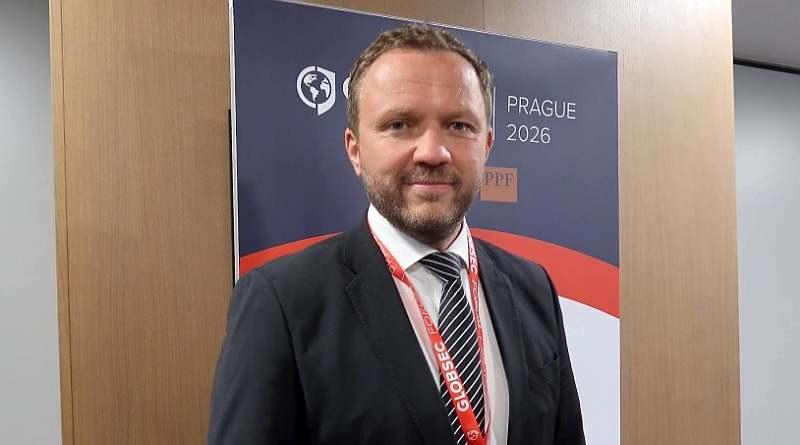
Olga Tanasiychuk, Prague / Ukrinform
Estonia is one of Ukraine’s most dedicated partners. The voice of this small state resonates loudly in the EU and NATO, and on various international platforms. One of the strongest voices is the Estonian Minister of Foreign Affairs, Margus Tsahkna. Ukrinform discussed with the diplomat the assistance to Ukraine, prospects for integration into Euro-Atlantic structures, progress on the issue of confiscating frozen Russian assets, the necessity of holding the terrorist state accountable, and other topics.
NOBODY QUESTIONS UKRAINE’S RIGHT TO ATTACK DEEP INSIDE RUSSIA’S REAR
– Mr. Minister, Kyiv and the region experienced another Russian combined attack over the weekend, involving dozens of missiles and hundreds of drones. You condemned this terrorist act. The topic of drones has recently become very relevant for Estonia as well. Do you expect the number of incidents violating Estonian airspace to increase, and will Russia’s tactic of spreading fear and reducing assistance to Ukraine eventually succeed?
– Of course, we are not pleased that these drones end up on our territories, but the responsibility lies with Russia, as it can stop the war even tomorrow. We may see more such incidents. These are side effects of Russia’s aggressive war.
The issue is that now Russia is deliberately “pushing” these drones onto NATO territory, simultaneously spreading a false narrative that NATO, we – the Baltic states and Finland – officially allow Ukraine to use our territory for these attacks. This is untrue. We have never allowed this.
We expect the world to understand that the responsibility lies with Russia.
Undoubtedly, Putin wants all of us to pressure Ukraine to cease these attacks, but we are not doing that. It has to be crystal clear, and during the meeting of NATO foreign ministers last week, we explained this: the issue is not Ukraine, but Russia.
Putin always plays on this fear of escalation. He wants to show that the Baltic countries and this part of NATO will be drawn into the war. Historically, we understand this fear of escalation from the West, but I think we cannot be afraid. I can tell you that no one questions Ukraine’s right to attack targets deep in Russia’s rear. I believe that Ukraine’s “long-range sanctions”, as my Ukrainian colleague Minister Sybiha calls them, are working well.
We would like Ukraine to be more cautious about the borders, but if you strike at the “lifelines” of the Russian military machine in Ust-Luga, St. Petersburg, and others – it is very close to our borders. Putin is deeply concerned because almost 60 percent of gas and oil exports go through these ports. Therefore, Ukraine must continue.
But our people are asking what measures we are taking for their protection, how we are shooting down drones, what they should do if drones are flying. Many people asked whether NATO is functioning at all. NATO is working – a Romanian fighter jet shot down a drone. This was an adequate response. We are also sending early warning messages: where to hide, what to do. Ukrainians have too much experience, but for our people, this is new. We need to enhance resilience in our society. We need to use this situation and prepare well because very tough times lie ahead.
UKRAINE HAS EFFECTIVE AND CHEAP SOLUTIONS THAT WE NEED TO LEARN FROM
– About protecting people… There is already a “Baltic Line of Defense” on the borders with Russia and Belarus. It was reported that hundreds of bunkers have been built…
– Bunkers are just one part. We are talking about surveillance capabilities, air defense, drones, and cyber capabilities. Of course, we need to invest huge amounts of funds. And we need to learn a lot from Ukraine. That’s why our companies are increasingly cooperating with Ukraine, particularly in the defense sphere. It’s a very practical tool because Ukraine has tremendous experience, developments and, to be frank, much cheaper and more effective solutions.
Now we are investing 5.24 percent of GDP in defense. We are planning the development of the defense industry for the next ten years and procurements for the next four years. We must act strategically and not just buy things through open tenders. We are constantly improving the system. It will never be 100 percent ready, and we are unlikely to shoot down absolutely all drones, but we are working on minimizing the side effects of the war.
– Regarding joint ventures: how promising are they, and can you name their approximate number?
– This is public information, but I won’t name exact numbers. Ukraine has proven that its defense industry is extremely innovative. In particular, Middle Eastern and Gulf countries are very interested in Ukrainian experience.
Our strategy involves providing comprehensive military support through the PURL program, primarily investing in the Ukrainian defense industry, as well as through joint ventures and even manufacturing outside Ukraine. We have various projects in Estonia together with Ukraine. This is necessary because the idea here is that Ukraine is part of our future security guarantees. So it’s not just about supporting Ukraine now, but also about the fact that without Ukraine’s security guarantees for Europe, we will not have lasting peace in the future. Hence, expanding industrial capacities is key. Soon, we will see many large projects we have announced.
WE NEED TO ENSURE THAT SUPPORT FOR UKRAINE IS SUSTAINABLE
– Estonia was the first to commit to allocating 0.25 percent of GDP to aid Ukraine back in 2024 for four years. What can you say to other countries that also help but not as strongly on a per capita basis?
– Together with the Ukrainians, we calculated a fixed number for the long-term (4–5 years) perspective. If the coalition countries guaranteed such a level of support, Ukraine could conduct a defensive war and sustain society. It came out to 0.25 percent of GDP. We proposed this from the very beginning. Many countries are already doing this, but let’s be honest, the burden distribution is not fair. The Northern (Nordic), Baltic countries, Poland, Germany, the Netherlands – these are the main countries bearing this burden. Some do even more than 0.25 percent. We now give more.
I am very pleased that the NATO Secretary General will raise this issue in the Alliance so that everyone takes on such commitments. This is in addition to the 90 billion euro loan provided by the EU. We must ensure that support for Ukraine is sustainable.
– If the war doesn’t end in the two years remaining of your current commitment, will it be extended?
– Yes, I think so. These percentages are just part of what we give. We have investments and other mechanisms like PURL. We invest a lot of money. Estonia’s total aid is approaching 3 percent of GDP. So we will continue.
But we hope to corner Russia and start real negotiations.
WE MUST MAKE PUTIN WANT TO NEGOTIATE PEACE
– It seems that Putin still doesn’t want any negotiations. Recently, he has resorted to the rhetoric of the early days of the war. And now – one of the most brutal attacks on Ukraine…
– We say we need to talk to Putin. But first, we need to bring him to the negotiating table, put him in a position where he is forced to change his goals in real life. We need to increase pressure on Russia so that he truly wants to negotiate peace.
From the European side, there is a great desire now, seeing Putin in a weaker position, to “jump in” and extend a helping hand, thereby giving Putin the opportunity to draw Europe into the role of a mere mediator. But mediation is not the position Europe should be in.
We are talking about European security, we are in this together with Ukraine: it’s not just about Ukraine, about territories, but about peace in Europe.
We need to bring Ukraine into the EU and NATO in the future to have mutual guarantees of security and eliminate these “neutral” or “buffer” zones between NATO, the EU, and Russia. These are the conditions we must adhere to as Europe, not even as the European Union. But I also see, and this is a dangerous path, that Putin now wants to involve Europe to lay his demands on the table again and put Europe in the role of a mediator, as it was with Trump in some aspects. But this does not help Ukraine at all.
– The USA, Rubio have made it clear that they are not very interested in participating anymore. China also seems not eager to be a mediator. Europe is still not quite at the negotiating table. What to do?
– There is no “table” now. Let’s be honest: there is no negotiating table.
So we need to stick to a two-point plan: more pressure on Russia and more support for Ukraine.
Perhaps then a table will emerge where Putin will come to truly negotiate. Now he is not ready to discuss anything. Everyone talks about an energy or “airport” truce – Putin can do this in one day, without problems, and Europe’s mediation is not needed for this.
EU EXPANSION IS A POLITICAL DECISION
– You mentioned the EU and NATO, to which Ukraine should be brought. Estonia supports Ukraine’s membership in both organizations. What do you think about the idea of “associate” membership? Aren’t we being politely offered a substitute for full membership?
– This is not a substitute for full-fledged membership. That’s why we need to focus on the real process of expansion. We are pushing hard to open all negotiation clusters before the June EU Council. There is hope because Viktor Orban (former Prime Minister of Hungary, – ed.) was blocking everything, but now we are talking about this, including with Anita Orban (head of the Hungarian MFA, – ed.). I hope that through constructive dialogue the issue regarding the Hungarian minority in Ukraine will be resolved.
But, let’s be frank, many other countries are emerging from Orban’s shadow. They have their own concerns.
The most important topic for the EU this year is to advance further in the genuine process of expansion. A “replacement” for membership is not the ultimate goal. We can talk about some process, some parts of this process, but it is not the main objective.
The full expansion of the European Union is Ukraine in the EU, Moldova in the EU.
Of course, this is difficult, not because of foreign policy and security policy, but because it involves topics such as agriculture, economy, free movement of labor, and more. But let’s sit down and negotiate.
– Is the goal of the year 2030 still relevant?
– We certainly support this goal.
– President of Moldova Maia Sandu stated that her country is definitely ready to start negotiations on all chapters and hopes for an official decision in the coming weeks. In Ukraine, the process is not going as smoothly. Is it possible that Moldova will move forward while Ukraine gets a bit “stuck”?
– Now I see more consensus on moving forward together. For two years, while Orban blocked the process, we worked to keep the two countries integrated because separating them is a trap.
Of course, this is a merit-based process. Moldova and Ukraine are countries of different sizes, and yours is in a state of active war.
But let’s be honest: this new wave of enlargement began precisely because of Russian aggression against Ukraine. Naturally, we need to involve the Western Balkan countries. But ultimately, it is a political decision. We remember how the Baltic countries were admitted – we certainly did a huge amount of work, but first and foremost, it was a political decision. That’s why we insist that at the June EU Council, a political declaration should be made or a clear announcement of the year when we, as Europe, will be politically ready for real-life enlargement.
A COMMON UNDERSTANDING OF RUSSIA AS A CONTINUING THREAT IS NEEDED
– It’s more complicated with NATO. Ukraine had high hopes for the summits in The Hague and Vilnius, but now they are more restrained. The Alliance summit in Ankara is approaching, to which President Zelensky has already been invited. What should Kyiv expect? What should be the political message?
– Ukraine also needs a united NATO. So, the strategic message from Ankara should be that NATO is cohesive. A much clearer understanding of the relationship between the US and Europe is needed because just as we need the US, the US needs NATO and European partners. A common understanding regarding Russia is needed, as Russia will remain a threat. And, of course, a focus on developmental goals, potentials, based on our plans that we already adopted in Vilnius. It’s not just about the 5 percent, which is very important, but also about their implementation.
So, the main cooperation between NATO member states and Ukraine is the PURL mechanism, which is very useful. The Secretary General also proposed a 0.25 percent military support among member states. After intensive discussions, there will likely be decisions regarding cooperation in the defense industry, because that is what NATO also needs from Ukraine.
The topic of membership is still not on the table. It isn’t because US President Trump has been very clear about it, along with several other leaders. But the main point is not to negotiate in a way that dismisses it as a future possibility. That’s clear.
– How do you view the formation of new alliances now or after the war, for example, between countries like Ukraine, the Baltic states, and Northern Europe? Could they be more effective than NATO?
– These are not competitive solutions. If we provide security guarantees to Ukraine, we expect that Ukraine will also provide security guarantees to us. Because Ukraine is now the largest military state in Europe, and it also has no political issues with fighting against Russia.
So, looking at the map, it’s very logical. Estonia now leads the Nordic-Baltic Eight NB8.
We have talked a lot about this cooperation on military defense with Poland, Germany, Romania, and some other countries. So I see it as part of the future European security architecture. We need to act together. And this is also Ukraine’s path to NATO.
RUSSIAN FROZEN ASSETS WILL NOT BE PART OF ANY PEACE AGREEMENT
– Estonia was a leader, back in 2024, from the perspective of domestic legislation, in the issue of transferring frozen Russian assets to Ukraine. Can we expect that Belgium and some other countries will change their stance regarding Russian assets?
– We are moving forward with the adoption of a law in Estonia that will actually allow us to seize frozen assets, including private ones.
In Belgium, we are talking about the Central Bank and frozen state assets. These are different things.
Now we are moving forward with the issue of a loss registry, as well as a compensation mechanism, which is very important. This is the foundation for the next steps. I hope this happens as soon as possible, and finally, we can show the world that it is possible. If Ukraine sues Russia, Russia cannot be forced to recognize it, and then we will proceed to seize these assets and transfer the money to Ukraine. But this must be part of this compensation mechanism. So I hope it will be done as soon as possible.
The second issue concerns the frozen assets in Belgium itself. Of course, we aim to support their confiscation. We have 210 billion, but by the end of last year, the decision had not yet been made.
The good thing is that we no longer have the threat that every six months, when we needed to renew or cancel sanctions, we could lose them because each time we needed consensus among the EU countries. Now that’s not necessary. We also see the decision regarding 90 billion euros. It was a good decision because now we share the burden, as it was carried by us – the Northern countries, the Baltics, Germany, Poland, the Netherlands, and others. Now the European Union will pay, and we still have these 210 billion. I am sure that quite soon there will be new debates about whether and what we can do, to actually confiscate them.
So it’s good that we have the money, we control it. Russia will not get it. They will not be part of any deal, whoever handles it, since it concerns the European Union. This is an opportunity for the future, 210 billion is a lot of money.
RESPONSIBILITY – PART OF PEACE
– A widespread topic is the Special Tribunal for the crime of aggression. How do you see the prospects of bringing the guilty to responsibility? Do you believe in justice?
– I believe in justice.
For four years, Estonia has been at the forefront of the process of creating a Special Tribunal for the crime of aggression. And just last week we announced that 45 countries will move forward under the auspices of the Council of Europe. I also spoke with the new government of the Netherlands, and they are really making efforts. So I hope that quite soon we will see an active tribunal.
Now we are also advocating for more countries outside of Europe to join. I see prospects for Canada, Australia, Japan, and possibly a few more countries.
Everyone talks about peace, but responsibility is part of peace. This concerns not only the people of Ukraine, it is about the most serious international crime – the crime of aggression. And only leaders are responsible for this, and they now have immunity.
We had Nuremberg, but there was no International Tribunal for the crimes of communism. And the consequence of this is that we see the continuation of this aggression.
So we need the Tribunal. I’m not an optimist, I’m a realist, but we are moving forward. No one really expected that so many countries would join us now. We needed 16, now there are 45 and more and more are joining.
– And finally: how strong does the support for Ukraine remain among Estonians?
– Support for Ukraine is very high. It depends on what question you ask, whether it’s about military or financial assistance, but it’s from 70 percent to over 90 percent. And this does not change. No one doubts that it is necessary.
Photo by the author
