
In Russia, the number of businesses specializing in funeral services increased by 22.5% in the first half of 2026 — 995 new companies and individual entrepreneurs were registered. Should this be viewed as preparation for mobilization in Russia and the intensification of military activities against Ukraine?

The Kremlin, of course, denies preparations for mobilization — trying to allay growing public concern, especially in megacities. Dmitry Medvedev stated on July 28 that the latest reports on mobilization preparations are “provocations and Ukrainian propaganda aimed at destabilizing Russia ahead of the State Duma elections in September.” He also criticized advertisements to sign a contract for military service today to avoid mobilization tomorrow. According to Medvedev, Russia does not need mobilization and has fully met the military personnel needs by recruiting about 200,000 contract soldiers in the first half of the year (221,000 in July). The loss of 225,000 servicemen, of course, was not mentioned. But the numbers show that recruitment barely covers current losses, and there is practically nothing to form strategic reserves from, so the claims that “mobilization is not needed” seem unconvincing.
Amid this discussion, the head of the State Duma’s defense committee, Andrey Kartapolov, and propagandist Vladimir Solovyov, offended by the Italian government’s confiscation of his villa on Lake Como, also dismissed the prospect of mobilization.
Meanwhile, the Russian state United Shipbuilding Corporation recently changed the criteria for reserving specialists, effectively releasing most of the personnel for a potential draft. Sources within the corporation reported that the new management is simultaneously trying to find ways to reduce salaries. Such behavior is typical for managers who received tacit orders to prepare for a draft but do not want to pay much to those who will be drafted, as the company is obliged to keep their jobs and pay salaries.

The preparation for mobilization is also evidenced by numerous documents adopted in July by the aggressor country’s government, which regulate a wide range of issues regarding the implementation of legislation on mobilization preparation and mobilization. For example, citizens with criminal records are now allowed to contract for military service with the RF Ministry of Defense during an officially declared mobilization period. Documents have also been approved that impose restrictions on the Russian population to suppress potential resistance to mobilization.
So far, the opponent is focusing on recruiting volunteers. However, it is becoming increasingly difficult to recruit contractors—both due to a decrease in those willing to join and the depletion of regional budgets. Recruitment plans are handed down from above, yet there is little funding for signing bonuses. Our Center for Counteracting Disinformation reported that, for instance, the Khanty-Mansi Autonomous Okrug and the Republic of Dagestan offer bonuses up to 4.1 million rubles (approximately 49,000 dollars) for those willing to sign contracts with the RF Ministry of Defense. However, this helps little even in the most impoverished regions, where all those eager to fertilize Ukrainian soil have already fulfilled their desires.
The GUR MO of Ukraine reported that the opponent’s goal this year is to draft 409,000 citizens. The stagnation of most front sectors or the slow advance in the enemy’s main offensive directions does not bring it any closer to fulfilling the task set by the Kremlin—to complete the occupation of Donbas by December 31. This recruitment challenge is already imposing a difficult decision on the military-political leadership of the enemy regarding whether to conduct partial or full, open or covert mobilization, which may result in a powerful social upheaval, primarily in the capitals, or to find money to increase bonus payments to the few who are still hesitating, choosing between paying off a loan and dying ingloriously in an unnamed field in the Ukrainian steppe.

It is clear that if they work day and night, the enemy will be able to draft the number of people they need, equip, arm, and basically train them, but there is no time left to form combat-ready regiments-brigades-divisions from this mass by the end of the year. The aggressor’s General Staff must choose one of three scenarios:
• capture Donbas by December 31 with the groups available in the Southwestern TVD. They have not yet succeeded in capturing Kostiantynivka, let alone all of Donbas. Unlikely;
• conduct mobilization, which a significant part of the political leadership resists, calmly form reserves, plan a new offensive operation and carry it out. Then the date “December 31” should be crossed out and Putin disappointed. Unlikely;
• wrangle money from the budget, pressure the military commissariats of all levels, squeeze out the planned 409 thousand recruits, and throw them into infiltration groups at Ukrainian positions to break through the defense line known to the world as the Belt of Fortresses. This might happen.

Meanwhile, reports from Yerevan indicate an increase in Russian migration amid rumors of a new wave of mobilization. Over the past three months, housing rental in Yerevan has soared by 30%. The main reason is the influx of Russians into the country. Local realtors compare the situation to the figures from 2022.
In the meantime, Russia has started selling gold from its reserves: 44 tons have been sold for approximately 5.5 billion dollars. Total reserves are estimated at 400+ billion. In September, an auction will be held for the sale of very large diamonds from the Russian State Fund.
And why does a country where about 22.6% of households, or over 30 million people, do not have centralized sewage, about 16.8% use cesspools, and over 5% have no drainage system at all, tens of thousands of homes have no toilets either indoors or outdoors, about 29 million people, or over 12.5 million households, do not have centralized cold water supply (using wells, delivered water, or boreholes), millions of households heat with wood or coal due to lack of piped network gas, need such enormous amounts of money?! Surely not for gasification!
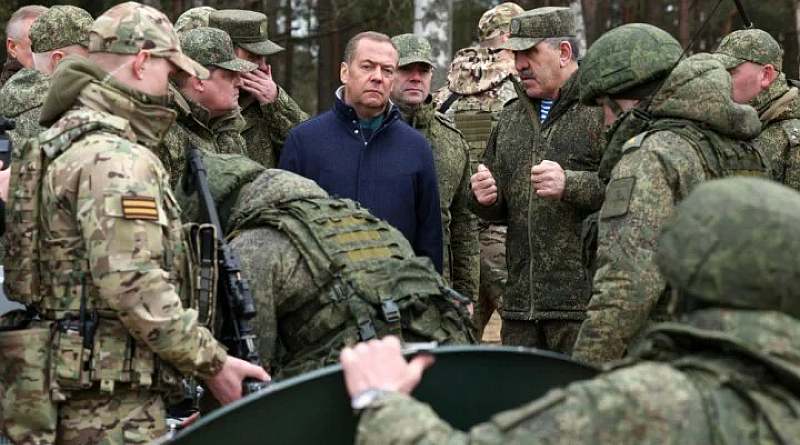
On the cover: Deputy Chairman of the Security Council of the Russian Federation Dmitry Medvedev at the training center of the Leningrad Military District, April 30, 2026. Photo: Occupying media
