
On July 1, 2,000 Ukrainian-made drones crossed the border for the first time since the full-scale invasion. These were the F-10 copters by F-Drones. They were purchased for the US Army.
Before this, F-Drones went through a significant journey, building cooperation with the Pentagon. Today, they are already expanding production in America.
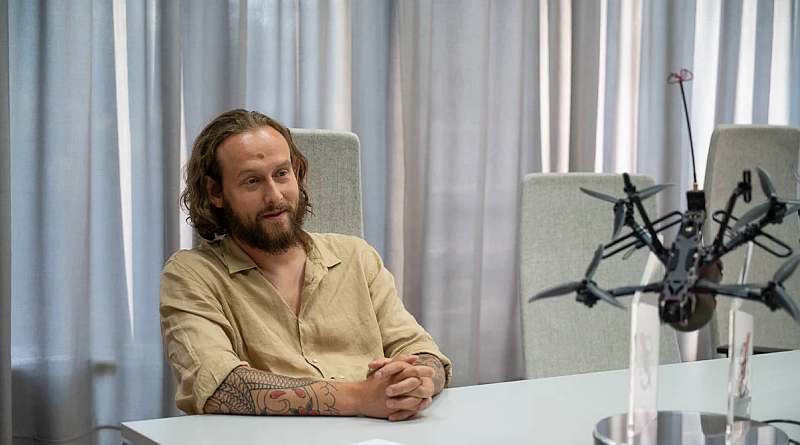
We talked with the company’s CEO, Stanislav Khutor, about F-Drones technology, participation in the Drone Dominance Program, export procedures, and the upcoming plant in the USA.

About Khutor and F-Drones
Let’s start by talking about your background. What were you doing before the full-scale invasion and before you joined F-Drones?
I am a dentist with a focus on maxillofacial surgery. Before the full-scale invasion, I held various positions, but all in the medical field.
With the onset of the full-scale invasion, I went to serve. I served in a special unit of the T.O.R. battalion in the patrol police. We were a combined unit and participated in various operations: Bucha, clearing the Kyiv region, Kharkiv operation, Mykolaiv, Kherson.
At that time, we began to develop various scale strike complexes based on our unit. Initially, these were large agro-drones that we modified for drops. This was during the Mykolaiv operation. And in Kherson, our first FPV drones were operational.
What happened after your service?
I was demobilized—there is such an option in the patrol police contract. Then, I worked as a technical director of the Drone Army under the Ministry of Digital Transformation: we opened a training center for pilots and wrote regulations that simplified the integration of unmanned systems into service.
I first saw F-Drones products at the Drone Army: we distributed them to units as part of a volunteer project. I remember sending trucks with these drones to the Zaporizhzhia region.
When the Drone Army project began reformatting, I received an offer to join the F-Drones team and soon took charge of the company as CEO.
What is the current product portfolio of F-Drones besides F-10?
The range is extensive. From small quadcopters like our well-known F7: by the end of 2025, it was recognized in the “Delta” system as one of the best means for the number of hits on personnel, light, and armored vehicles. The F11 BORYS model is quite popular, capable of carrying up to 3 kg in radio version and with fiber optics.
Heavier platforms include the hexacopters F10 HEXA and F13 HEXA, which can also be re-equipped, like bombers. The smart drone-relay with Starlink, the F18, follows. Next is the interceptor Litavr, which destroys enemy “shaheeds” every day, including jet ones.
By the way, we’ve prepared a release of the updated interceptor model LITAVR+, designed to hunt jet “shaheeds”.
Reveal a bit more information about this product. After all, the fight against jet “shaheeds”, as well as ballistics, is currently a major concern for Ukrainians.
LITAVR+ is an enhanced version of our main interceptor, reaching speeds of 400 km/h and even a bit more. It still includes many useful features: proprietary software, a special navigation system (without GPS), a last mile targeting system (allowing missions to be completed without pilot intervention). And, of course, remote control technology, enabling pilots to operate the drone from virtually anywhere in the world.
Has it already passed combat tests?
LITAVR+ has passed factory tests and is now in combat trials, with successful applications in shooting down jet “shaheeds”, accompanied by corresponding video reports.
Speaking further about the product line, there’s also the new F-Capitan—a middle-strike class aircraft-type attack complex: 10 kg of combat load over a distance of up to 100 km. Destroying enemy logistics and supply corridors is a huge demand from the army, and this tool is already being actively used by the military.
There are several more products in the testing phase. We’re keeping them under wraps for now. The company’s overall direction is to offer the military great drones across all domains: in the sky, on land, and in water.
So should we soon expect an NRC from F-Drones?
Yes. The release will occur when we’re ready to showcase it publicly, and active work with the military is underway.

I also want to ask about FPV drones, specifically about their relevance. There was a period in the media of regular FPV, then fiber optic, now interceptors, mid-strikes. How widely are regular FPV drones used nowadays?
This is a tool that will stay with us forever. It’s like a bullet—a standard that has been, is, and will be, regardless of the side or conflict.
The fact that there’s less media noise about FPV doesn’t mean it’s less effective or needed. The military’s need for this tool is massive.
Why is the company named F-Drones?
I would link it to F-7.
So the drone came first, and then the name?
Yes. It was a time when Ukrainians eagerly awaited Western aid: Leopard tanks, F-16 aircraft. The realization came: while waiting for those F-16s, the enemy would be destroyed by F-7, which we would make ourselves. This is where the F series and the whole F-Drones concept originated.
How does your company stand out in the market: product, components, service?
In several ways. First, we are the first Ukrainian company to localize 100% of the components in-house: engines, frames, electronics (flight controllers, speed regulators, communication systems, video transmitters, ground and airborne antennas across the frequency range). All the things that usually make a manufacturer dependent on China. We are getting rid of this dependency.
Second, the focus on innovation. We deliberately have a high percentage of R&D staff: engineers, inventors, programmers. This allows us to timely launch new products and upgrade existing ones.
Third, vision. We truly believe that drone production (and broader Ukrainian defense tech and deep tech) should become a strategic sector of the economy, Ukraine’s specialization in the international division of labor, its powerful asset, and “cards” for influence in the world.
For this to become a reality, F-Drones is ready to invest in building the industry ecosystem, reviving and developing the Ukrainian engineering school, and supporting talents. For us, this is an important mission and responsibility as successors of the great engineering tradition of Sikorsky, Antonov, Korolev, and Kondratyuk.
And we are already doing this.
Why did F-Drones remain a non-media company until recently?
The decision to be low-profile was primarily driven by the safety of our people and production locations. Non-publicity helped us remain less visible to the enemy. Working in the shadows allowed us to quietly develop complex projects and participate in important missions. We just did our work quietly.
Today, our products have already created enough noise themselves, so it’s impossible to remain a completely non-public company. Security issues remain just as relevant. But decentralization and geographical dispersion of production facilities allow us to tell a little more about ourselves — of course, without disclosing sensitive information.

On Cooperation with the USA and Export Procedure
Why did you decide to participate in the Drone Dominance Program from the Pentagon?
Returning to the thesis on strategic impact in synergy with the state: the participation of Ukrainian manufacturers in such programs is a direct tool for shaping a global vision of the future. Right now, it’s being decided what drones should be like, how to build the component base, and achieve real independence from China. The unique expertise that Ukraine has gained during the war, we are obliged to convert into both the protection of the country and the success of domestic companies.
The decision to enter this market is not about instant money. It’s about strategic choice and deep gratitude. The United States is a strategic partner whose support helped Ukraine withstand the most critical moments. Meanwhile, the USA remains the most demanding, high-tech, and largest defense-tech market in the world. Yes, American partners do not yet fully grasp all the nuances of modern high-intensity drone warfare, but this is precisely where global standards are being forged.
For F-Drones, this is an important reputational project and a bridge to global scaling. It is an opportunity to show the world what the Ukrainian tech industry is capable of. In practical terms, it involves attracting external financing, developing our R&D and creating solutions that will strengthen our front tomorrow.
Regarding the program itself: initially, there were over 200 applicant companies. 25 were selected to participate, and only 11 reached the final. We took 6th place, and today all our drones have been commissioned by the US Army.
Did you need a representative company in the USA for this?
Yes. This is the Ukrainian Defense Drones Tech Corporation (UDD Tech Corp), with which a memorandum was signed and which today is the importer of our drones, manufactured in Ukraine, to the USA.
UDD will assemble our drones under license in the USA. We are now submitting a document to obtain an export permit for the provision of such assembly licenses for the UAV F10. If everything goes smoothly, the first F-Drone will roll off the assembly line in Ohio in the fall — using Ukrainian technology, but made in USA.

What did the competitions in the USA look like?
This is America’s request for a specific tool tested by the US military. Field trials were conducted as part of the program—without Ukrainian pilots, only Americans flew. They performed missions, compared results, and assigned scores. The number of drones to be purchased depended on the placement.
What are the expectations for the second round of the program?
According to open data, the order volume is linked differently to the placement there. However, there are more participants in the second phase—the competition has significantly increased. There are also more Ukrainian companies among them. As a result, 2,000 drones were ordered.
How long did the export permits take, and what did it look like?
The whole process took about two months and required intensive interaction with various state structures at different levels. We completed the main part of this journey in close cooperation with the state exporter “Spetstekhnoexport”.
The procedure was genuinely challenging: first, an application is submitted to the State Export Control Service, after which approvals are needed from the SBU, GUR, Ministry of Defense, and the Foreign Intelligence Service. The final decision was made by the Interdepartmental Commission on Military-Technical Cooperation and Export Control Policy.
It is symbolic that we received the permit on July 1, when the government officially announced the reform of drone exports. This is an important and significant date for F-Drones as well as for the entire domestic defense industry.
We became the first company to receive a permit to export a finished unmanned system of Ukrainian production to the USA. After us, the system changed, but we were still going through the old procedures.

How much did participating in the Pentagon program and receiving drone orders from the States help?
It really helped. We had official letters of support from the US Department of Defense. For Ukrainian state bodies, this was a clear signal: a serious story at the highest level, not purely a business case, but really a matter of interstate relations with a strategic partner. Accordingly, the attitude towards reviewing our documents was as attentive as possible, although there were also “surprises”.
Is this deal with America somehow parallel to the Drone Deal program? As far as I know, Ukraine and the US have not signed it yet.
The parties are still negotiating. Perhaps our case will also help in signing the Drone Deal between the US and Ukraine.
Is it known what will happen now with the F-Drones that have already been delivered to the US? Will they participate in any combat operations?
As far as I know, no. This quantity was taken for initial testing and training of personnel. That is, with the help of these drones, crews in the US Armed Forces will be trained. And contracts equipped with combat units will be later, considering the results of training, tests, and flights within the country.
So they are testing and training on this batch, and with the findings, the Pentagon comes to you: “we need this many more”?
This is exactly the development we hope for.
And you’ll supply new batches already through an accelerated procedure?
Yes, and here we see two parallel paths: direct export of finished products from Ukraine or export of technologies — that is, licensing the production of our drones abroad. We plan to use both tracks.
In particular, we are moving towards deploying production in the US through licensing the production of our drones at facilities in Ohio.
What will be more — export of finished complexes or technology transfer — depends on the Drone Deal conditions, the needs of the Ukrainian army, as well as our production capabilities and component base. After all, priority No. 1 is the uninterrupted supply of the Ukrainian military, only then external programs.
The state has set absolutely correct benchmarks, which we fully share: primarily the Armed Forces of Ukraine and the best technologies for our front. And if we have the resources and capability to simultaneously influence global trends in the drone industry — we certainly take advantage of this.
About the plant in Ohio
Were the plans to launch production in the US immediate when applying for the Pentagon program? Or were these two parallel tracks?
Initial discussions were underway from the start, but the final understanding that we would open a full-scale plant developed later. We are currently preparing the site for launch. We expect to receive all the necessary licenses and permits for the production of both the F-10 model, which is already under contract with the US Department of Defense, and our other lines in the near future.

So, the factory in Ohio will produce finished products that meet the US requirements for full component base localization?
The component base in the US and Ukraine has its differences. In the United States, there is a strict requirement of the NDAA law—complete absence of Chinese components in the drone’s construction. To a large extent, we are already meeting these requirements with our own component base. We have a clear understanding of how to achieve 100% compliance with NDAA standards across the line and get into the Blue UAS register—the official list of drones allowed for purchase by government and defense agencies in the US. By the way, our UAV F-10 is already included in this blue list.
How did you choose the state and did you research the labor market before the launch? What is the situation with this?
This is a very interesting market: in the US, the state itself proactively helps you deploy business. The negotiation process was lengthy. A number of factors influenced the choice of Ohio in particular. Congresswoman Marcy Kaptur, co-chair of the Congressional Ukraine Caucus, played a significant role; she actively facilitated our entry into the region and demonstrated all the state’s incentives. These include grant programs, tax benefits, and support in creating jobs. Additionally, we saw that other large defense-tech players also choose states with a strong industrial history. For example, Anduril places its facilities in this region.
How did you agree with UDD on the protection of intellectual property rights?
All intellectual property rights to our developments remain in Ukraine. In the US, we are exclusively deploying production facilities, so the key technological capital and design rights remain with our company and under Ukrainian jurisdiction.

I’ve heard from many market players that the culture of intellectual property is not very well developed in Ukraine and companies are not quick to patent solutions. How do you address this issue?
We’ve approached this systematically, patenting since 2023. This is a strategic priority for us, so we register and protect our rights in three jurisdictions — Ukrainian, European, and American legal fields.
How will you transfer feedback from the military to foreign production, which affects the speed of updates? Or will the American side decide how it works?
A new, independent experience will form on the American market, and we will organically combine it with the Ukrainian one. Which balance between these two areas of expertise will prevail will become clear over time. However, the principle remains unchanged: American-manufactured drones will undergo the same quick iterations and modifications that we’ve become accustomed to in Ukraine.
So, we take two companies, two countries — how will the experience of the Ukrainian war influence the company’s work in the US, and how will the experience of the US Army influence the products of the Ukrainian company?
Exactly. It would be senseless not to take the opportunity to learn and scale through collaboration with partners of such a level. The US Army is a colossal institutional and technological resource.
I don’t mean that Americans will come and teach us to fight. It’s about using our unique combat experience to view products from a different perspective. In Ukraine, we work in “firefighting mode”: we needed the product yesterday, the solution the day before. In such a frenzied rhythm, there’s simply no time for some things. In the US, we have the space to apply new methodologies, programs, and assessments.
This applies to everything: approaches to assembly, quality control standards, legal and administrative procedures, and ultimately the model of cooperation with the military.
About the EU-Ukraine Drone Alliance
F-Drones recently joined the founding companies of the EU-Ukraine Drone Alliance. Why did you decide to apply?
For us, it’s an opportunity to directly convey our vision of the future market. The European Commission conducted a thorough selection across Europe, resulting in the formation of the Alliance’s core: 9 Ukrainian and 9 European companies. In our application, we outlined our view on the development of unmanned systems, robotic systems, the component base, and overall industry development.
Can you disclose this?
Not yet.
What is the benefit of participating in the Alliance for the company and the country?
First and foremost, this is quality networking. The Alliance is the only platform for finding European partners, contractors, suppliers, and directly exchanging combat and technological experience.
Secondly, it is direct participation in the formation of joint EU and Ukraine policies. We develop specific proposals to make the European defense industry stronger, more sovereign, and technologically independent. Ultimately, this is a fundamental component of collective security for both Ukraine and the entire Europe.
As a company, do you see from Europe’s actions that it is now truly ready to listen and adhere to agreements, rather than simply talk about how we need to preserve democracy?
Considering the scale and results of joint military exercises and simulations in the air, on the water, and on land, I am convinced: we have finally been heard. The results of these tests speak for themselves: when a conditional fleet is sunk within five hours during a simulation, and a small group of UAV operators completely halts a division, any doubts disappear. European partners have clearly seen the realities of modern warfare and realized that the time for empty talk is over — it’s time to act.
