
For years, Ukrainian law enforcement and migration agencies have extradited Chechens, Ingush, Circassians, and ethnic Russians to Russia through intermediary countries. These individuals fled their homeland due to persecution by the Kremlin and were formally accused of “terrorism” in Russia. Some of these refugees fought on Ukraine’s side. However, this did not prevent their forced handover to Putin’s regime. Why does this happen, who is behind this wrongdoing, and is there corruption involved? Human rights activist Borys Zakharov explains in an interview with Texty.org.ua.

Double Standards
— Let’s start with the story currently in the spotlight. Aslan Khakimov, a Russian citizen who fled FSB persecution in 2015, has been making ground robotic complexes for the Ukrainian Armed Forces at his own expense since the start of the major war. Despite this, since April 2026, he has been held in a temporary detention center for foreigners, and the migration service is seeking his extradition to Russia, where he has been declared a “terrorist.” It seemed that after 2014, and especially after 2022, such extradition to the aggressor country would be impossible?
This is a longstanding, chronic issue. Since 2014, it has been as if nothing changed after the start of Russian aggression. Take Adam Osmayev, a well-known commander of the Dzhokhar Dudayev Battalion, husband of Amina Okuyeva (of Chechen-Polish descent, a doctor, soldier, killed by assassins in 2017 during an attempt on her and Adam Osmayev’s life. — Ed.).
Osmayev was almost extradited during Yanukovych’s time, but was saved by Rule 39 of the European Court of Human Rights (ECHR) on interim measures, submitted by the Kharkiv Human Rights Group. (Rule 39 allows the court to take urgent measures if there is a threat to life, health, or if there is another violation of rights that cannot be remedied, including extradition to a country where there is a threat of death or torture. — Ed.).
But after the start of the war, many foreigners—Russians who resisted the Kremlin regime—found themselves under extradition arrest and were being tried to be handed over to Russia by all means.
— Quietly?
Some quietly. In 2015, two Chechens were handed over—I don’t even know their names. This was done secretly, and human rights activists learned about it after the fact. Then there was a meeting of the Ukrainian Parliament’s Committee on Human Rights, National Minorities and Interethnic Relations, where I spoke. The issue was raised by Members of Parliament Refat Chubarov and Heorhiy Logvynsky, representatives of the SBU were called, and Ombudswoman Valeriya Lutkovska was there.
— What is the main contradiction?
In the double standard. On one hand, Russia is judging our Ukrainian citizens—Crimean Tatars, Azov fighters—for “terrorism,” “participation in terrorist organizations,” “extremism,” “sabotage.” And we rightfully say that these cases are fabricated, that the people are innocent, and that Russian legislation is deceitful. But in the case of Chechens, Ingush, and others who fight against Putin’s regime, we say: yes, these are criminals. We hand them over to Russia to die.

— Give examples.
Timur Tumgoev, an Ingush, a fighter of the Sheikh Mansur Battalion (Chechen peacekeeping battalion, created in 2014 in Denmark by the “Free Caucasus” movement; initially acted outside state structures, and after the start of the full-scale invasion, fights as part of the Ukrainian Defense Forces; according to specialized resources, under the command of the Main Intelligence Directorate. — Ed.).
In Russia, Tumgoev was accused of terrorism—allegedly he was a terrorist in Syria. Not as part of the “Islamic State of Iraq and the Levant” (ISIL), but among opposition forces that eventually defeated Assad’s pro-Putin regime. These formations were indeed considered terrorist in some countries, there was a public scandal about this, and the United Nations (UN) Committee prohibited the extradition of their participants. But unlike rule 39 of the ECHR, the UN Committee’s decision is only advisory. And Ukraine handed over Timur Tumgoev to Russia in 2018. Plus, there could have been a corruption component.
Money from authoritarian regimes
— How was he handed over?
Our lawyer met with Tumgoev two hours before he was to be taken away. Tumgoev realized what was happening, refused legal services—he decided that nothing would come of it except bargaining with the Ukrainian security forces.
And the bargaining began: a sum with five zeros in dollars. A bribe to “outbid” the money that Russians pay our SBU department workers for each handed-over person. I know this from our lawyer, who managed to visit Tumgoev before the extradition. He was present at the conversation, but when they started discussing sums, Tumgoev himself asked him to leave.
Totalitarian regimes do not spare money to persecute their opposition —
Russia pays with money and services for the elimination of enemies of the Putin regime.
I don’t have absolute proof, but there are so many indirect testimonies that there’s no doubt left.
— Does this concern only the Russian regime?
The Belarusian regime too, and the Central Asian ones: Uzbekistan, Tajikistan, Turkmenistan, Kazakhstan. The same was true with Assad’s regime in Syria. Although in Syria there was a civil war — most opposition members received additional protection in other countries.
One notable case was Muntasir Albobol (a Syrian doctor, leader of the Syrian community in Ukraine, human rights activist), a member of the opposition government, personally persecuted by Assad. He has a wife and four children in Ukraine. Human rights defenders, national deputies intervened, and the State Migration Service finally granted him refugee status.
Office Races Against Death
— Let’s return to the Russian direction. How is extradition carried out technically?
Currently, Ukraine has no international legal cooperation with Russia — they are our enemy on the battlefield. But until 2022, they tried to extradite everyone Russia demanded.
A notable case was the 2016 one involving an Ingush, Zelimkhan Belkharoev (a known Greco-Roman wrestler). He was also saved by rule 39, but they wanted to extradite him nonetheless. Because there is a narrow “window”: while the ECHR makes a decision within a day, a person can still be taken out of the country.
For Belkharoev, rule 39 arrived on Thursday evening to the Ukrainian government representative in ECHR matters (then it was Ivan Lishchyna). He forwarded the document to the international department of the General Prosecutor’s Office, where they had to endorse it and stop Belkharoev’s extradition. At the prosecutor’s office, people had already gone home, possibly intentionally. And on Friday morning, Belkharoev was placed in a bus to be handed over to the Russians.
— How was he saved?
He was saved by the first deputy minister of justice Natalia Bernatska. I raised a huge scandal on Facebook on Thursday, tagging everyone, calling the then Prosecutor General Yuriy Lutsenko — he didn’t answer. The penitentiary system is subordinate to the Ministry of Justice, and until rule 39 is endorsed, it is forbidden to remove a detainee from extradition arrest. Thanks to Bernatska’s lawful intervention, he was saved.
— And with Timur Tumgoev, who was handed over to the Russians, what happened afterwards?
He was tortured more than once and given 18 years. Now he is in a critical condition, barely able to move — nothing remains of a healthy person. And he was our fighter — a fighter of the Sheikh Mansur Battalion. They did one more vile thing: before handing him over, they put his Sheikh Mansur Battalion ID into his pocket so the Russians would add that he fought here.
All these actions are betrayal. And not just of a person, but of the Homeland, because it’s a fight against those who defend Ukraine.
And here we must mention a significant mistake by Volodymyr Zelensky — the illegal sanctions against our fighters from that same Sheikh Mansur Battalion and several other battalions, enacted in 2021.
To Putin through Third Countries
— Has anything changed since 2022?
When the full-scale invasion began, legal cooperation with Russia was finally stopped and the issue quieted down. But, apparently, there was a strong desire to resume extradition: in 2024 they started extraditing again — through third countries.
One guy was almost directly handed over: Oleksiy Herasymov, a student from Cheboksary, who illegally crossed the border to join the Siberian Battalion. He was caught, placed in a temporary foreign detention center, included in the “thousand for a thousand” exchange list in May 2025, and handed over to Russia.
That is, they took our captive fighter and, in exchange, gave them a Russian opposition student who wanted to defend Ukraine and also become our fighter. According to reports from Russian media, he received 25 years.
Another tragic story is Zaur Shogentsukov. He crossed the border with Belarus (with which we did not sever cooperation) to join the Ukrainian Defense Forces — his case was backed by the commander of the “Caucasus” battalion. But supposedly, he did not pass the polygraph test with the SBU. Zaur Shogentsukov was handed over through readmission to Belarus — effectively into the hands of the Russian Federal Security Service (FSB).
And in less than a month, his body, mutilated after torture, was returned to his family in Nalchik. He was a Kabardian, from an intelligent family, elite of Kabardino-Balkaria. His grandfather — Ali Shogentsukov, a classic of Kabardian literature.
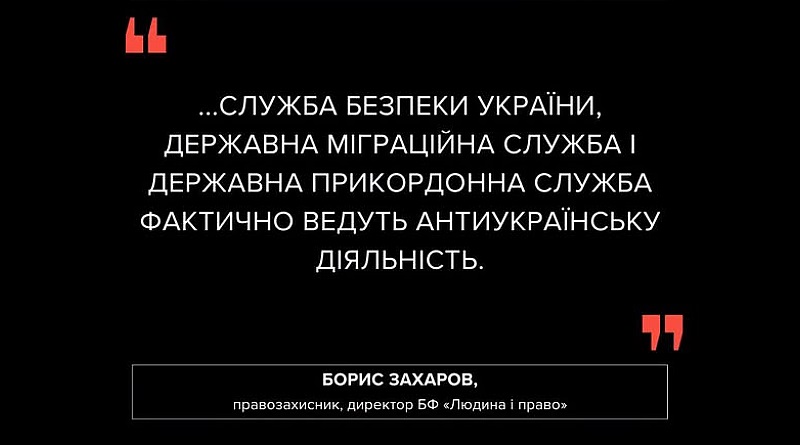
All this directly contradicts the policy of decolonization of Russia, in which Ukraine should be interested, and it becomes an element of state policy. Meanwhile, the Security Service of Ukraine, the State Migration Service, and the State Border Guard Service are essentially conducting anti-Ukrainian activities. Moreover, under international law, this is complicity in a crime: if we handed over a person and they were tortured there, it means we did not assess the risks and are also responsible for it.
— How can extradition be prohibited altogether — both direct and through Belarus?
Through Belarus — it’s essentially immediately to Russia, without any procedures. But extradition can also be done through Moldova or Turkey — they maintain cooperation with the Russian Federation. And in Russia, there are “terrorist” charges against Caucasians, Muslims, and our Crimean Tatars: participation in a terrorist organization, financing of terrorism (as in the Hakimov case now), or participation in illegal armed formations that contradict the interests of the Russian Federation (Article 208 of the Russian Criminal Code).
— Have there been cases of extradition through Moldova and Turkey?
Yes, and more than once. Individuals with “terrorist” charges are often extradited from various countries, even from EU nations.
Azov, Aidar members, and Crimean Tatars
— Do our volunteer battalions within the Armed Forces and the National Guard fall under the term “participants of illegal armed formations contrary to the interests of the Russian Federation”?
— The Free Syrian Army, which defeated Assad’s regime, does too. Our Azov members, Aidar members, and Crimean Tatar activists are categorized under “terrorist” charges. Our state needs to make efforts to prevent their extradition from third countries if Russia issues an international warrant.
— What can be done to ensure that people’s fates don’t depend on chance: money, bribes, whether human rights defenders can be found, and protection from extradition comes through the ECHR or UN, or other circumstances?
There is a good draft law No. 14160 on foreign military members and their families: it prohibits extradition and, importantly, grants the right to reside in Ukraine and to acquire citizenship.

A quota is provided for those who contribute to defense capabilities. But it’s underdeveloped. It mainly concerns service, whereas it should include all who help with defense: volunteers and those who finance it.
The problem is typical: a person’s Russian passport expires, they can’t get a new one, the residence permit isn’t renewed, after which they end up in a temporary accommodation center for foreigners, and then face forced expulsion.
A recent presidential decree partially addresses this, but I believe it emerged because the parliament lacks the political will to adopt a law (referring to the president of Ukraine’s decree No. 110 from February 11, 2026, which updated the list of documents for acquiring citizenship, specifically for foreign military members and their families, shortened timelines, eased document requirements, allowed taking exams later; for citizens of Russia and Belarus, even expired passports are still permissible. — Ed.).
Plus there’s an issue with law enforcement.
Repressive practice
— Explain.
Here lies the main problem. Our authorities have a repressive bias and almost never assess risks. There is a fundamental principle of non-refoulement — not returning a person to where they face death, persecution, or torture. We do not conduct proper risk assessments, which is why Ukraine cannot be considered a safe country for foreigners.
With legislation and conventions, we are more or less fine, but the practice is repressive. For example, repeated arbitrary arrests: the appeal court releases a person, but they are grabbed again at the courtroom exit based on a new investigating judge’s decision. This happens up to five times in a row. The European Court of Human Rights already has a ruling on this, “Karpenko v. Ukraine,” and this practice needs to stop.
— What needs to be done to bring law enforcement practices in order?
Change approaches. The State Migration Service should integrate foreigners into society, but it mostly persecutes them.
Corruption mechanisms are created, where many issues can be “settled.”
— Here, fans of “security agencies” might say that human rights defenders are “leftists,” and so are journalists — hindering the fight against terrorism…
On the contrary, I would call myself a person with right-wing views. But there is a separate category — refugees, people who are persecuted and face danger. This category cannot be returned to where simple retribution awaits them. These are obvious things, and this is the policy that needs to change.
Reference

Borys Zakharov is a human rights activist, director of the Charitable Foundation “Human and Law.” Host of the program “Human and Law” on the “Espreso” TV channel. Long-term member of the Kharkiv Human Rights Group, author of the book “A Sketch of the History of the Dissident Movement in Ukraine (1956–1987).” Specializes, in particular, in protecting the rights of asylum seekers and victims of persecution by authoritarian regimes.
