
Daryna Pidhornа / Mirror Weekly
The key task of a museum is to create a public space for gathering, storing, and exhibiting artistic, historical, and scientific values where people can learn, enjoy, and reflect.
For Russia, especially in temporarily occupied territories (TOT), the task is the opposite: to create a space that controls thinking and directs memory and perception in a way that benefits Moscow. The priority audience is children and youth, though adults, including prisoners, are also involved.
The ultimate goal of the entire policy is to reformat Ukrainian identity so that whole generations perceive Russia as their homeland and Ukraine as an enemy. Where this does not succeed, there is a fallback plan: to sow doubt that the occupied territories were ever Ukrainian.
The mechanism of destruction was developed back in 2014
The sequence of appropriating Ukrainian heritage is always the same: military presence → “referendum” → law on the inclusion of the territory into the Russian Federation → law proclaiming local cultural heritage as Russian property. The scheme was first tested in 2014 in Crimea, and in 2022 it was almost unchanged repeated in Donetsk, Luhansk, Kherson, and Zaporizhzhia.
This is no coincidence: the mechanism was anchored at a strategic level — in the Russian Federation’s National Security Strategy and State Cultural Policy Strategy, which were specifically updated to meet the “requirements” of TOTs. Their content is simplified to one thing — everything hostile to Russia must be eradicated.
Such actions grossly violate international humanitarian law — particularly the Hague Convention for the Protection of Cultural Property (1954) and its Second Protocol — and constitute a war crime under Article 8(2)(b)(ix) and potentially a crime against humanity under Article 7(1)(h) of the Rome Statute of the ICC.
The scheme of appropriation and museum propaganda involves not only officials but also Russian scientists, cultural figures, clergy, and military personnel (both active and veterans). This systematic approach was provided by the program “Zemsky Cultural Worker”: in 2025, 71 Russian cultural workers had already arrived in the TOT, and another 103 are planned for 2026.
What is happening to Ukrainian museums in the occupied territories?
Initially, appropriation. All museums are re-registered according to Russian legislation, employees undergo “loyalty checks” to the new authorities, and museum collections are included in Russian registers. If the collections contained any “inconvenient or wrong” inscriptions, exhibits, or similar items, they are hidden, rewritten, or simply thrown away. They are replaced with “correct” values. For example, in April 2026, the Berdyansk Art Museum launched an exhibition “The Great Russian Word,” in which the museum’s funds received 64 paintings by Russian artists. This is a mechanism of substitution in its purest form, where Russian is presented as “indigenously local.”
When looking at Russian novelties in museums, the entire ideological work of the latter in the occupied territories can be reduced to three target narratives:
1. The occupied territories are “historically Russian”
The goal is to justify the occupation. For example, Chersonesus is presented as the “cradle of Orthodoxy and Russian statehood.” Dozens of museums in the occupied territories annually celebrate the “Crimean Spring” and “reunification” with Russia.
Another line is added to this: the integration of occupied territories into the Russian “family of nations.” For example, the Luhansk Regional Museum held a lesson dedicated to Dagestan, where Russian military personnel were honorary guests.
2. Victory in World War II is an “exclusively Russian legacy,” and the fight against Nazism is still ongoing
In the Russian tradition, the celebration on May 9th is interpreted as a “license” for the Russian Federation, as the successor to the USSR, to “liberate” other countries from Nazism. Thus, the invasion of Ukraine is seen as a continuation of the fight against (“Ukrainian”) Nazism.
Since 2022, this myth has been reinforced with exhibitions about the crimes of the “Kyiv neo-Nazi regime” and expositions about the Russian army, from Alexander Nevsky to the “heroes of the special military operation.”
This narrative is most blatantly presented in Tokmak, Zaporizhzhia region, where the local museum added to its exhibit a downed combat drone and a Switchblade munition fragment. Thus, the ongoing Russian war enters the showcase even before it ends: it is immediately museumified as a “glorious page” in the fight against Nazism, a continuation of the grandfathers’ history.
3. Russia protects traditional values
The Russian Federation positions itself as opposing the “decadent West.” In this discourse, the war is redefined as a spiritual mission: soldiers are blessed, equipment is consecrated.
This narrative merges culture with law enforcement: occupational cultural institutions collaborate with the Russian military command and conduct joint activities for the personnel.
Control over youth is presented as care: for example, in the Starobilsk Local History Museum in Luhansk region, a “preventive” event was held on “criminal and administrative liability of minors”: formally against “extremism and terrorism,” but in reality as a tool of intimidation and suppression of dissent.
Counter-strategy
The Russian tactic of constructing an alternate history is crude and unscientific, yet effective with a poorly educated audience. Ukraine cannot act symmetrically — different strategies are needed.
Legal Sphere. The destruction of Ukrainian culture is the destruction of Ukraine itself. Although cultural genocide is still not legally recognized due to the lack of political will from the international community, Ukraine can and should define this concept with its own meaning and facts. The first partial step has already been taken: the Verkhovna Rada is currently considering a draft law to amend the Criminal Code, which will define the destruction of culture and forced assimilation as acts of genocide.
Documentation. Every exhibition, lecture, and “lesson of courage” must be recorded. There is almost no bureaucratic trace, so monitoring open sources becomes the main source of evidence.
International Pressure. The international community needs to recognize the destruction of museums as part of Russia’s strategy, not as accidental war losses; the museum community must create a register of stolen heritage and verify the provenance of collections; donors must provide real support to Ukrainian specialists.
Education. The most important thing is to form a basic historical and cultural narrative resistant to Russian aggression: educational courses, textbooks, popular science literature, school programs. A first step is the decolonization guide for museums.
This work also requires the unification of Ukrainian civil society. Specifically, the “Raphael Lemkin Society,” DOFA Fund, the Heritage Monitoring Lab HeMo, with the support of the “Partnership for a Strong Ukraine” Program, are documenting Russian crimes against Ukrainian culture and seeking to punish Russia for genocide, the form of which is cultural destruction.
Remember: museums are not neutral warehouses of memory. By destroying Ukrainian museums, the Russians erase Ukrainian identity. In new spaces, occupation is presented as “return.” Thus, Russia has turned culture into a weapon.
The most vulnerable aspect of any nation is not its government or borders, but its value system. As long as a nation’s own system of meanings lives in its consciousness, it is invulnerable to aggression. That is why Russia targets not the museum walls, but what those walls should protect — our ability to decide for ourselves who we are. Therefore, the victor in the war can be determined by who tells the story in the museum.


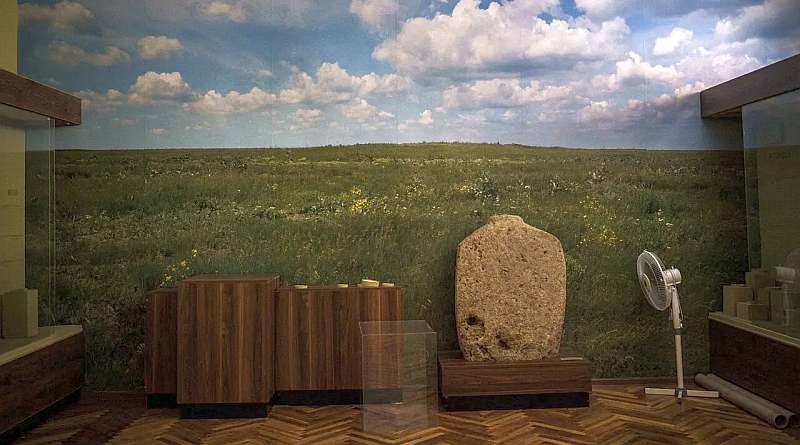
On the cover: Looted halls of the Kherson Regional Museum of Local Lore amid the Russian invasion of Ukraine, 12/22/2022. All photos: Dmytro Honchar/hromadske
