
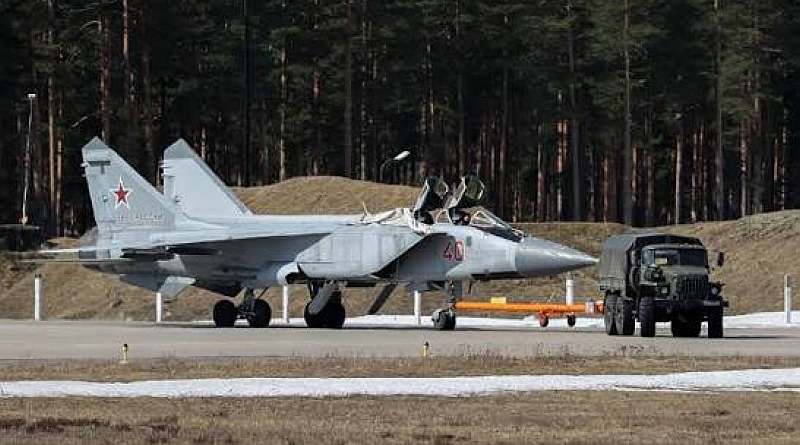
Tom Cooper / Translation by iPress
Tom Cooper claims that Ukrainian strikes on Russian oil refineries are already creating increasingly noticeable problems for the fuel logistics of the Russian Aerospace Forces (VKS), although military reserves are still significantly more protected than civilian ones. He explains why replacing specialized Russian aviation fuel RT-1, TS-1, and T-6 with international Jet A-1 is not a complete solution and may accelerate engine wear, limit altitude modes, and increase the risk of failure. The key factor is Russia’s separate military pipeline network through which aviation fuel is supplied to VKS bases, including from Belarus and remote refineries. Therefore, systematic repeated strikes on refineries and fuel infrastructure could have significantly more severe consequences for Russian combat aviation than a single reduction in civilian reserves.
A few days ago, someone asked about the state of fuel supply for the Russian Aerospace Forces (VKS).
Of course, for us “normal people” (and even for oddballs like me), it’s quite “normal” for the air force to be supplied with kerosene, so “airplanes just fly.” However, if you look closer, the topic of aviation fuel is actually one of the most interesting—and at the same time most speculative. Especially in any war.
The reality is somewhat different.
The basic question is very simple: jet aircraft need aviation fuel.
No, this is not a “controversial statement.” It’s not a “NATO thesis.” And it’s not “Western propaganda.” It’s that darn thing called physics. Jet engines burn fuel to generate thrust; without it, they can’t even make noise.
Other physics-related matters are just as simple. The VKS has about 1,200 combat aircraft. About 300 of them are actively engaged in the war against Ukraine. One combat sortie for a Su-34 requires approximately 4.5 tons of aviation fuel. The Su-35 requires about 5 tons. The MiG-31BM, if it takes off at all, requires over 16 tons. As of August, the VKS performs approximately 200-250 combat flights per day.
If we now apply simple arithmetic (I know, just the word itself now strikes fear in many internet users), it’s easy to calculate that, to maintain the pace of operations over Ukraine, the VKS needs at least 900 tons of kerosene per day, and most likely about double that. Every day…
Let me note right away: yes, civilian fuel reserves in Russia were minimal even before the war. As Donald Gill noted in his latest weekly review, they lasted for about three to four days. This summer, they suffered severe hits. Yes, strict refueling restrictions are in place at 26 Russian airports (including Pulkovo). And Moscow has banned all kerosene exports…
But Russia’s military fuel reserves were… uh… “significant.” Certainly “better than civilian.” Likely, there were enough reserves for “up to six months of intense operations” (meaning, that’s how they were before the full-scale invasion in February 2022…).
Simply put: Russia’s military supply system is a separate mechanism. Therefore, while Ukrainian strikes on Russian refineries have an obvious and visible impact on civilian life and fuel exports from Russia, the same cannot yet be said about Russian military reserves.
The main reason is that the armed forces are prioritized in Russia. Literally, one could say: “Su-34s are more important than Boeing 737s” (and Airbus, of course).
…and yes, there are reports of a “serious shortage” of both main types of fuel used by the Aerospace Forces: RT-1 and TS-1, although sources do not specify how serious. The fact is that Moscow has stopped exporting both types and has begun importing Jet A-1.
And here is where it gets most interesting.
Yes, the engines of Russian military aircraft—interceptors and fighter-bombers of the Aerospace Forces—are often praised for their “compatibility with Jet A-1” (the most common type of aviation kerosene in the world). Their fuel pumps are said to be so much more reliable than those installed on Western-made aircraft, that you can often hear something like: “Well yes, you can pour Jet A-1 into the tanks of a Su-34, it will start, take off, and fly. No problems.”
Well, yes and no. That is, initially—seems without problems.
Note: compared to RT-1 and TS-1, Jet A-1 is heavier and denser, contains more energy, has a higher flash point, better lubrication properties, different density, higher vapor pressure, but at the same time a higher freezing point and worse overheating resistance.
So the real answer to this question is: both yes and no.
RT or TS-1 can be replaced with Jet A-1, but simply pouring in another type of fuel and forgetting about the problem will not work. Using Jet A-1 in Russian military aviation inevitably leads to mechanical and operational complications.
In response to a related reader question, I have already compared this to “slow poisoning”: such fuel can quite possibly damage rubber seals, reducing maintenance intervals or, if the need for more frequent maintenance is ignored, increasing the likelihood of catastrophic engine failures.
Therefore, if in the coming days, weeks, or months you see or hear that some Su-35 crashed “out of nowhere,” supposedly “due to a technical malfunction”… there is a significant probability that the real cause was the fuel…
Several examples—and I’ll probably start with the most radical: attempts to fly the MiG-31BM with Jet A-1.

In practice, this is almost impossible. Firstly, the MiG-31 requires special T-6 fuel primarily because the principle of this aircraft’s operation can, to some extent, be compared to the circulatory system in our body. To simplify (oh no: certain “colleagues,” i.e., my biggest fans, are going to kill me for this), the MiG-31 “works” only thanks to the fuel pump system that continuously circulates the fuel throughout the airframe, even around the avionics bay, for essentially one purpose: cooling.
Why?
Because the MiG-31 engines generate an incredible amount of heat. Add to this the heating due to air friction at high speeds…
The first problem with using Jet A-1 is its higher freezing temperature compared to T-6. If the MiG-31, fueled with Jet A-1, flies in its usual mode – high (20,000-25,000 m) and fast (Mach 2+) – the fuel may freeze inside the tanks. If the fuel freezes, it won’t reach the engines. The consequence is simple: the aircraft will effectively be out of fuel and will crash, even if its tanks are still full.
So, if you see a video of a MiG-31 gliding smoothly into a field or forest with engines off, now you know one of the possible reasons…
Furthermore, Jet A-1 lacks the special chemical stabilization necessary to maintain its properties at high temperatures. On Russian jets, many fuel lines are routed close to the engines. Therefore, the T-6 for the MiG-31 is designed to withstand temperatures up to 280°C without breaking down. Jet A-1 is not. And this essentially (again, very simplified, to keep the text accessible to non-specialists) means: even if Jet A-1 doesn’t freeze in the tank, under high temperatures, for example, when the aircraft is flying high and fast, “thermal cracking” (“coking”) can begin: the fuel breaks down, leaves carbon deposits, clogs fuel injectors, damages the engine, etc.

Even if you take a less extreme example and fill up a Su-30, Su-34, or Su-35 with Jet A-1, the freezing point of Jet A-1 at −47 °C still matters.
Yes, Jet A-1 is denser, which means it contains more energy per unit of fuel mass (the author likely meant per unit volume – iPress). This means that the Su-34 on such fuel would theoretically have greater range and flight duration.
Cool, right?
Actually – not really.
There is a significant reason why special military fuels like TS-1 with a freezing temperature of −60 °C exist. First and foremost, the higher the aircraft climbs, the colder the air becomes, and using Jet A-1 poses the risk of freezing and engine stalling at high altitude. This means the Su-34 on Jet A-1 would need to fly lower and/or limit high-altitude and high-speed modes.
So, in essence, the VKS can use Jet A-1, but mainly for short flights at low altitudes. And currently, this is not the mode in which they can regularly perform their tasks.
Why?
Firstly, additives are extremely important for thermal stability, lubrication properties, anti-icing characteristics, and more. If “bad” fuel is run through the AL-31, coking, deposits, and turbine damage risks reoccur (this has happened before).
As previously mentioned, this won’t happen as quickly or as often as with the MiG-31 – not “immediately,” but “over time.” But over time, the cumulative effect will resemble the same “slow poisoning”: reduced maintenance intervals, increased wear (especially of rubber seals), and, consequently, a higher likelihood of catastrophic engine failures.
Secondly, aside from VKS interceptors, flying at high altitudes makes Russian fighter-bombers more vulnerable to interception by the Ukrainian side. Even if Su-34s can drop UMPK from a distance of 95–120 km, during many sorties they attack targets located quite deep behind the Ukrainian front line, thus entering the range of Ukrainian air defenses – whether interceptor fighters like the F-16 or ground-based missile systems.
In other words: it’s not good (unless someone wants to fly around shouting: “Kill me, shoot me down first,” of course).
That is why Ukrainian strikes on Russian refineries are so important. Yes, leaving civilians in Russia without fuel is “oh, so easy” and “oh, so fun.” But the real importance lies in cutting off fuel supplies to the Russian armed forces, which is why it’s equally crucial to strike already affected refineries again (which, however, is done too infrequently)… That’s why these strikes have had only a limited impact on military supplies so far, and therefore on the pace of VKS operations.
For example, Russians have resorted to importing TS-1 and RT from Belarus. I can’t remember exactly where I read this, but it seems in July or August, Moscow imported 22,000 tons of aviation fuel from Belarusian refineries.
You can be sure: this will continue until the pipeline used to transport kerosene from Belarus is also hit…
Meanwhile, if Ukraine continues to strike Russian refineries repeatedly, no matter how much their defense is strengthened, we can expect this “crisis” to deepen. And not just because of the physical shortage of TS-1 and RT. For example, a repeated Ukrainian strike on the Moscow refinery disabled the main fuel source for the VKS in the western part of Russia.
How so?
The thing is, this refinery was at the very center of the pipeline network that supplies the VKS in the western part of Russia.
Yes, you read that right: the Russian armed forces (and therefore the VKS) have their own pipeline system, separate from the civilian one.
It’s impossible to transport sufficient quantities of fuel across such a vast country as Russia solely by tanker trucks (Russians never even attempted this) or by railway: military pipelines are needed. And to be clear: each NATO airbase is also connected to military fuel pipelines, and NATO is currently expanding this system, especially towards Eastern European member states. That’s why there is the Moscow Ring Pipeline System around Moscow; branches go south to Voronezh and Belgorod (and beyond—field lines laid by the pipeline troops of the Russian armed forces). That’s why Ukrainians have already attacked this system (see “sabotage on the Moscow Ring,” operation “Vivaldi,” etc.).

No wonder: when such an important refinery near Moscow is disabled, a significant fuel supply problem arises. Currently, Russians are pumping fuel from deep Siberia and Belarus through their network, increasing restocking times.
Most importantly: after the strike on this refinery, the VKS were forced to reallocate fuel from “non-priority operations” to combat ones. This means cutting back on training flights, regular patrolling in non-combat areas, and the activities of military transport aviation (MTA).
In “five to six weeks”—that’s how long it is expected for the repair of this refinery—we’ll see if the situation improves or if the Ukrainians strike this facility again.
In the caption: Towing of the MiG-31D3 interceptor. Photo: Ministry of Defense of Russia
