
Every state, at a certain stage of its development, acquires its own name. Over time, the name can change under the influence of radical or evolutionary perturbations that give the name a distinct political coloring.
For instance, the current UKRAINE was once known as RUS, which imperial historians renamed Kyivan Rus to indicate that there were other Rus’. There was the RUTHENIAN KINGDOM, whose first anointed ruler was Danylo Romanovych, Prince of Galicia. There was the name ZAPORIZHZHIA ARMY, also known as the Hetmanate, later the Ukrainian People’s Republic and the West Ukrainian People’s Republic. There was the regrettably remembered Ukrainian Soviet Socialist Republic, one of the founding members of the UN. In any case, as “Ukraine,” the territory inhabited by Ukrainians was first named in the Kyiv Chronicle of the Ipatiev list in 1187 (12th century) in the context of remembering the death of Prince Volodymyr Hlibovych of Pereyaslav: “For him, Ukraine mourned greatly.”
European cartographers, considering that starting from 1237, the Mongol invasion came upon Rus, completely burning Kyiv in 1240, had access to these lands only after the destruction of Krakow, the establishment of the Volga Golden Horde, and the gradual pacification and decline of Batu’s empire. And in 1613, the indestructible name “Ukraine” appeared on the map.
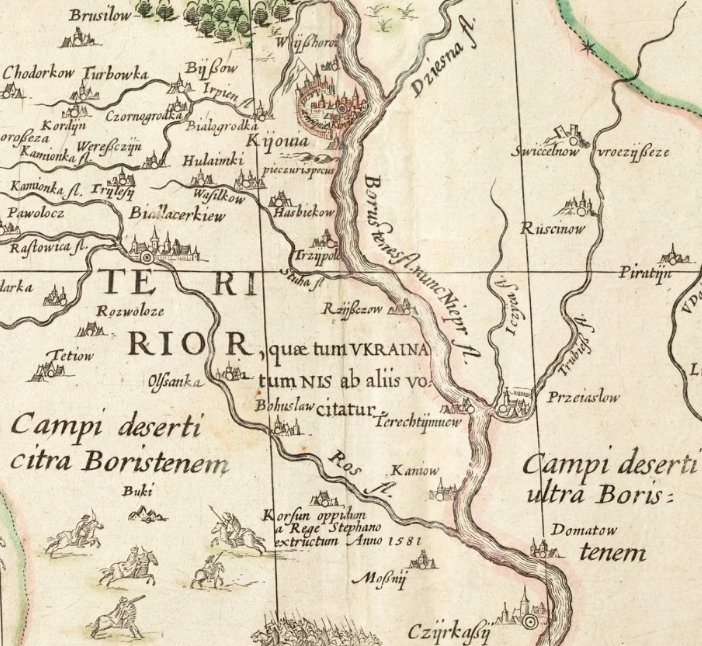
The same Ukraine, which, as is known, was invented by the Austro-Hungarian general staff with the guidance of the world proletariat’s Kalmyk Jew, Vladimir Ulyanov.
Generally speaking, geographic names are notoriously tricky. Peoples name themselves as they wish, paying no attention to anyone else. For example, the country where one of the world’s largest populations resides, which we are accustomed to calling “China.” However, it was never called China anywhere. It was mostly known during its existence as the country with a very resonant and meaningful title – “Zhongguo,” meaning “Central Country.” The Chinese themselves are called “zhongguo-ren,” which is not even a nationality but rather a citizenship. The nation is called something else – “Han.” Their language is Han. Besides the Han Chinese, there are 55 other nationalities in China, each with its languages. Yet they are all “zhongguo-ren.” And there is no changing it.
Does it mean that, having learned about this Chinese truth, we now and forever must refer to “Chinese script” as “Zhong script,” and “Chinese wall” as “Zhong wall”? To be politically correct towards the great Zhong people and the mighty Zhong culture. Oh, sure. Even by writing this quirky word and even pronouncing it with our imperfect Slavic speech apparatus, we won’t come any closer to adequacy, because the Zhong language is not just sounds and phonemes; it’s also the refined Zhong intonation, which we, wild barbarians from the Dnipro steppes, will never overcome. The only thing we can manage is to go to Beijing, which is actually called “Beijing,” and buy a t-shirt with friendly Han characters that say, “I am a stupid white European pig who doesn’t know the great Han language, and thus will die as a stupid pig.” And that will be the ultimate truth about us, stupid white Europeans.
Or let’s turn to a culture closer to us, entirely European, from which two great world wars emerged, wars that significantly ennobled the human race, spawning a series of masterpieces of world literature and establishing the rules and norms of international politics that all civilized nations wish to follow. Except, of course, those who don’t wish to follow them, occasionally shouting “Greenland is ours!” or “Let Crimea become the eighty-fifth subject of our great state!”
And we’re talking about a country that has long been called “Germany” in the Ukrainian language, meaning the country inhabited by “Germans.” And the word “German” in most Slavic languages means “mute,” someone who cannot speak the human, that is, our normal language. A clearly xenophobic racism and chauvinism. But it’s entrenched in the language. And the Germans, primarily, agreed with it and live that way. Presumably. Although… Why else would they have attacked us twice in the twentieth century? Maybe they didn’t like being called dumb mutes? Quite possible. Because the Germans themselves call their country “Deutschland,” which means “Country inhabited by people.” That is, “Deutsche” are simply “people.” As opposed to other surrounding living beings who are not people but are non-people. Such a cheerful tale about the indigenous German people. Does this mean we should desperately spit into our native Ukrainian dictionary and rename “the Federal Republic of Germany” to “the Federal Republic of Deutschland”? And should the feeble “deaf-mute” now be called “deaf-Deutsch”? I’m afraid our blessed parliament will not agree to such radical changes in internal and external politics.
What am I leading to? I am leading to the fact that how a state calls itself has never concerned anyone in the world. We will find our own, purely Ukrainian word for every spot on the map, which will enter all dictionaries, saints’ lives, and chrestomathies. And no one can forbid us: neither the UN, nor the IAEA, nor the IOC, nor even NATO.
And we approach the country that has always been a thorn in the side of our Ukrainian vision, as well as the eyes of all the surrounding peoples. In the history of humanity, there is no nation that, after encountering the great Russian nation, has not been filled with pure and genuine hatred for the brotherly Russian people. All the sagas, epics, and legends of the neighbors of this tribe on the Earth scream, hiss, and weep with curses and anathemas directed at the simple Russian Ivan, who managed to sow the seeds of humiliation and discord from the Baltic to the Pacific Ocean. And these seeds have grown and flourished, like any weed that has a strong life force.
How this state is called now is purely their internal matter. Historians worldwide know the exact course of events on the European part of the Eurasian continent, about how at the beginning of the 18th century, an impetuous descendant of the Kobyla dynasty, who had recently changed their name to Romanov for euphony, stole the name of a neighboring people, and since then the country’s population somehow brags about it. Perhaps because the heroes of the folk tales of this tribe mostly fed on theft, idleness, and sponging.
And we will see how those people were named by the very neighbors to whom the eternally underprivileged Ivans climbed for another’s bread. Personally, I am most struck by how the continuous occupiers were eventually named by the hot Estonian lads. The term has taken root in the Estonian language, it is not yet used in documents of a diplomatic nature, but considering the events of recent years – I would not exclude it. So, that poorly dressed, underdeveloped, and always unpleasant-smelling man came to be called by Estonians with the word that thug most often used at the beginning of any speech: “You, b***…” And so it was: we are Estonians, and that intruder who settled in the house of a shot Estonian writer – he is “tibla.” And he will die as a “tibla.” By the way, in modern democratic Estonia, there are plenty of those “tiblas,” it has always been cozy, cultural, European, homely there, every administrative Soviet “tibla” wanted to have an apartment in Tallinn and a house in Pärnu, and the children of tiblas to study at the world-renowned University of Tartu. Not a bad option for the name of the state “from the Volga to the Yenisei” – TIBLANDIA. It suits me. Let this be the first option.
But let us return to historical events. Throughout the 13th-14th centuries, the lands of Rus and Zalesye (north of Rus, beyond the Debryansk forests) thought of themselves as principalities, but in reality, they were uluses of the Golden Horde: the ulus of Kurumishi, the ulus of Nogai, the ulus of Mankerman, the ulus of Kartan, and other noble remnants of the ulus of Jochi. The Moscow ulus as an administrative unit eventually gained special significance, and when Ivan Kalita, meaning “Wallet,” obtained a yarlyk from the khan for governance (the nickname of the ruler clearly hints at his corruption), this ulus itself began to exploit its Ugro-Finnish subjects without the help of Tatar baskaks. Tax collectors, who were baskaks, were never liked, even in the Gospel tax collectors and Pharisees are lumped in the same disreputable basket. The main point is that Moscow distinguished itself from other Zalesye uluses and began its expansionist path, which led to its current moral and social collapse. Thus, historically, an alternative name for this state is THE MOSCOW ULUS. I will not clutter readers’ minds with information about the Tatar-Mongol origin of the ulus rulers or the decidedly non-Slavic inscriptions on their hats, crowns, and sabers, in the language of official communication in the state. The language became literary and suitable for use in a state document only after Pushkin. Before that, they spoke various languages in the territories of the Moscow ulus: Tatar, Polish, French… Therefore, the second option is the Moscow ulus. Historically correct, with a nod to Kazakhstan — the cultural heir of the Golden Horde and China — historically part of the same empire. All beautifully put, in my opinion.
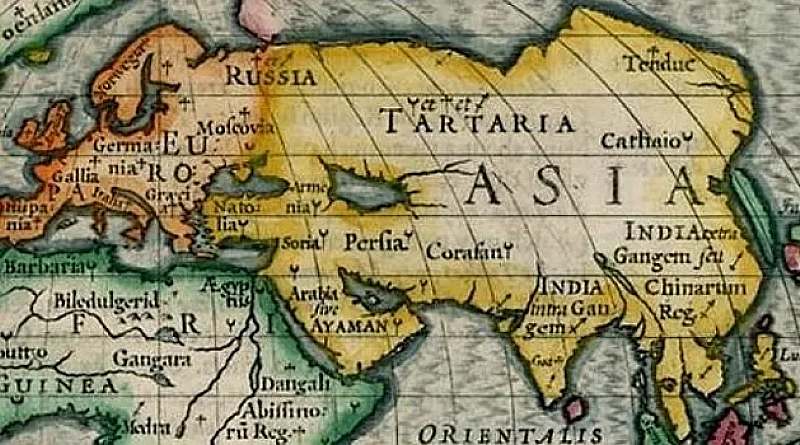
In Europe, people recovered after the Tatar invasion that came from the East, leaving a dark mark on consciousness: those lands beyond the eastern border are a dark and brutal evil, and nothing good can come from them. Forget, people, the times when the Kyiv prince distributed his daughters to European thrones, enlightening the wild Teutonic and Gallic knights who hadn’t held books in their hands. Now on the world maps, these lands are named with a terrifying and demonic name — “TARTARY” or “GREAT TARTARY“.
And why terrifying? Because the word “Tartar,” so resonant to the European ear with the word “Tatar,” has meant “hell” since ancient times, hellish torments. And for several centuries, during which Moscow princes measured strength with Lithuanian princes, as the latter clung to the Polish kings, Europe ignored all this turmoil, letting them wear each other out — thus the European mentality was nurtured. The history of Europe, with all its Reformations, centuries-long and Thirty Years’ Wars, Norman occupations of England, wars for the Spanish succession, in short, everything that constitutes European history and culture to this day, developed in absolute separation from the history and culture of the Eastern Slavs. Who, after all, were mostly Slavs only by language.
One way or another, for several centuries, what now occupies one-sixth of the Earth’s landmass was called “TARTARY” on European maps. Of course, cartography at that time was not an exact science, or even a science at all. This now allows certain writers to construct hypotheses about a mythical powerful empire, leaving behind graves with four-meter-tall titan skeletons and palaces across Europe with equally large doors and ceilings—all of which vanished into the same Tartarus. Well, then! In essence, there was a long period when the current aggressor was called as it should be—Tartary. Let this be the third option.
Let’s return to the northern neighbors of Tyblandia/Muscovy/Tartary. It turns out they paid no attention to how these Tybli wanted to name themselves, but called them as it was embedded in their linguistic consciousness. For example, Latvians, who are the current residents of Latvia, have always called their eastern neighbors “Krievija” (Kriviya).
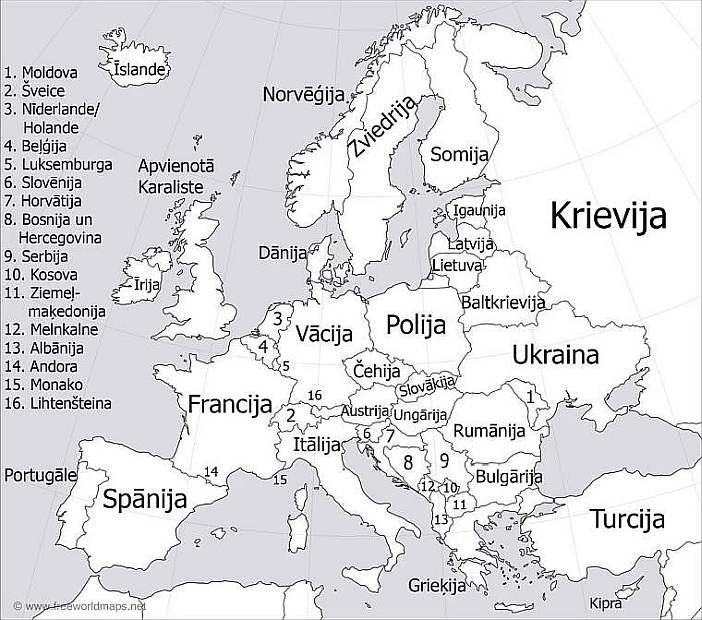
They didn’t care about all their neighboring great-power ambitions; they remember that the tribe, which from ancient times roamed their villages thieving, was called “Kryvichi,” presumably after their not quite upright legendary forefather Kryva, which then became Ilmen Slavs. In short, until a time machine is invented to study all the migrations of peoples over millennia, no one can guarantee anything. And the national memory of the Latvians said “Kriviya”—so KRIVIYA it is. That will be our fourth option.
There is another neighbor, who constantly had a hard time either from one aggressive neighbor—the Swedes—or from another—the Kacaps (Russians). They, too, resorted to a historical discourse, even deeper than the Latvians.
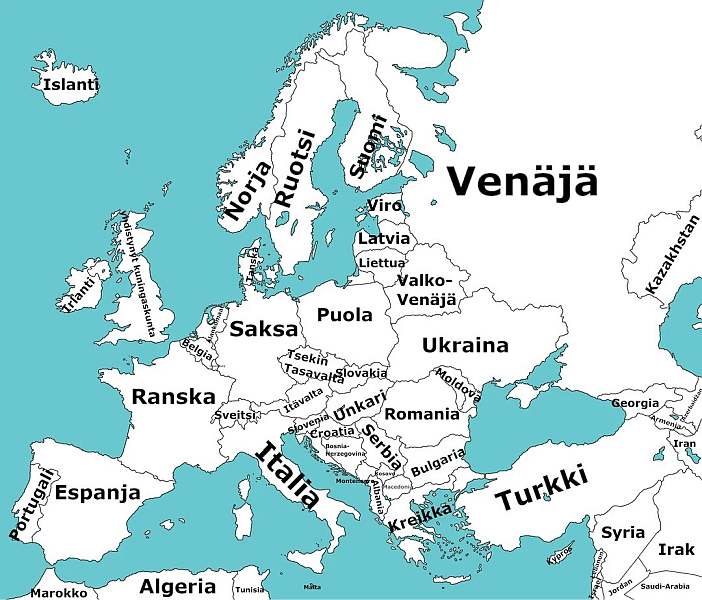
“Venäjä” (Venaya)—this is how the Finnish-Suomi call their restless neighbor. Bearing in mind that they originate from the ancient Greek and Latin word “Venedi”—a general Slavic name for all those tribes that lived far north for the Greeks. The Finns were an educated people, reading ancient classics in the original, so those strange Slavs, from whose Ural depths the Finns, with great difficulty, once clawed their way out, in their consciousness became the country of VENAYÄ. Let this be the fifth option.
There are a number of Caucasian and Asian peoples who may have suffered the most from the Muscovites/Katsaps. However, in the process of subduing the peoples of Siberia, Central Asia, and the Caucasus, no unifying force was found capable of opposing the predatory fury of the imperial nature of this tribe. Therefore, in most cases, the names of Russia in their languages varied with the root “rus/urus” in different variations, which does not allow us to speak of any special characteristic of naming from this vector.
Thus, summing up the options for the official renaming of the state of Russia for Ukrainian usage, let’s list them again:
Tybliandia;
Moscovia/Moscow Ulus;
Tartaria;
Kryvia;
Venaya/Venedya.
From Ukrainians and Don Cossacks we could add Katsapia.
Daring to propose the introduction into the Ukrainian language lexicon of one of those names that historically correspond to the essence of the neighboring state, may it decay, but already with another name, instead of the brazenly stolen name “Russia”. Based on the historical and linguistic experience of other countries, I do not see the need to duplicate the self-name of this state in Ukrainian usage. Such a replacement will contribute to the growth of both the national consciousness of our state and international authority.
Oleksandr Hlotov – Doctor of Philology, Professor, member of the National Union of Journalists of Ukraine.
