
When Putin starts talking about Ukraine supposedly invented by Lenin or about territories gifted by Stalin, we perceive it as propagandist nonsense – since we know the history of Ukraine and the Ukrainian people much better than he does, and most importantly, we are aware of it.
However, Putin’s statements have a message addressed not only to us. The Russian president is desperately trying to figure out why nothing worked out with Ukraine. After all, it seemed there shouldn’t have been any special problems. A large number of Russian-speaking people, who lived for centuries as part of the Russian Empire and the USSR, and even after proclaiming independence, continued to vote for openly pro-Russian politicians and their course. The election of Volodymyr Zelensky as president, who a few years prior hosted festive concerts in Ostankino and starred in films intended for both Russian and Ukrainian audiences – it was assumed that they were the same viewers, “one market.” So, from Putin’s point of view, Zelensky himself, like Kuchma before him, might have been tempted by power or “frightened by nationalists.” But the people who elected him – the “electorate” – remained the same! So why did it not work out neither in 2004 nor in 2022?
In search of an answer, Putin tries to shift the responsibility to the Bolsheviks, to Lenin, to the very structure of the Soviet Union. But what did Lenin actually do for Ukraine?
Let us recall the mindset of the inhabitants of future Ukraine in 1917. The national movement in the territory of the Russian Empire was rather weak; in the Ukrainian provinces, it traditionally relied on the countryside. Most Ukrainian politicians dreamed of a cultural minority – about territorial autonomy within a new Russia.
The year 1917 changed everything, primarily the positions of politicians who thought about territorial autonomy. The Bolshevik coup created opportunities for the proclamation of a new state. However, a large part of the population living on the lands of the proclaimed Ukrainian state retained an imperial mentality. Moreover, it was divided into both supporters and opponents of Bolshevik power.
After militarily defeating their political opponents in Russia, the Bolsheviks tried to reduce the danger of national movements. This is how the idea of territorial autonomies emerged, which in the case of the occupied new states were realized in the form of Soviet republics, intended to enter into a union with Red Russia. Stalin proposed to include the republics as autonomous entities within Russia – just as modern-day Tatarstan or Chuvashia are part of Russia. However, Lenin, under the influence of, among others, the head of the Council of People’s Commissars of the Ukrainian SSR, Christian Rakovsky, who did not want to lose his status as head of the government of a sovereign Soviet Ukraine, agreed to another concept: the republics create a new state – the Soviet Union.
In fact, it is the same Russia under a new sign, under the rule of one party. Formally, the residents of Soviet Ukraine who consider themselves Ukrainians may think they are living in a Ukrainian state — even if it is under the Bolsheviks. But for those without any Ukrainian consciousness, nothing seems to change either: they lived in the empire, and they continue to live there. And even more so, nothing changes for the inhabitants of Russia itself — they continue to perceive the united state as a great Russia under another name.
After Lenin’s death and victory over his political opponents, Stalin, who, as is known, was the Commissar for Nationalities, shifted from nationalizing life in the union republics to unifying them. This paradigm somewhat changed during the Second World War, when the authorities needed the support of all the peoples of the empire, not just the Russians. In Ukraine’s case, this led to the creation of the Order of Bohdan Khmelnytsky (the hetman ceased to be a feudal traitor to his own people, becoming a fighter for their independence), and to the tolerance of patriotic works by Ukrainian writers. After the war, this line was curtailed in favor of new Russification, but even before Germany’s attack, Stalin made a historical mistake, mentioned by Putin: the annexation of the western lands, where Ukrainians have a distinct national-political identity. These people also unexpectedly found themselves in an artificial state with Ukrainian attributes but without Ukrainian content. For most of them, Ukraine is a state, not a territorial unit, and this unites the new citizens of the Soviet Union with those Ukrainians who hold the same view of their country.
But what about the others? Those for whom such a Ukraine was not a value?
These people have lived for several generations in the Ukrainian SSR, which for them is part of the Soviet Union — but not at all Russia. And in this, they differ from the residents of the neighboring RSFSR, for whom everything in the USSR, from Estonia to Turkmenistan, is Russia, and especially Ukraine, since it is the “cradle of the three Slavic peoples” — Rus, that is, Russia.
Therefore, it is not surprising that when the Soviet Union disappears on December 1, 1991, Ukrainians with a distinct administrative-territorial identity vote the same way as Ukrainians with a national-political identity. And it is no surprise that Russians are puzzled by this, literally all of them — from Gorbachev and Yeltsin to a locksmith in Nizhny Tagil. And this is not because they are unaware of the existence of Ukrainian nationalists. They suspect they exist — somewhere in Lviv or Kyiv. But they are definitely fewer. Why did everyone else vote this way, why did they “betray”? Russians do not understand. But more interestingly, Ukrainians themselves do not understand either. Ukrainians with a national-political identity believe that the results of the vote mark the triumph of the national idea. And Ukrainians with an administrative-territorial identity believe they voted correctly simply because Ukraine is not Russia. And then they need to live as they did and build good relations with Russia — how else? That’s why the CIS was created.
Thus, Ukrainian independence became possible because it was supported by people with different motivations. For some, Ukraine was a national state. For others, it was a country that had existed for decades within the administrative borders of the Ukrainian SSR. They answered the question of what Ukraine is differently. They answered the question of whether it should exist the same way. And they answered the question of what it should be in completely different ways.
In the coming decades, all these groups will live within their own paradigms, not even trying to understand each other. Russians will try to forget about December 1st, reduce the collapse of the Soviet Union to the agreements of Yeltsin, Kravchuk, and Shushkevich in Belarus, and return to the idea of a unified country where Ukraine first becomes part of a union state again and then simply part of Russia. After all, in Russian political thinking, a chauvinistic vision prevails, where even the conditional compromises of the Soviet Union are seen as a mistake, and the Russian Empire of pre-Soviet times is the ideal. Ukrainians with national-political thinking will try to build a truly Ukraine-centric state that will become part of Europe and will be Ukrainian-speaking and Ukrainian-cultural. Both of our Maidans are primarily about this. Ukrainians with administrative-territorial thinking will strive to be left alone. To live in a comfortable state, earn money in Moscow if needed, vacation in Italy and France, speak the language they like, and go to church without caring whether it is Russian or Ukrainian. And to be left alone primarily by those Ukrainians whom they consider nationalists.
Ukrainians with an administrative-territorial identity refuse to believe that Russians will not leave them alone.
Differences in the perception of Ukraine are actively used by politicians and political technologists, primarily Russian ones, in practically all presidential and parliamentary elections. In the 2019 elections, administrative-territorial identity once again becomes the political choice of the overwhelming majority of citizens. Before the elections, presidential candidate Volodymyr Zelensky promised to carefully review the newly adopted language law. The conflict with Russia also seems close to resolution, as it’s believed that without “nationalists” in power, it will be easy to negotiate with Moscow. Literally everyone believes this. The virtually unavoidable start of a large-scale war is believed by literally no one. But it begins. And once again it proves that at a critical moment, when it comes to Ukraine’s existence, Ukrainians with a national-political identity unite with Ukrainians with an administrative-territorial identity against Russians, just as on December 1, 1991. Putin did not understand what Gorbachev couldn’t understand, who, on the eve of the referendum, in his first interview to Ukrainian television campaigned against independence—this country is valuable to all of us, no matter how we perceive it or who we are.
But this does not negate the fact that both during the war and after it, we will live in a country where these two identities—national-political and administrative-territorial—with increasingly blurred boundaries will continue to compete.
Ukrainians with a national-political identity will continue to wonder where young people come from who still speak Russian, attend Max Korzh’s concerts by the thousands, and mourn for Monetochka. They will wonder that these people essentially remain Russian-cultural even if they have never heard of Bulgakov or Kirkorov.
Ukrainians with an administrative-territorial identity will wonder about something else: why can’t the “nationalists” calm down? After all, no one stops them from speaking Ukrainian, listening to Vakarchuk or “Boombox”. So why, from their point of view, impose the Ukrainian language on everyone else?
We can only hope that the generations experiencing the war together will approach these cultural differences more calmly than those from the pre-war period, because they will be united by shared trials, not just a shared cultural world.
However, I do not undertake to speak about what post-war Ukraine might be like. At the very least, because none of us knows when the war will end, what borders the Ukrainian state will have, what its population will be, and from which regions its people will predominantly come.
Nevertheless, we must accept as a fact that we live in a state of such diverse identities. We can strengthen the influence of national-political identity through state education and cultural policy. But we must understand that this is primarily a way to bring Ukrainian national identity out of the marginalization imposed by empires. It will not quickly lead to the disappearance of the administrative-territorial identity of Ukrainians.
A Ukraine in which national-political identity will be not just predominant but the only one is not a matter of the near future.
We may continue to argue about what our state should be like. But as long as the majority of Ukrainians answer the question of whether it should exist in the same way, Ukraine has a future.
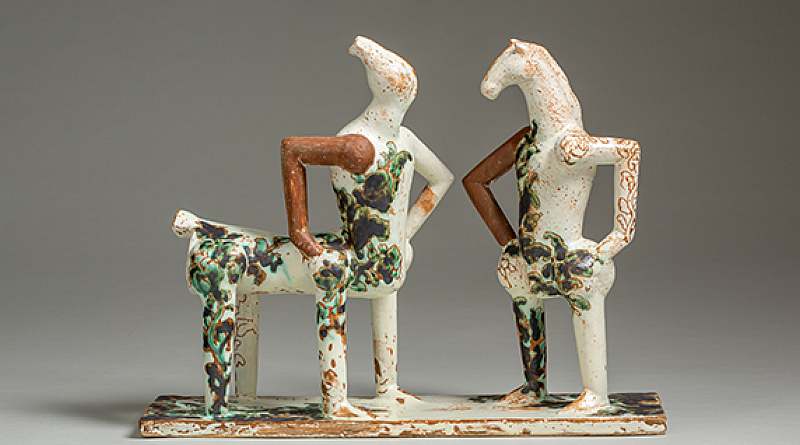
On the cover: sculpture “Rivalry” by Ukrainian ceramic artist Hanna Drul.
