
Olesia Zhyhaliuk, BBC News Ukraine
In the war against Ukraine, Putin had four trump cards. Two are already lost, but he still hopes for the other two, writes the Wall Street Journal.
Moscow does not intend to abandon the initial goals of the war — to subjugate Ukraine and change the security system in Europe established after the Cold War.
Russian negotiator Vladimir Medinsky confirmed this again on state television this week: “All the goals we set for ourselves will be achieved.”
It seems the Kremlin has decided not to hasten events.
Director of the Eurasian program at the James Martin Center for Nonproliferation Studies, Hanna Notte, believes that Moscow will wait until the spring of 2027.
Then it will be able to assess the results of missile strikes on Ukraine and the impact of the presidential elections in France.
Two plans failed
Initially, Putin expected to defeat Ukraine on the battlefield. However, despite huge losses, the Russian army could not achieve decisive success, writes the Wall Street Journal.
According to the publication, this year Russian troops advanced in eastern Ukraine at the slowest pace since the start of the full-scale war. Attempts to encircle Ukrainian positions in Donetsk failed.
The Ukrainian Armed Forces hold the defense, although they lack personnel.
Since the beginning of the full-scale invasion, Russia may have lost over 450,000 soldiers killed. This is evidenced by data from Rosstat, obtained by hackers linked to Ukraine and the Belarusian opposition. Some analysts mention an even higher figure — almost 600,000 dead.
One of the main reasons why the Russians fail to advance is Ukrainian drones.
“There are so many Ukrainian drones on the front line now that the Russian army can achieve noticeable success only in bad weather, when the drones cannot function fully,” explains Konrad Muzyk, founder of the Polish analytical company Rochan Consulting.

Putin’s other expectation – of Donald Trump – also did not come true. Returning to the White House, the American president promised to quickly end the war. During a conversation with Volodymyr Zelensky, he even stated, “You have no cards in hand.”
In Moscow, there was hope that Trump would pressure Kyiv to agree to territorial concessions.
But Ukraine did not agree to give Russia the lands it failed to capture.
Moreover, the Trump administration’s decision to effectively curtail military and financial aid to Kyiv also weakened Washington itself. There are now fewer opportunities to influence the course of the war and negotiations.
Certain leverage on Ukraine in the US still remains.
Volodymyr Zelensky reported disruptions in Starlink satellite communication, provided by Elon Musk’s SpaceX in coordination with the Pentagon.
Moscow also tried to persuade the US to ease sanctions. For this, American investors were offered lucrative economic projects. But the matter mostly did not proceed beyond discussions.
The Kremlin no longer hides its disappointment. In late October, Russian presidential aide on foreign policy Yuri Ushakov stated that the Americans “have practically nothing to offer” in negotiations.
“Putin is painfully aware that Trump cannot do more for him now. Therefore, he will continue the war until the situation in Ukraine changes or until he sees changes in Europe,” believes the founder of the analytical company R. Politik, Tatiana Stanovaia.
Winter as a weapon
Having failed at the front, Russia increasingly targets the Ukrainian rear.
The strikes hit power stations, warehouses, Black Sea ports, and bridges.
The Kremlin’s goal is to deprive cities of light, heat, and water, cause a humanitarian crisis, and deliver such a blow to the economy that the country cannot live and work normally.
So far, Russian shelling has not broken the resistance of Ukrainians.
But if infrastructure destruction continues, the economic situation could sharply deteriorate. Ukraine’s dependence on financial aid from other countries could increase.
Putin hopes for a split in Europe
Another bet for the Kremlin is that Europe will tire of helping Ukraine.
Economic difficulties, high energy prices, and increasing social spending reduce support for current governments. Political forces that oppose further aid to Kyiv exploit this.
Ukraine might face a significant threat if Marine Le Pen is elected President of France next spring. She promises to reduce aid to Ukraine—both French and European.
In Germany, the far-right party “Alternative for Germany” is gaining more supporters. It advocates for the renewal of large-scale purchases of Russian gas. In Italy, some politicians, both in the ruling coalition and in the opposition, are against aid to Ukraine.
This threat is discussed in the Guardian by Mujtaba Rahman, the European Director of the consulting firm Eurasia Group.
In his opinion, European leaders are paying too much attention to Donald Trump’s stance and finding an EU representative to negotiate with Moscow. Instead, they underestimate the consequences of Le Pen’s victory.
The US is no longer as actively supporting Ukraine as before. Since Trump’s return to the White House, Washington has not provided Kyiv with new military aid.
However, Ukraine still heavily depends on American weapons, including Patriot missiles, and intelligence that helps detect Russian ballistic missiles. According to Rahman, Europe will not be able to fully replace this support until at least 2030.
Even greater problems could arise if France changes its political course. If Le Pen wins, Paris could stop aiding Ukraine, block its increased contribution to the EU budget, and prevent the adoption of the next seven-year EU budget.
Also at risk is the planned €100 billion financial aid to Ukraine after 2028.
Furthermore, France could hinder Ukraine’s EU accession and block the extension of sanctions against Russia. Their term expires in July 2027, and without Paris’s consent, extending the restrictions will be difficult.
Russia cannot fight indefinitely either
Economic issues are becoming more evident within Russia itself.
The Wall Street Journal reports that military expenses are already consuming a third or even more of all budget funds.
The Kremlin is finding it increasingly difficult to cover the budget deficit. Some Russian regions are already forced to save and reduce payments to families of deceased soldiers.
“We are dealing with a very unstable system,” says Alexandra Prokopenko, a senior fellow at the Berlin-based Carnegie Center for the Study of Russia and Eurasia.
Despite these problems, Putin does not abandon his goals. He has not managed to defeat Ukraine on the battlefield. Nor has he forced Kyiv to capitulate with Washington’s help.
But now, Europe might become the weak link. And its support is crucial to determining whether Kyiv can continue resisting Russian aggression.
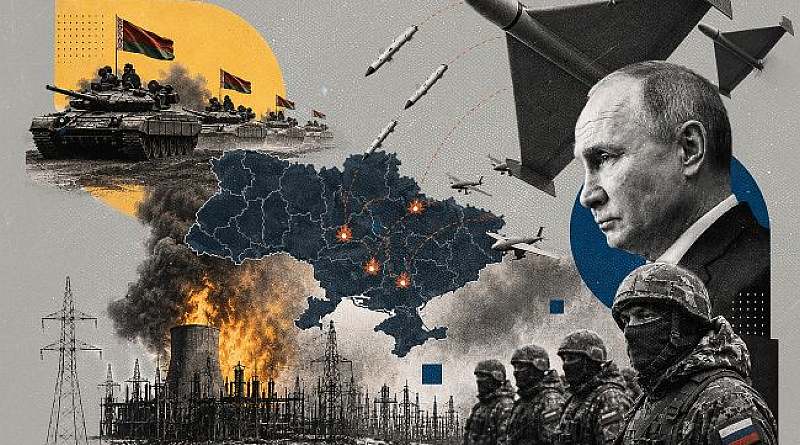
Cover collage: RBC-Ukraine
