
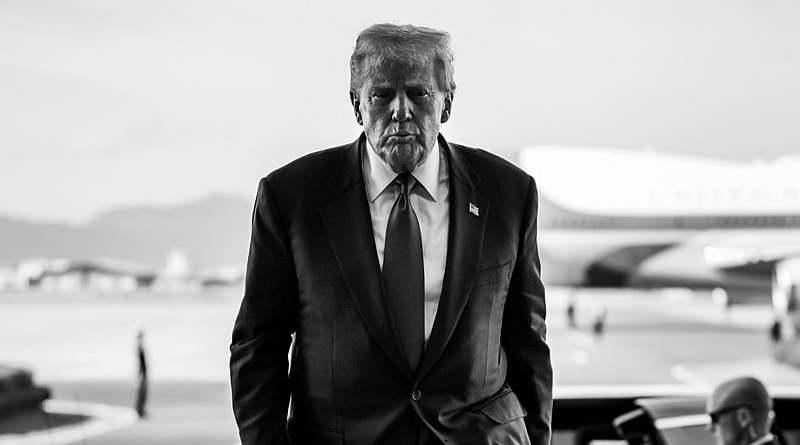

The approval rating of U.S. President Donald Trump has dropped to critically low levels, predictably bringing aggressive foreign policy and a “maximum pressure” strategy back to the global agenda. As reported by leading global media, the U.S. is seriously considering new forceful and extremely tough sanction scenarios against Iran and Cuba. While The Wall Street Journal and Politico actively discuss the possibility of further targeted strikes on Iranian military and nuclear infrastructure, Spanish-language media speculate on the preparation of unprecedented economic strangulation of Havana.
Washington’s goal is abundantly clear: it is the final dismantling of the communist regime on the Island of Freedom and a radical change of power in Tehran.
And here, amidst the loud headlines of the Western press, a completely logical question arises, which international observers now openly ask: where is Russia at this critical time, traditionally the main geopolitical sponsor and protector of these anti-democratic countries?
The answer is obvious both to the West and to Moscow’s disappointed “allies”: Russia is hopelessly mired in its own imperial ambitions.
The current geopolitical crisis ruthlessly exposes the first crucial thesis: today, Russia is absolutely incapable of providing effective support to its authoritarian partners. The war in Ukraine has catastrophically depleted the military, financial, and diplomatic resources of the Kremlin. If in the mid-2010s Moscow could afford a quick deployment of contingents, as in Syria, or the issuance of multi-billion-dollar loans, now the Russian military-industrial complex operates at the limit of its capabilities solely to replenish the huge losses on the Ukrainian front.
Cuba, on the brink of total energy collapse, did not receive from Russia the life-saving oil tankers it needed. Iran, desperately awaiting modern S-400 air defense systems and Su-35 fighters to protect against possible U.S. strikes, receives them with critical delays. Moscow has turned from a global security donor into a political burden, itself humbly asking Tehran for missiles and kamikaze drones.
The second threat to the Kremlin is existential in nature. Moscow will remain completely isolated on the international stage in the event of regime changes in Cuba and Iran. The Islamic Republic and the Cuban dictatorship are not just situational partners; they are key nodes of Russia’s anti-Western axis. The fall of the ayatollah regime will deprive Russia of a logistic corridor to the South and a crucial channel for gray technology imports to circumvent sanctions. The collapse of the dictatorship in Havana will permanently take away Moscow’s last geopolitical foothold in the Western Hemisphere. Without these two allies, the concept of a “multipolar world,” which Russian state propaganda feeds to its domestic audience daily, will finally turn to dust. Russia will find itself in a geopolitical vacuum, tightly squeezed between a consolidated West and a pragmatic Beijing, for which a weakened, satellite-less Moscow is merely a cheap raw material appendage.
In such difficult conditions, the Kremlin faces the real prospect not only of foreign policy bankruptcy but also of internal destabilization. The blatant inability to protect its ideological partners demonstrates the system’s weakness.
The conclusion is self-evident: only withdrawing from the war against Ukraine can at least partially stabilize Putin’s regime. The immediate cessation of aggression is perhaps the authorities’ last chance to free resources stuck in endless battles, slow down economic degradation, and attempt to regain subjectivity.
Without this step, Russia is doomed to helplessly watch as Washington methodically eliminates its allies while it rapidly descends to the status of a rogue state.
Photo: The White House
