
In 2025, Netflix released a documentary, “Marines.”
It was about the 31st Marine Expeditionary Unit of the US Marines. It is stationed in Okinawa, Japan, and is tasked with responding to threats in the western Pacific region. Essentially, it is a rapid response group with a total strength of up to three thousand people. The entire documentary is dedicated to how the unit conducts training exercises.
The series has one important point: the psychological problems of soldiers are not limited to PTSD. Moreover, they may also experience “shame of non-participation.”
One of the senior sergeants in the unit spoke in the film about how his entire service he was prepared for war. The problem was that a real war never happened for him. He was not sent to Iraq or Afghanistan, remaining on the “Pacific front line.” As a result, he lives in a constant existential gap. The efforts he put in were never tested in battle, and the experience of “non-participation” threatens with a feeling of emptiness, comparing himself with other marines leads to frustration.
And if the trauma of what was experienced leads to posttraumatic stress disorder, then the “trauma of what did not happen” leads to doubt, depression, and self-devaluation. Shame that can cripple no less than combat experience. If you didn’t meet others’ and your own expectations, you’ll have to live with it further.
I often think that we risk falling into a similar trap.
In the fifth year of the war, we have developed a veteran standard. We see it on billboards, recruitment brochures, and city lights. It invites the interlocutor to “prove themselves,” “become a legend,” and “gain strength.” He is strong, brutal, and bearded – completely matching the stereotypical notion of what a military professional should look like. The problem is that not everyone in the Ukrainian army looks like this.
Our army is arguably the most populous of all. People bring their civilian skills and habits to the war. Their appearance and the imprint of their life experiences. The manner of speaking and dressing. The army changes you, but decades of civilian background hold like a root system. Therefore, even the fifth year of war doesn’t necessarily make you resemble a role model from the brigade billboard.
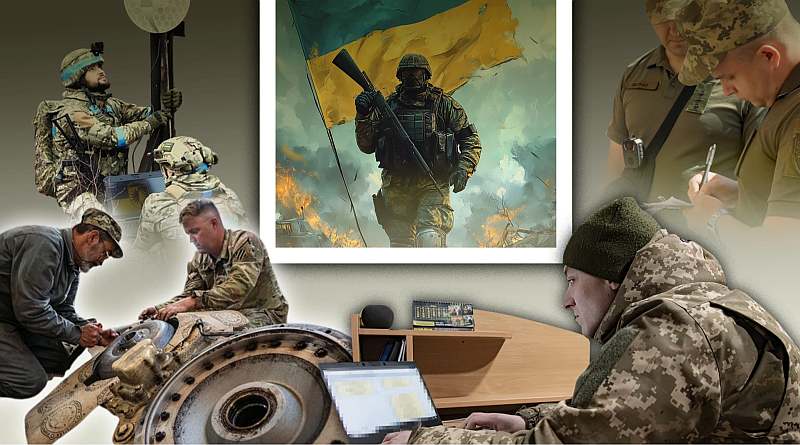
Moreover, the variety of army professions is not limited to assault tasks. For every fighter on the front line, there are several who support them. They repair his vehicle. Provide him with logistics. Handle accounting and write-offs. Service drones. Prepare meals. And if the entire description of a veteran is reduced only to heroes from posters, then the second group will live with a feeling of their own non-conformity to the standard. They do not recognize themselves in the description, do not see their relevance to the image, and may doubt how much their contribution to the common cause deserves recognition.
In any combat battalion, there are non-combat positions. In each brigade, there are not only combat battalions. The army system is multi-layered, and there is room for various specialists with different service geographies. Most of them will only shoot on the range, and the nature of our war is such that one can spend years in it without ever being in a firefight.
At the same time, the “hardships and difficulties” of army service affect everyone. You are integrated into a hierarchy, remain on duty around the clock, surrounded by a fence of restrictions, and see your family only during leave. You might be on duty at the command post, servicing drones for crews, sorting out army accounting, being a signalman or mechanic – and still be part of the barrier that protects the country. Even if you don’t have to shoot, take positions, and hide from FPVs.
Glorification of service is the most natural thing that can happen during war. But the standard of this glorification can be broader than the current framework. So that everyone who doesn’t recognize themselves in the photos on recruiting brochures fits into it.
Especially considering that army advertising addresses an audience that no longer exists in the rear. Those who wanted to “find their pack” and “prove themselves” have long been serving. This value profile is not very large in any country, and its carriers usually engage in the war at the onset. We need to talk differently to those who remain in the rear.
It would be a mistake to think that only “dodgers” are left in the rear. They are usually the loudest, creating the impression of their ubiquity. Dodgers can organize a festival of despair in comments, yet we are not only discussing mobilization with them. A more important category is the fatalists.
Fatalists live by the principle “if called, I’ll go”, “if not called, I won’t”. Much of the monthly replenishment that comes to the army without incidents and scandals consists of them. They mostly do not avoid responsibility, but unlike “volunteers”, they do not seek risk or challenge, but the rules of the game. We need to speak to them not in the language of service glorification, but by explaining duties. They want to understand what awaits them and what is expected of them. Pathos might scare them because they perceive chaos in it. We need to talk calmly, structurally, and honestly to foster mutual trust.
The problem with current agitation is that it doesn’t explain to the “fatalist” their future service. It doesn’t talk about what their reality will look like. It doesn’t explain the rules of the game and the requirements for the candidate. When a fatalist sees yet another storyline about an incredible front-line feat, he is only reinforced in believing that there are “born warriors”, whereas he is not. The heroization of service sharpens his sense of mismatch with what he sees. He could be reassured by the routinization of service, which would show role models proportional to himself. But instead, Scandinavian gods still look down on him from billboards.
To some extent, the army has become a hostage of glorification. Some in the rear fear its role models. Others in the rear are intimidated by its role models. And when military families try to explain that army life isn’t exhausted by these forms of participation, they are accused that their husbands’ service is “not real”.
Army role models need revising. To include those who do not resemble Vikings – neither in appearance nor in their line of work. So that those who are ready to exchange a job in the rear for a similar one in the army can recognize themselves in them. So that these role models embody the diversity that distinguishes a real army from a poster one.
We need technicians and mechanics. Clerks and bureaucrats. Engineers and programmers. There is a place and application for everyone. Everyone deserves their share of recognition. Everyone will have the right to be proud of themselves and their service.
War is a collective sport. “Shame for non-participation” will fall on those who decide that the army can do without them.
Collage: Andriy Kalistratenko/UP
