
Anthony Zurcher, BBC North America correspondent, Sean Coughlan, Royal Correspondent, BBC News Ukraine News Department
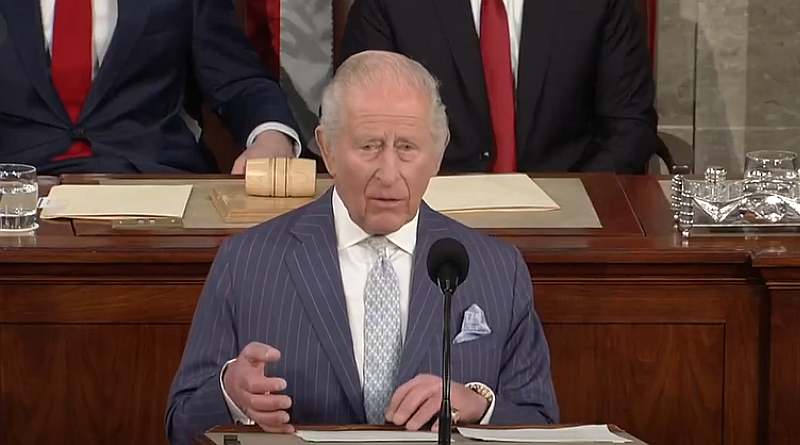
“We gather at a time of great uncertainty – amidst conflicts from Europe to the Middle East, presenting us with extremely complex challenges,” King Charles III addressed Congress.
Speaking at the Capitol building, he warned that in today’s “more unstable and dangerous” era, both countries must stick together, and he explicitly stated the need to support NATO and Ukraine.
This visit marked the most significant diplomatic moment of his reign amid rising political tensions between the US and the UK – and even before the speech began, the King received a standing ovation.
The speech was interrupted about a dozen times by loud applause and additional ovations.
King Charles III’s visit to the US was intended as a celebration: the 250th anniversary of America, the enduring Anglo-American ties, and “special relations.” However, it is also viewed as an attempt to ease tensions.
Once the US and UK partnership in defending democratic values was perceived as self-evident.
But after recent disagreements, such confidence is no longer there – and the King came to restore this alliance in front of an audience that included Vice President JD Vance and influential political figures from both Republicans and Democrats.
The last time a British monarch addressed both houses of the US Congress was 35 years ago – in 1991, when it was done by the King’s mother, Queen Elizabeth II. That era coincided with the fall of the Berlin Wall, the end of the Cold War, and a period of self-assured liberal democracy.
Now King Charles had to become a symbolic defender of values at risk, to speak about the international rule of law and the importance of shared faith in “democratic, legal, and social traditions.”
“It felt like a civics lesson in one of the leading seats of democracy,” commented BBC correspondent Sean Coughlan.
War in the Middle East
At the beginning of his speech, King Charles III mentioned conflicts in the Middle East and Europe – topics that have recently become sources of tension in UK-US relations.
Thus, the King’s goal was to soften these discrepancies through diplomacy and personal influence – primarily through his address to Congress on Tuesday.
“I am inspired by the profound respect that emerges when people of different faiths strive to better understand each other,” said the King, calling for peace amidst unpredictable conflicts in Iran and the Middle East.
However, in a later speech at a state dinner at the White House, President Trump seemed to state that the King supports his stance on preventing Iran’s nuclear program – despite the UK and US having previously publicly disagreed on the Iranian issue.
“We defeated this particular enemy militarily and will never allow them… Charles agrees with me – even more than I do… we will never let this enemy obtain nuclear weapons,” Trump told dinner guests.
The King typically avoids such political topics, and Buckingham Palace did not comment on these remarks.
Relations with NATO and Support for Ukraine
Quoting former U.S. Secretary of State Henry Kissinger, the king spoke about the transatlantic partnership and reminded – not for the first time from America’s European allies – that the example when NATO mobilized forces to defend one of its member states was after the September 11 attacks carried out by “Al-Qaeda”.
Trump repeatedly spoke disparagingly about the British navy, which is traditionally a source of pride for the kingdom. He called British ships “toys” and aircraft carriers “not working”.
King Charles, who served in the Royal Navy for five years, specifically mentioned his own military experience – using it as a reason to discuss the advantages of security and intelligence cooperation between the two countries, as well as between America and Europe.
King Charles emphasized that the strength of the partnership between the USA and the UK has repeatedly helped to confront common enemies and make the world safer.
Now, according to him, this strength is needed to protect Ukraine, which is at war with Russia.
“Today, Mr. Speaker, the same unwavering determination is needed for the defense of Ukraine and its extraordinarily brave people – to ensure a just and lasting peace,” he stated.
Such speeches are prepared with the participation of the Foreign Office, and this time they contained a clear signal to U.S. President Donald Trump, who repeatedly demanded that America’s allies increase defense spending.
“Our country, preparing for the future, has committed to the largest and longest increase in defense spending since the Cold War,” the king stated.
He even found a way to touch on the topic of climate change – an issue long personally important to him.
“From the depths of the Atlantic to the catastrophically melting ice caps of the Arctic, the dedication and professionalism of the United States Armed Forces and their allies underpin NATO – an alliance committed to defending each other, safeguarding our citizens and interests, ensuring the security of North America and Europe from common enemies,” the king stated.
Signal for Democrats
At the same time, in the king’s speech – the first since Queen Elizabeth II’s address to Congress in 1991 – there were themes that could inspire Democrats and simultaneously cause concern in the White House.
When King Charles reminded that executive power, “limited by a system of checks and balances,” is a British legal tradition enshrined in the Magna Carta and later laid at the foundation of the U.S. Constitution, he again received applause.
The applause initially came from the Democratic side of the hall, and then filled the entire Congress.
Critics of Donald Trump from the left political flank have repeatedly accused the president of what they view as abuse of power. The conviction that the president should be under strict control of the system of checks and balances became one of the key impulses of the “no kings” movement, whose actions over the past year have gathered hundreds of thousands of people across the country.
Later, at the end of the speech, one of the king’s concluding phrases elicited a muted reaction from the Democrats – both approving and wary.
“America’s words carry weight and significance – since the very declaration of independence,” said the king. “But the actions of this great nation bear even greater weight.”
Democrats are well known for their criticism not only of Trump’s actions but also of how he articulates them.
Consciously or not, it seems the liberal part of the audience perceived the king’s speech as a warning signal for the country – and at the same time, an opportunity to publicly express their sentiments “without kings.”
Without Mention of Epstein’s Files
This state visit also brought personal pressure on the king and queen amid the toxic aftermath of the scandal surrounding Andrew Mountbatten-Windsor.
One of the main questions surrounding King Charles’s visit was whether he would mention Jeffrey Epstein in his speech or address the victims of the late sexual offender.
He did not.
The closest he came was a veiled remark about the need to “support the victims of some misfortunes that unfortunately still exist in our societies today.”
For those who called on the king during his stay in the USA to meet with the victims in the Epstein case, this comment might be insufficient.
Nevertheless, the scandal surrounding Epstein has had more serious consequences in the UK than in the USA, where few current political figures have suffered real losses.
And even if this topic was not mentioned in the speech, it does not disappear from the headlines – and the full picture of what happened in the USA may still only be emerging.
Royal Humor
Given the seriousness of the goals the king set for himself – as nothing less was at stake than the future of relations between the USA and the UK – his speech sounded surprisingly witty at times.
He began with the famous Oscar Wilde quote that the USA and England have everything in common “except, of course, language.”
The king joked about a British parliamentarian being “taken hostage” every time the monarch speaks at Westminster, and inquired if anyone in Congress volunteered to take such a role this time.
He also ironically noted that for a country with such a long history as the UK, the independence of the USA happened “literally days ago,” and assured that he did not come to America with a “sly plan” to restore British rule.
Jokes were also made during the state dinner. The king ironically referenced America’s colonial past.
“Recently, Mr. President, you said that without the United States, European countries would be speaking German,” he noted.
“I dare to add: if it weren’t for us, you would be speaking French,” he addressed the guests.
After a difficult period in relations between London and Washington, the king’s mission was challenging – trying to restore trust. He leveraged his own authority and Trump’s interest in the monarchy to revive a sense of transatlantic partnership.
The British delegation, including Foreign Secretary Yvette Cooper, received the speeches – in Congress and at dinner – with optimism. The king spoke of serious matters, while President Trump largely avoided sensitive topics.
There were neither demonstrative exits nor protests related to the Epstein case victims, likely due to the fact that the visit’s early days occurred in strict security mode without public access.
Trump looked particularly pleased with the gift the king presented to him during the dinner – an original bell from the wartime submarine HMS Trump.
“And if you ever need to contact us – just ring,” the king joked.
This positive atmosphere and loud applause in Congress gave the British side hope that the situation had moved from a deadlock.
As the king himself expressed, it became a “story of reconciliation, renewal, and exceptional partnership.”
Whether public words – and probably conversations behind closed doors – will be enough to strengthen the Anglo-American alliance remains unclear. However, after the afternoon meeting at the White House, Trump appeared satisfied.
“He is an extraordinary person,” the president said about the king. “They are amazing, and it is a great honor for us.”
Cover photo: screenshot from video
