
Ariana Gic, Gabrielius Landsbergis, and Roman Zon, in their column for the Royal United Services Institute (RUSI) website, urge Europe to stop hiding behind rhetoric supporting Ukraine and finally take direct military responsibility for the outcome of this war. In their opinion, the current European policy of “help but not fight” effectively plays into Putin’s hands, who bets that Ukraine will eventually exhaust its resources without real allied intervention. The authors insist that the first practical step should be a humanitarian military mission to protect Ukrainian skies and civilian infrastructure—an action that is not an act of war but would fundamentally change Moscow’s strategic calculations. Ultimately, they argue, the geopolitical future of Europe itself as a global player is being decided right now in Ukraine, and Europe’s inaction is a conscious choice for its own defeat.
Only Europe can take the actions necessary to defeat Russia, save Ukraine and the rules-based international order, and restore the geopolitical strength of the bloc.
Europe’s red lines regarding support for Ukraine effectively invite Putin to destroy increasingly larger parts of Ukraine and further dismantle the rules-based international order. While Ukraine defends NATO countries’ peace from Russian aggression, Europe’s political formula of “supporting Ukraine as long as it fights” is humiliatingly insufficient. To assert its geopolitical power, Europe must act in Ukraine.
When Ukrainians are asked what support their country needs, most politicians in Europe prefer that they do not answer honestly. Ukrainians are allowed to talk about military aid, financial support, strengthening sanctions, or even international justice for Russian war crime perpetrators, but the expectation of direct European military involvement in the Russian war is a taboo topic. This is a red line that causes discomfort among Ukraine’s friends and anger among Russia’s friends in Europe.
After 12 years of one of the bloodiest wars on the planet since World War II, Europe continues to expect Ukraine to defend itself against the war and genocide waged by Russia on its own. The determined refusal by European governments to even hint at possible military action in Ukraine remains Europe’s main geopolitical weakness. It also allows Moscow to believe it can achieve its genocidal objectives in Ukraine by prolonging the war, relying on Ukraine running out of people and resources for self-defense.
The future of a unified Europe as a global force depends on Russia’s war against Ukraine. Russia’s defeat could secure this future. This goal cannot be achieved if Europe remains on the sidelines of the struggle and shifts its own defense against Russia onto Ukraine. The Sleeping Giant of Europe may not be awakened by conference speeches, but by actions that prove its power. Europe’s strength is determined by its ability to act in Ukraine. The first step of this awakened giant should be a humanitarian military mission to help protect civilians and critical infrastructure—especially nuclear facilities—from Russia’s war of destruction.
The grim consequences of inaction catch up with Europe
European leaders tend to ignore the fact that their inability to act decisively against Russia has undermined Europe’s ability to project power. Their fear of taking risks has turned the powerful alliances of the European Union and NATO into a “gilded cage,” trapping European countries between the appeasement policies of Putin and Donald Trump, the inability to assert their own strategic autonomy, and the loss of ability to demonstrate real strength.
The political slogans of European leaders reflect a consistent fundamental idea underlying European politics over the last four years: the war with Russia is a war that only Ukraine should fight. The slogans have changed, but their basic message has remained the same—from Biden’s era formula “We will support Ukraine for as long as it takes” to Ursula von der Leyen’s recent call to “turn Ukraine into a steel porcupine,” while awakened Europe takes responsibility for its own security. Other rhetoric—such as “it’s up to Ukrainians” to decide how the war should end—often masks Donald Trump’s turn to pressuring Ukraine to concede to Russia through a “peace agreement.” The recent call to “keep Ukraine strong in the fight,” aimed at re-energizing military aid to Ukraine, suppressed by Trump’s “peace negotiations,” also highlights the unchanging European policy prioritizing external military aid over direct intervention. Even politicians who acknowledge that there is a “war in Europe” act as if defending the continent from Russian aggression is solely Ukraine’s responsibility.
For decades, European elites kept Ukraine outside of the European Union and NATO to avoid confrontation with Russia. They believed that Ukraine’s membership would weaken the EU by undermining the benefits that the largest European economies received from Russian energy sources, and that it would weaken NATO by exposing the alliance to a higher risk of confrontation with Russia. They also acted on the illusion that the high walls of their “European fortress” would protect them from aggressive Russian revanchism. They mistakenly believed that Russia’s ambitions would end at the borders of former Soviet states not in the EU or NATO, assuming that European interests would never be directly challenged.
However, the reality of geopolitics bitterly proved their mistake. From the very beginning of the Russian aggression, the turning point of the global balance of power was located in Ukraine. The Western response to Russia’s war defines the nature of the collective West, the rules of the international order, and the West’s ability to deter the aggressive ambitions of global “forces of unfreedom,” led by the Chinese-Russian alliance.
Unjustified restrictions in supporting Ukraine have harmed the projection of Western power and undermined the rules-based international order. These restrictions include:
- Absence of an Economic Embargo: No comprehensive economic embargo has been imposed against Russia. EU sanctions remain “targeted” to exert limited pressure while minimizing losses for European economies.
- Protection of Frozen Sovereign Assets: Although approximately €210–280 billion of Russian sovereign assets remain frozen in the West, they have not been confiscated using countermeasure mechanisms to provide Ukraine with sufficient resources for self-defense.
- Lack of Legal Accountability: No Russian perpetrators of war crimes, crimes against humanity, or genocide have been brought to international justice. Ukraine has been denied the establishment of an international tribunal for Russia’s aggression under a UN mandate. Moreover, there are clear signs that some EU governments intentionally delay the creation of a Special Tribunal for the crime of aggression against Ukraine, using justice for the war’s victims as a bargaining chip at the negotiation table with Moscow.
- Absence of a Humanitarian Military Mission: No Western country has sent a humanitarian military mission to protect Ukrainian civilians or critical infrastructure, including nuclear. This refusal persists despite Russia targeting the protective containment of one of Chernobyl’s reactors, threatening regional nuclear safety, and despite Russia’s deliberate attempts to plunge Ukraine into a humanitarian crisis this winter by destroying power grids in extreme cold temperatures.
- Reluctance to Join Collective Self-Defense: No Western country has joined Ukraine in its legitimate self-defense under the UN Charter, leaving Ukraine alone against the world’s second-largest army, posing a real threat to EU and NATO members. Today, ordinary Ukrainian civilians defend Europe, sacrificing families, personal lives, and professional careers, risking their lives on the battlefield, and enduring brutal torture if captured by Russian forces. Meanwhile, trained professional NATO armies—tasked with defending Europe from the Russian threat—merely await politicians’ decisions while the Russian army kills Ukrainian soldiers’ relatives in their beds with airstrikes hundreds of kilometers from the frontline.
- Weaponry Limitations: Western countries continue not to provide Ukraine with long-range weapons crucial for weakening Russia’s capacity to carry out airstrikes on Ukrainian civilians and critical infrastructure. Many Western countries still impose unjustified restrictions on the use of their weapons against legitimate targets on Russian territory, effectively protecting Russian military production and storage facilities and allowing Moscow to increase military potential.
- Limitations on Russia’s Isolation: Russia’s rights and powers in various international organizations remain largely untouched, including in the Organization for Security and Co-operation in Europe (OSCE) and the UN General Assembly (despite precedents).
- No travel bans imposed: No Western country has imposed an entry ban on Russians, and only Estonia has banned entry to the Schengen area for Russian combatants who fought against Ukraine.
- Limited sanctions against Belarus: Belarus is an important ally of Russia. Recently, the Trump administration lifted part of the existing sanctions, undermining the economic isolation of the regime involved in Russia’s war against Ukraine and continuing to aid in circumventing sanctions against Russia.
- Russia’s “hybrid war” against the EU remains unanswered: European governments have essentially allowed Russia to conduct a “hybrid war” against EU countries, creating a conceptual “gray zone” between supporting terrorism and acts of aggression – a space where Moscow can act with impunity and which does not require any immediate practical response from the EU governments besides strengthening deterrence.
This incomplete list shows that the Western response to Russian aggression, especially from European states, is disproportionate to the severity of Moscow’s atrocities in Ukraine and the global threat they pose.
Years of a compromise policy of non-intervention in Russia’s criminal actions have seriously weakened the EU and NATO, putting Europe’s freedom at stake. Only Ukraine’s continuous, unyielding, and bold resistance protects the continent from falling under Russian subjugation.
The West’s inability to uphold a rules-based order signals its weakness.
The lack of political resolve to counter Russia has manifested as Western weakness in defending the liberal international order — the source of its authority in international relations. American assaults on Venezuela and Iran may have demonstrated that the White House can wield the great military power of the US to advance its own interests, but they also showed that Washington is not committed to adhering to international law. Instead, the US further undermined the very idea of universal rules that apply to all. The ability to use violence or the threat thereof to achieve objectives in international relations, unilaterally defined by the political leader of one major world power, can hardly be considered a viable basis for order.
The return to great power rivalry is a degradation of international order, destined to bring even more global suffering through the spread of inequality and disparities.
The West’s failure to uphold a rules-based order, further exacerbated by divisions caused by Trump, has accelerated a global geopolitical rebalance. The recent statement by Chancellor of Germany, Friedrich Merz, about the death of this order is a recognition on the global stage that the West is retreating from defending the principles of a just world. But this is a misguided approach. Although the American “break” with transatlantic allies ended the Western-led world order, abandoning the basic set of rules prematurely is a mistake — it was shaped long before the power architecture underlying the post-World War II order.
Destroying the good forged by the sacrifices of millions in World War II and the efforts of subsequent generations is not leadership, but a failure of responsibility. Europe must learn from the devastating lessons of the 20th century to avoid the reckless path currently taken by the US administration. Embracing a new era of uncontrolled great power rivalry means playing with human lives on a catastrophic scale. Instead of degrading to the imperial order of the 19th century, 21st-century humanity needs an evolutionary update of our post-war architecture to meet contemporary challenges.
Moscow and Washington want to turn back history
For two decades, Putin has been striving for a “Yalta 2.0” – to return the world to the balance of power of 1945, when Russia was institutionally established as a world hegemon. Russia, having lost its status as a global power after the collapse of the Soviet Union, stubbornly seeks revenge. The main tools for restoring its influence have become aggression, force, weaponizing everything that gives it leverage – from energy to media, capturing international organizations, corrupting foreign political actors, and discrediting business. Moscow has felt so unpunished that today Russian intelligence is already running a “terrorism online supermarket” on social networks, recruiting people to carry out terrorist acts across Europe.
With each day of the Trump administration’s rule, it is becoming increasingly clear that the US administration wants to eliminate international rules and institutions that have been formed over the last eight decades to contain major powers. The American administration wants the UN to “return to basics”, discarding all international mechanisms and institutions – such as the International Criminal Court – that limit the ability of states to act unilaterally, ignoring the interests of other nations. Repeated statements by US Secretary of Defense Pete Hegseth, who rejects “foolish rules of engagement” to “untie the hands” of the American military, clearly outline the aggressive goals of the US administration.
The American thesis on “return to the core mission of the UN” is a code name for “Yalta 2.0.” The Trump administration and the Putin regime share a common interest in dismantling international rules they see as threats to their interests. They want to return to a world where they can decide for everyone and force the rest of the world to accept their will. The US wants total exclusive control over both Americas and for its influence in other parts of the world, in matters of energy and trade critical to American interests, to be respected and undisputed by other states. Russia, as it made very clear in its 2021 NATO ultimatum, wants its own sphere of influence in Eastern Europe. Moscow also wants to maintain influence over Central Asia, despite the growing weight of China and Turkey in the region and in parts of Africa.
While Russian and American ruling elites wish to turn back the clock, betting on the degradation of humanity, Europe does not need to repeat historical mistakes. Modern Europe’s prosperity is built on a rules-based order, peace, human rights, democracy, and free trade. All of this cannot be exchanged for uncertainty, coercion, and violence. Europe should bet on human progress and unite with those willing to build the future together. Abandoning the rules-based order without a fight would doom Europe to become a pawn in the game of larger states.
The West’s longstanding support for a rules-based order offered humanity a positive vision of the future. It made liberal ideology attractive to many parts of the world and helped spread democracy, making the world safer. Returning to power competition between major global players who place their own interests above shared rules is a vision of a destructive future, appealing to autocrats and dictators. Europe should not follow the Trump administration down this destructive path. Instead, Europe should seriously invest in saving American democracy to help protect the very idea of a rules-based order and work together on renewing the system.
The end of the Western-led world order is an achievement of Russia, but it should not become its strategic victory.
Order is the defining line between legitimate power and pariah regimes. We distinguish international actors by which side of the law they choose. If Europe renounces its role in maintaining this rules-based order, it will be a historical failure with dire consequences for the future of humanity. Such a retreat will not only destabilize global security, making the world dangerous for everyone, but also alienate the majority of the world that desires the preservation of the rules-based order and provoke deep internal instability across the continent.
Placing the will of authoritarian leaders above global peace and security inevitably leads to conflict, chaos, and suffering. Europeans who accept Secretary of State Marco Rubio’s assertion that the supremacy of a rules-based international order is a “dangerous illusion” need only look at Russia’s war of annihilation against Ukraine to see the grim reality of a world without rules.
Russia has used its war against Ukraine as a battering ram against a rules-based international order; defending Ukraine has always been a struggle to preserve it. Although many argue that Russia has strategically lost due to NATO’s expansion and Ukraine’s steadfast resistance, we cannot ignore Moscow’s significant success in undermining the rules-based order. This subversion was partly facilitated by successive American administrations—from Obama to Trump—whose policies viewed Russia as a power entitled to act beyond international law.
While the destruction of the world order led by the West is largely a Russian achievement, we must not allow it to become a Russian strategic victory. Europe must not renounce its leadership in international relations and should not voluntarily relinquish its authority and interests.
American claims on Canada and Greenland are a stark reminder for Europe that maintaining a rules-based order is a matter of urgent self-interest. Either the international community collectively defends these norms from attacks by aggressive regimes, or we return to an era where unchecked violence becomes once again an acceptable tool of international affairs.
Defending the rules-based order is a collective responsibility; Ukraine should not bear this burden alone. If Ukraine were to fall, Russia would emerge as a global power, unconstrained by international law, ready to impose its will on other nations. The entire political and security landscape of Europe would have been fundamentally altered by that point.
The Power of “Awaiting”
The future of Europe as a global force depends on the outcome of Russia’s war against Ukraine, yet European leaders continue to refuse to acknowledge that only Ukraine’s victory can ensure the continent’s security. While Russia destabilizes the entire continent, European states avoid responsibility, hiding in NATO’s panic room and waiting for decisions made in the White House.
Europe’s refusal to raise its response to the scale of the threat posed by Russia effectively protects Moscow, allowing it to continue its unrestricted war of destruction against Ukraine. Every day of “vacillation” regarding military confrontation with Russia gives Moscow the opportunity to act with such disregard for humanitarian law that it destroys the rules-based order and causes endless suffering.
Instead of taking decisive measures to help Ukrainians defend against Russian genocide, European governments hide their inaction behind the excuse of a “peaceful” process. Some quietly and others not so quietly support Trump’s pressure on Ukraine to force it to concede to Russia through a “peaceful” agreement. While European governments and officials play along with the farce of ending Russia’s war at the negotiating table, Moscow uses the “peace” negotiations as a tool of war and continues to destroy Ukraine.
Pretending that a settlement based on Ukrainian concessions will lessen Moscow’s aggression is a dangerous illusion. It will neither curb Moscow’s revanchist ambitions nor provide Europe with a respite to build “impenetrable” deterrence. By clinging to inaction to avoid risk, Europe guarantees future conflict, undermining the very deterrence it needs for survival.
Ukrainians are adamantly against making concessions to Russia. They will not exchange territory for illusory security guarantees. They see that the “peace agreement” currently on the negotiation table will not bring a just and lasting peace. After 12 years of war, 65% of Ukrainians are ready to endure it as long as necessary. They are ready to fight for victory. Moreover, mathematical modeling based on a sociological survey of Ukrainian men not currently serving in the army showed that Ukraine could, under certain conditions, voluntarily mobilize up to one million soldiers into the Armed Forces. Notably, 40% of Ukrainian men said they would join the military if they were confident they would fight for Ukraine’s victory. 27% of respondents said an increase in Western support would motivate them to join the army, and 13% said they would be convinced by the involvement of a Western ally in the war on Ukraine’s side. (The latter figure likely reflects the skepticism among Ukrainians about Western military power – as long as the West’s actions are constrained by fear of military confrontation with Russia, Western attempts to project military strength are met with distrust.)
Ukrainians are ready to trust Western actions, but they are disappointed with Western rhetoric. When NATO Secretary General Mark Rutte promises a “devastating reaction” if Russia violates a future ceasefire with Ukraine, Ukrainians recall the empty Western promises of “sanctions from hell.”
The policy of responding to Russia’s war and genocide by demanding concessions from Ukraine – particularly territorial ones – is doomed to disaster. Instead of promising “reassuring measures” by the Coalition of the Willing tomorrow, Ukraine today needs a Coalition of the Determined, which will defend Ukrainian skies. The main reason Russia does not plan to stop its war is that Ukraine holds the front alone. Putin’s calculation is simple: Ukraine has fewer resources than Russia, so sooner or later it can be crushed, as no one will come to its aid. As long as Russian cities are protected from war due to the West’s refusal to provide Ukraine with long-range missiles, and Ukrainian cities are razed to the ground by Russian airstrikes, Putin will believe that his calculation will come true.
European states urgently need to reassess their policy and implement a humanitarian military mission in Ukraine to protect civilians and civilian infrastructure—and, critically, to safeguard Ukrainian nuclear power plants—from Russian air attacks. Shooting down Russian missiles and drones in Ukrainian airspace does not risk direct confrontation with Russia and is not an act of war; it is a humanitarian action to save innocent lives from genocide. A humanitarian military mission can establish Europe as a global geopolitical actor by projecting effective military deterrence to prevent Russia from testing NATO’s resolve in northern and Baltic states.
Europe Must Take Responsibility for Its Future
Moscow’s criminal ambitions in Ukraine go far beyond territorial conquest. Russia seeks to destroy Ukrainian statehood and systematically erase the Ukrainian people as a distinct ethnic and national group. Russia wants to restore its sphere of influence in Europe and dismantle the EU and NATO, making it the primary threat to peace in Europe. By using unrestrained military force to establish itself as a global power, Russia has become a true pariah state that poses a danger to humanity.
Ukraine is part of Europe—neither a shield nor a buffer. There can be only one policy on the table: the full restoration of international law, grossly violated by Russia’s war of aggression against Ukraine and its genocide against Ukrainians. Russia must rectify all its violations of international law. This plan includes the defeat of Russia, and this goal is attainable. After 12 years of aggression, Russia is far from defeating the Ukrainian army. Moreover, just recently Ukraine liberated over 400 square kilometers of territory through a series of small counterattacks along the front line.
Thanks to Ukraine’s steadfast resistance, Europe enjoys the security benefits provided by the tangible projection of force from a rules-based order. Ukraine’s resistance has given Europe a place and influence in global power politics. It was Ukraine’s significant weakening of Russia that made the Iranian regime more vulnerable. And it is Ukraine, in the midst of war, that has become a security factor in the region.
But Ukrainians should not be treated as half-human, half-robots from a sci-fi movie fighting evil forces on a distant planet. The war is happening in Europe, and Europe must respond with action. Launching a humanitarian military mission aimed at helping Ukraine defend against air threats is just one of many steps that can change the course of this war and make Europe safe again.
Europe must also take the initiative and work tirelessly to advance an international agenda to renew a rules-based system, so its norms are not subject to the whims of global powers. We need strong international institutions and effective mechanisms to uphold principles.
Instead of competing for headlines with apocalyptic forecasts, European leaders should mobilize their countries to step out of the comfort zone of inaction and take responsibility for their future. To survive the perfect geopolitical storm, Europe must stop being a hostage to Putin and Trump; it must act. We are not obliged to accept the world as Russia and the USA want it to be. By uniting with Ukraine, Europe can find the missing resolve to awaken the sleeping giant.
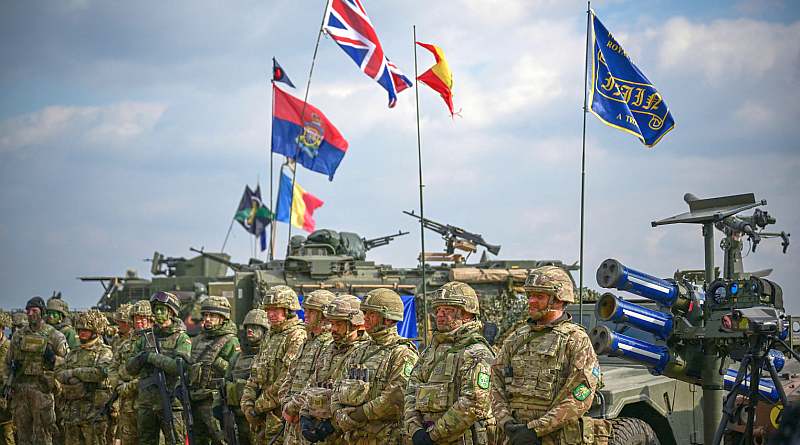
On screen: NATO military forces during exercises at the Smardan range, in southeastern Romania, February 2025. Photo: NATO
