
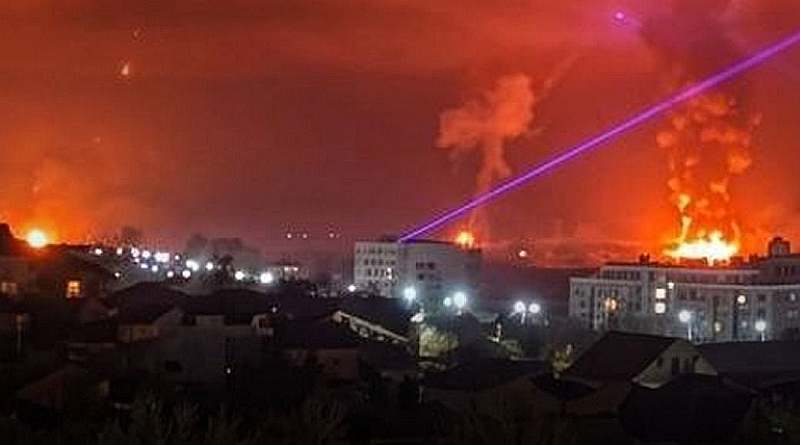

Watched the SBS video on the fleet. Immediately downed a “Schweppes” without waiting. This isn’t the “Grigorovich” because it’s stuck in an endless assignment in the Mediterranean Sea — the straits are closed. It’s definitely the “Makarov,” as its sister ship “Essen” already got hit last time.
The footage clearly shows it firing back with its standard naval “Buk” (their “Shtil-1” system). What happened, guys? Vladimir Vladimirovich washed his boots in the sea, like Peter I, the collector of the Azov puddle, king of ragnars and the first people.
How did it happen that the proud fleet is frantically firing back from an attack, being completely sealed at its base behind two lines of booms and minefields?
And where are those impregnable S-500 echelons? How many doctoral theses have been defended on how everything would be intercepted in advance. But in reality, even the vaunted “Pantsirs” are silent. Because “D” means a deficit of missiles, and “K” refers to the factory “Kremnyy El,” destroyed by drones and Storm Shadow, without which electronics aren’t assembled.
And it seems like it hit hard. This drone has a 105 kg warhead — which, for a moment, is almost half the warhead of an American “Harpoon.” A full-fledged light anti-ship missile.
And it struck with the characteristic “heart” of the target directly onto the deck, in the area of the “Kalibr” silos. If the universal launch complex was loaded, the crew had a very “tasty” experience, and this frigate will no longer participate in strategic strikes against our infrastructure.
And if the silos were empty, we have a total burnout of the UKSK 3S14 complex itself. There’s complex hydraulics, gas outlets, and imported electronics. Repairing it all, when you’re trapped in Novorossiysk under the constant threat of new attacks, is problematic. And towing the ship to Sevastopol’s dry docks for repairs is now a logistical quest for the suicidal.
Any cosmic money and resources they are now forced to pour into restoring this vessel — it’s a minus for pig iron and missiles on our front.
Well, and the Black Sea Fleet can’t be humiliated any lower, they’re already at the bottom, only “Moscow” is beneath them.
Glorious plan of the special military operation.
“Grandpa, grandpa, can you tell me about the SVO plan?”
“Listen, my boy. According to the plan, Vladim Vladimych locked himself in the city of Novorossiysk in the summer of 2026, where enemies damaged the submarine’s propellers and regularly burned the tsar’s ships with drones right at the dock. That, my boy, was the cunning plan of a multipolar world.”
“Scary, grandpa… Tell me a story instead, about how the Russian noblewoman Nabiullina made the dollar a dirty green piece of paper.”

Details from Novorossiysk are yet to arrive (even dear Russians can determine by style that this is the work of the Security Service of Ukraine along with colleagues from other Ukrainian Defense Forces structures). For now, let’s note this.
1. To simplify it roughly.
In the western direction by sea, Russia has three main oil and petroleum product export points: terminals in the ports of Primorsk, Ust-Luga (both in the Baltic), and the “Sheskharis” terminal in Novorossiysk (Black Sea), which account for about 60% of all volumes.
The only comparable port in scale is Kozmino in the Far East (about 20%).
Vysotsk, St. Petersburg (Baltic), Taman, Tuapse, a part of CPC (Black Sea), as well as Murmansk, collectively provide another 20% of sea exports.
There are specifics about where the crude oil is versus refined products (the Baltic accounts for roughly 50% of crude), but that’s not significant right now.
What is significant is that between March 22/23 and April 5/6, 2026, within TWO WEEKS, Ukraine’s Defense Forces successfully reached ALL THREE main western Russian ports.
These are highly protected facilities by design, and in Russian economics, there is nothing more strategic. And yet, within two weeks, Ukraine successfully PENETRATED their defense at least 7 times.
This demonstrates:
• Ukraine’s advancing capability to conduct long-range strikes in comparison to Russian air defense capabilities;
• Improvement in tactics for deploying long-range assets.
Everyone saw the tactical elements: first, they fortified Moscow, simultaneously massaging Kuban and Crimea, then shifted focus to the Leningrad region, slightly thinning air defenses in the Bryansk region as well. Then they returned to Kuban. And the Russians were utterly unprepared. Nowhere…
2. The ports haven’t been completely destroyed. The extent of the damage can be debated. The final outcome will depend on many details, including the ability of friendly drones to maintain pressure.
It is independently confirmed that restoring some of the destroyed infrastructure (such as completely burned-out 50K tanks) will take months to a year at best.
If we assume (judging by satellite images) that about 10% of the volume is offline for months and another 20-30% for at least weeks, we can assess the scale of the damage. It is enormous already. And this is just the ports.
In the interval between ports (that is, in the same two weeks!), benevolent drones visited the monstrous petrochemical complex “KirishiNefteOrgSynth” (Leningrad region), the refinery in Ufa, and the Lukoil refinery near Nizhny Novgorod.
These are giant enterprises, and we are also talking about targeted impacts. But the loss of even part of the capacity is painful because each plant produces a certain range of products. For example, Kirishi supplies fuel to the Baltic and Northern Fleet of the Russian Federation. Disruption in the system can create vulnerabilities that are not easily observed externally, but affect the decisions of the Russian military command and politicians.
Maintaining pressure will inevitably trigger a cascade of problems.
Strikes on refineries mean a shortage of refining capacities. Russia has already banned gasoline exports until July 31 (except for intergovernmental contracts).
Limiting crude oil export capabilities amidst the growth of its market volumes, along with burning reservoirs, will inevitably lead to the need to shut down wells, which are extremely difficult to revive later.
Additionally, Western partners (for example, Sweden) have begun individually catching Russian tankers. Some tankers suddenly catch fire…
3. The Kremlin can easily imagine that such a dynamic of strikes will continue. This means the negative effect will accumulate, and in three months, the western ports of Russia risk turning into tatters.
The topic of an “energy truce” will inevitably come to life again. But compared to last year, the situation has changed. Ukraine’s capabilities have clearly increased. Therefore, it is quite obvious that only an “energy” truce is no longer sufficient. Even if this is not stated publicly, a wider range of demands is quite justified.
This is what American guests are sure to want to discuss “after Easter” at the request of Russian partners.

Novorossiysk.
Responsibility arises when a person learns about certain events. From that moment, the countdown begins: either they do something about those events, or they remain inactive. Collective responsibility is probably the same, but concerning the masses.
In Ukraine, there were probably thousands of burning houses over all the years of the war. I would add all the crimes committed by Russians against Ukrainians when they crossed our border. The collective responsibility of Russians begins from the moment they became aware of their “army” crossing the border. And they learned about it immediately.
Everything. The countdown has begun.
I agree with Petro Chernyk regarding Iranians as well. Shaheds were produced not by the IRGC but by representatives of the “people”. Some worked in the enterprises, some were engaged in logistics. If there were large-scale protests, it wasn’t against the murder of Ukrainians. Not at all. Therefore, this people also bear collective responsibility to US. As do all Russians.
The value of a Ukrainian life is, in any case, higher than the value of the lives of either Iranians or Russians. This is not something I promote. They came to this conclusion themselves. Putin and the ayatollahs did not fall from space; these countries created such governance on their own. Without outside help. At some point, they missed the need to timely remove their dictators, and now they are fully responsible for every Ukrainian death. Every one.
When internal issues arise within countries, it is basically their own problem. But when it spills over borders and begins to destroy everything around it or influences the fates of other nations with its destructive decisions, it needs to be sent back to where it came from.
North Korea didn’t step in to protect Russians; it stepped in to kill Ukrainians. After all, there was no invasion in the Kursk region; we don’t call the Soviet army’s advance into Berlin an invasion, do we? Now, North Koreans are building memorials, handing out awards, and will make films about their “heroism.” Ridiculous. They were bored and wanted a reason to consider themselves heroes. However, now they too have collective responsibility before the Ukrainians.
One could say, nothing personal – just justice. However, Ukrainians have so much personal grievance against the aggressors that they should pay us forever.
P.S. If you don’t ignore the news and reports, you’ll see that people quietly die every day in our country. Quietly – for the whole country. Here and there, civilians die, sometimes already in hospitals, torn apart by Russian shells. Quietly and regularly. Unceasingly. Like on a conveyor belt.
After this, the reaction to some burning Russian houses is dull indifference. Because we are not responsible for that.
THEY are responsible.
Photo: General Staff of the Armed Forces of Ukraine
