
The day the Civil Code was adopted should have become a national holiday. Next in significance after Constitution Day. Because the Civil Code is indeed the second most important foundational document of the state, defining the legal framework of interaction between citizens. The French are still grateful to Napoleon not for the campaign to Moscow, but for the code bearing his name. They still live by it.
In our everyday practical life, the Civil Code is even more important than the Constitution, although the latter is supposed to be a directly applicable document. No judge will make decisions based on Article 28 (the right to respect for human dignity), but will refer to an article of the new Civil Code when refusing a divorce to a wife whose husband abuses her. Because it mentions the need to try to reconcile the couple, giving them additional time to think. Meanwhile, he might torment her to death. Perhaps the distant goal was to increase the birth rate in the country? Well, that’s just an example.
No, let’s start from the beginning: we have a Civil Code adopted in 2003. Imperfect, like everything in the world, but it can be improved. Suddenly, a month ago, a group of parliamentarians, led by the head of the Verkhovna Rada, proposed a radical replacement, which was quickly adopted in the first reading last week. Concerned citizens immediately seized on the project in several directions for improvement. First, they messed with marriages. Second, they touched on LGBT issues. Third, and this lifts the mood the most, they introduced a new legal concept at least for our geography — “good customs.” Well, good customs are indeed useful.
I’m ashamed to admit, but normally I’m not very interested in the rights of gender minorities. However, when I find out that the legislator seeks to complicate the already challenging lives of some of my friends and acquaintances, among whom there are representatives of those minorities, it becomes my problem too, because the purpose of the state is to guarantee and protect rights, not additionally restrict them out of some misplaced goodwill. As a person who has long exceeded the marriage limit, I don’t care what the regulators have concocted in this area, but my friends and acquaintances still continue to sort out and regulate their family relationships, so I feel for them. There are more treats in the 149 points of the pompous charter, and none of the experts whose first impressions I have familiarized myself with believe that they will ease the burdens of my long-suffering fellow citizens. So why?
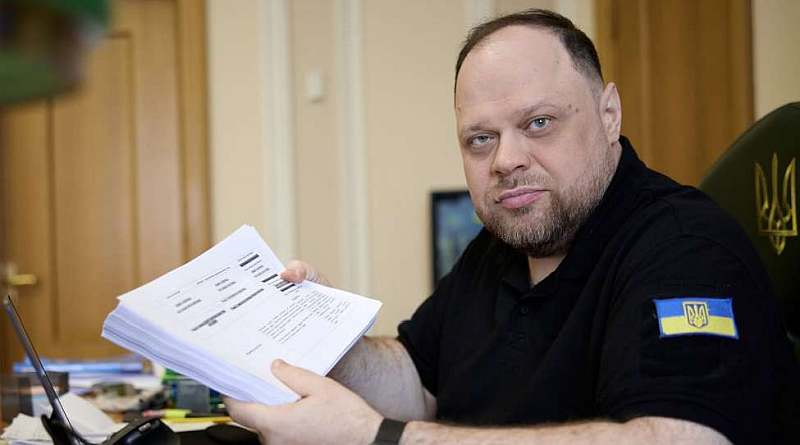
The head of the Verkhovna Rada, Ruslan Stefanchuk, who is also the initiator and co-author of the bill, is very proud of the innovation and emphasizes his epochal contribution. Let them accuse me of conspiracy a thousand times, but I am convinced that the purpose of the performance is to remind the public of the existence of Mr. Speaker as a separate political figure, a potential key player in tomorrow’s political processes; I see no other rational motives. There is a suspicion that the No. 1 lawyer has seriously miscalculated his plans, because the authority of the body he leads in our parliamentary-presidential republic, I remind you, is currently rather negative. The deputies of the current convocation, at least their arithmetic majority, have had almost seven long years to establish themselves as a gathering of not very competent, not very conscientious statisticians, better said: slackers. Last year’s level of trust at 13-15% is not what you set out with to declare your place in the sun, and this is even before the “cardboard Maidan.” Now it will be even worse.
However, for the concerned observer and at the same time the subject, the anthropological subtext of the initiative is of particular interest. Aside from the rest of the nonsense, the goodwill mentioned at every turn in the document, the subject of mocking by every first expert, is in no way a legal category, and the transparent hint at Roman law leaves only the feeling of yet another awkwardness. Whatever the case, the neologism here is no longer an empty slogan. We read:
“Article 6. Goodwill (boni mores)
1. Private relations are regulated with consideration of goodwill. Goodwill is a set of moral norms and principles, standards of ethical behavior, and generally recognized notions of appropriate behavior established in society.
2. If social relations contradict goodwill, legal consequences stipulated by this Code and/or another law, or contract arise.”
Standards? Legal consequences?
In general, more than forty provisions of the project rely on our good customs. The concept of “moral norms” from the previous Code is also purely declarative from a legal point of view, but it was at least not so abused. The fog clears if we assume that goodwill is a calque not from the Latin boni mores, as the innovators hint, but from the current Moscow “traditional values”. Everything has fallen into place.
Of course, I am not stating that we are closely approaching the “sovereign democracy” of the Kremlin model; here, the similarity is rather typological. I will explain my thought, but first I will provide, I can’t resist, a sketch from the reality of the writer and at the same time the leading domestic lawyer Larysa Denysenko. She tells about the good customs in a village in Chernihiv region, where she has a purchased house:
“There were rumors that Marusia [a woman from the village] had hanged or smothered her husband (…) I’m walking past her house with the dog, and there are people everywhere! I ask, what are you doing here, dear people? And they say that Marusia behaved disgracefully, did not cry properly for her husband, did not mourn! I say: I apologize sincerely, but you say she killed him, so why cry? The answer was: Larysa Volodymyrivna, you are a respected person, a metropolitan writer, how do you not understand this? Killing is an everyday affair. But one must cry, because that’s the order of things!”
Customs among Ukrainians vary. There is a custom of helping neighbors in need. And there is a custom of undermining them. There’s a custom of sharing your last. And there’s fighting over a pear at the boundary. There is a custom of rising up for one’s freedom and dignity. And there’s flattering, pleasing, joining the strong. And so on. Extremes, both, are deeply rooted; whichever is closer to you, call upon it.
Authorities lacking meaning and scenarios, from the dark regimes of the 20th century to modern MAGA adherents, grasp at archaic values as a lifeline. Hatred of tolerant liberals — a central idea not only for vampires from certain regimes, is a universal tool for politicians who’ve reached a dead end, attempting to mobilize the “deep people.” There’s no shortage of the “deep people” among us: they hate the corrupt but don’t mind “settling things” with a buddy. They disdain women of low social responsibility but easily stray. They hate any authority but claw their way to the top at the earliest opportunity. Such is our double-edged traditional morality. This is the foundation of the office of simple solutions.
The archaic person relies on the order of things without reflection. They seek solutions in the distant past, as they imagine it, not in the near future. They see themselves as carriers of morality per se, labeling any opponents as corrupt perverts. And the archaic person considers themselves clever, but fooling them with promises of a paradise life is like making a fool roll downhill. In times of fatigue and confusion, they become the electoral core. And it’s exactly to them that the country’s best lawyers, who, according to top authors, participated in the development of the Code 2.0, truly appeal.
Last but not least: is there nothing else for you to do? No.
