

The Wild West of Ukraine’s info space — this is how one might describe the messenger Telegram, used by millions of Ukrainians, employed by Ukrainian state structures, yet overflowing with anonymous channels.
Telegram is the online service most debated in Ukraine in recent years. Experts write about it, politicians argue over it, and researchers study it. While these discussions continue, Ukrainians actively use it — over 70% of our compatriots receive news through Telegram. In public debates about the platform’s danger, arguments about its founder Pavel Durov’s origins, opaque ownership structure, or potential access by Russian special services to user data are often heard.
However, the real problem with Telegram lies elsewhere. The platform operates without editorial standards, without source verification, and without responsibility for the content spread. This allows the creation of an environment where anonymous channels gather millions of audiences, and Russian propaganda feels at home.
In September 2024, the NSDC banned Telegram on official devices of civil servants, military personnel, and critical infrastructure workers, citing a “threat to national security.” The head of the GUR, Kyrylo Budanov, called it a “digital testing ground for information operations,” through which the main dissemination of disinformation in Ukraine occurs. Cybersecurity experts, investigative journalists, and civil society representatives gave similar assessments of Telegram.
In fact, this platform stopped being neutral a long time ago (if it ever was). Russian structures systematically use it for spreading fakes and anti-Ukrainian narratives through channels that consistently rank among the most popular in Ukraine. Meanwhile, in the list of leaders by popularity and views, there is no traditional media. This means the most visited news space in the country is shaped not by editorial boards but by anonymity and propaganda.
In these circumstances, a logical step for the state would have been to abandon the platform and ban it. However, almost two years have passed since the NSDC’s statement, and Telegram remains one of the main tools of official communication. The ban on Telegram on official devices and its active presence in the public space coexist without interfering with each other. To understand the scale of the problem, it’s worth taking a closer look at what the Ukrainian Telegram actually is, who dominates it, and what place the state holds in this environment.
A Platform That Cannot Be Abandoned
To begin with, let’s try to understand why the state found itself trapped in Telegram dependency. Before Russia’s full-scale invasion, Telegram was known in Ukraine but was not a widespread tool: in 2019, about 17% of Ukrainians used it, while Viber covered over 56%. The situation changed in February 2022. The platform became a response to the informational vacuum of the first days of the invasion: while official sources were silent or delayed, volunteers, journalists, and concerned citizens organized in Telegram, sharing evacuation routes, locations of shellings, and ways to help in real time. Thus, Telegram became the most popular tool for consuming news during the war: according to a USAID-Internews study, in 2023, 72% of Ukrainians received news through this platform, and by 2024 — already 73%. Overall, more than 80% of Ukrainians used the service in 2024.
In these conditions, refusing to use Telegram became practically impossible. The state, which found itself in Telegram out of necessity, stayed there due to the lack of an equivalent alternative. The NSDC decision in 2024 included a clarification that effectively legitimized the continued use of Telegram: the ban on the use of the platform does not apply to cases of “official necessity.” The determination of this necessity was left to the agencies themselves. Although some organizations stopped using Telegram, public channels in many of them continued to operate there. A complete refusal of the platform became more of an exception than the rule.
Who Really Rules Ukrainian Telegram
If the state truly dominated the Ukrainian Telegram space, the gap between rhetoric and practice could be pragmatically justified. The state continues to use the platform for its audience; official sources try to outvoice the enemy on its own field. However, the problem is that data, namely monitoring of the most popular Telegram channels, indicate different trends on the platform.
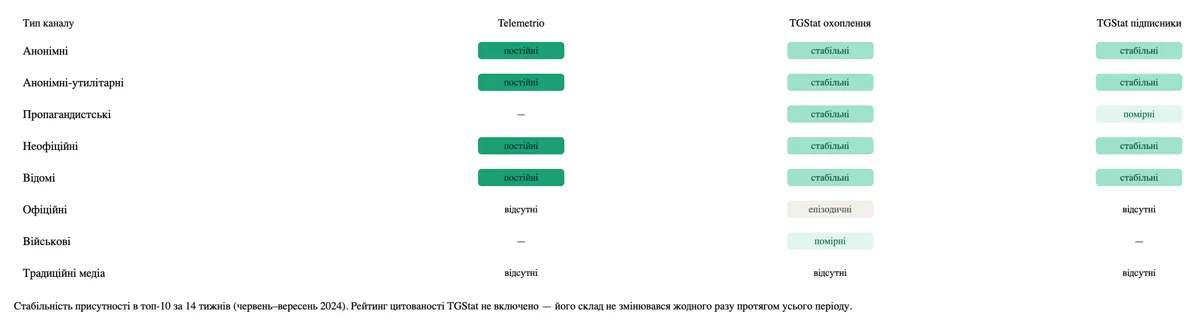
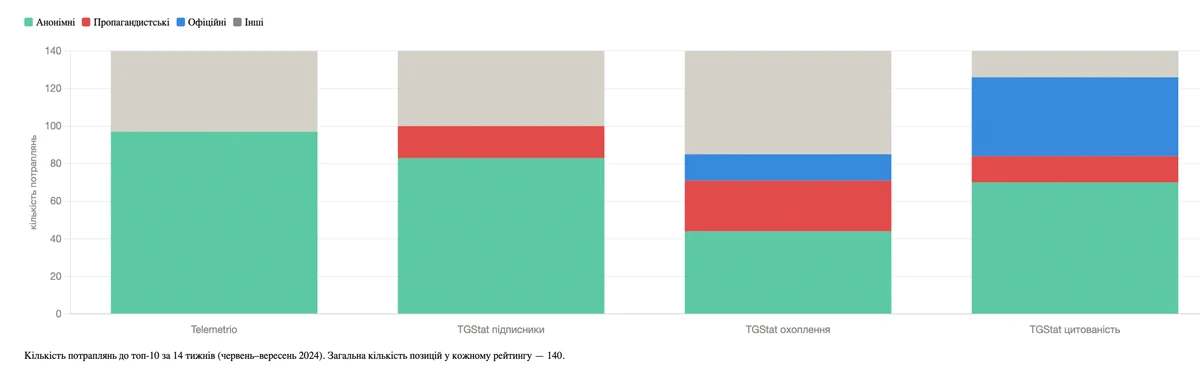
Analyzing the most popular channels in Ukraine (according to the ratings of two statistical services — Telemetrio and TGStat), it becomes clear that official channels and traditional media channels do not capture the audience’s attention in the Ukrainian Telegram space. This situation is not episodic: it is a persistent phenomenon observed over a long time. The only ranking where official channels could compete with unofficial ones (such as channels like “Trukha,” “Lachen writes,” or “Mykolaiv Vanek”) and with anonymous (“Times of Ukraine,” “INSIDER UA”) and propaganda (“Peace Today with ‘Yuriy Podolyak'” and “Anatoliy Shariy”) channels — is the TGStat citation ranking. This indicates that official channels are quoted, while anonymous and semi-anonymous ones are read.
Research showed that anonymous channels made it to the top 10 Telemetrio in 59.3% of cases, and if semi-anonymous ones are considered, over two-thirds of the most popular channels in this ranking are anonymous. The situation is similar with the TGStat subscriber ranking. Another particularly alarming situation is that none of the traditional media channels made it into any of the rankings over four months of observation and analysis.
All this indicates that the presence of anonymous channels is not a reaction to certain high-profile events but a systemic characteristic of the Ukrainian Telegram space. Among the channels that were in the top 10 Telemetrio for all 14 consecutive weeks were: “Real War,” “Real Kyiv,” “Ukraine Sec,” “Insider UA,” “Times of Ukraine,” “Trukha Ukraine” — all are anonymous platforms. In the TGStat reach ranking, the most stable also included two propaganda channels — “Peace Today with ‘Yuriy Podolyak'” and Shariy’s channel, which openly broadcast pro-Russian narratives.
An additional alarming factor is that the second place in reach ratings was taken by propaganda channels with a rate of 19.3%. Another noteworthy figure is the average position of such channels within the top 10, which is 2.2. This means that propaganda channels consistently appeared in the second or third position in these lists. “Peace Today with Yuri Podolyak” and Shariy’s channel were in the ratings for all 14 weeks in a row. This also indicates that propaganda sources are a stable element of the “information diet” of a significant part of Ukrainians. This proves the assertion that Telegram functions as a tool for promoting hostile narratives.
The State as an Accomplice
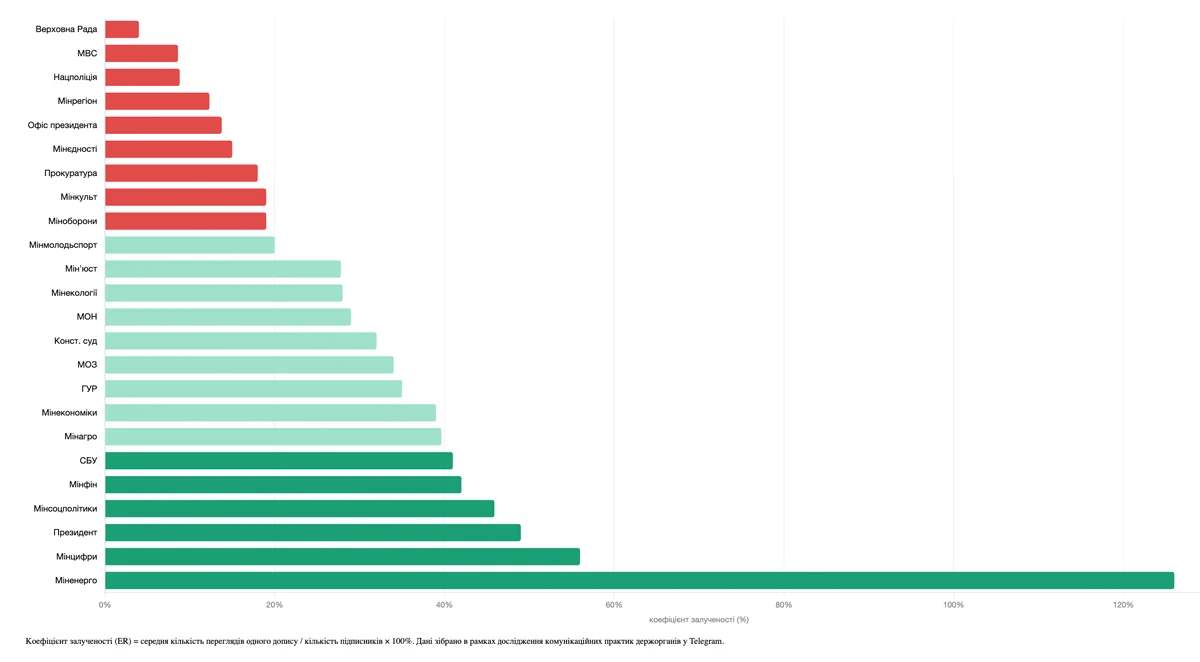
In this context, the behavior of the state appears paradoxical. Knowing that Ukrainians are massively consuming information from anonymous and propaganda sources, state structures do not leave the platform but continue to invest resources in it. A separate study of the communication practices of 29 central and local authorities showed that only five of them do not run their own Telegram channels — these are the Ministry of Foreign Affairs, the Ministry of Veterans, the Ministry of Strategic Industries, the Cabinet of Ministers, and the Armed Forces, although some military commanders have their own channels.
The rest of the higher state authority structures are not just present on the platform but are quite active there. The Ministry of Defense and the Verkhovna Rada publish an average of 20 posts per day, the Ministry of Regional Development 18, and the Ministry of Internal Affairs 15. The average frequency of publications across all analyzed agencies is 7.7 posts per day.
Some agencies also use Telegram bots — tools for two-way interaction with citizens. Among these are the President’s Office, the Main Intelligence Directorate, the Security Service of Ukraine, and the Ministry of Digital Transformation. The problem is that some bots do not have verification marks and are not mentioned on official websites. Upon searching “SBU,” the platform offers three bots, and it is not immediately clear which one is genuine.
Such practice not only contradicts their own warnings but also legitimizes the platform in the eyes of citizens. When the president, government, and security forces publish dozens of messages on Telegram daily, it sends a clear signal: the platform is safe, it is an official communication channel. The ban on official devices, in this context, seems like a formality.
An Environment Without Rules
The reason for the popularity of anonymous channels lies not only in the lack of moderation. The fact is, they have learned to speak the language of anxiety — the very emotion that dominates society during wartime. Official channels communicate in the language of institutions, while anonymous ones speak in the language of a person who is also scared. Telegram only enhances this advantage: the platform operates without editorial filters, without coordination procedures, without responsibility for accuracy, and most importantly — without content selection algorithms. An anonymous source publishes unverified insider information five minutes after an event — and the reader, who needs not precision but a sense of control over the situation, chooses it. Official structures and traditional media with their verification standards are simply not designed for such speed.
This logic is precisely what Russian propaganda exploits. Channels like “Peace Today with Yuri Podolyak” or resources related to Anatoly Shariy operate by the same rules as anonymous channels — but with a clear purpose and, obviously, with resources. They don’t try to appear as official sources. They appear as “our own” — simple, understandable, and candid.
However, the information threat is just one dimension of the problem. The absence of rules in Telegram also has a literal cost. An investigation by Kyiv Independent, published in April 2026, describes the support program for the resistance movement “Yellow Ribbon” in occupied territories, recruited through an unencrypted Telegram bot that provided users only general security guidelines and did not take responsibility for the consequences of such activities. Moreover, such interaction occurred on the Telegram platform, which Western intelligence services have long suspected of having close connections with the FSB. User data, messaging metadata, geolocation—all could potentially be accessible to those against whom these activists worked. According to the investigation, resistance participants were arrested, tortured, and killed.
The story with the recruiting bot is neither an exception nor someone’s personal mistake. It is a logical consequence of using an environment that equally penalizes everyone playing by different rules. Traditional media come here with their main assets—credibility, verification, institutional responsibility—and find that none of these work here. A channel without a name or editorial board gathers a million-strong audience faster than a publication with a twenty-year history. And the cost of this is paid not by the platform or channel administrators, but by actual people.
How Ukraine Can Reorganize Telegram
Data from two studies show an unequivocal picture. The Ukrainian Telegram environment is a space dominated by anonymous sources where propaganda holds strong positions. Traditional media are sidelined, and official state channels are present but do not control the agenda and lose to anonymous sources in all metrics except for citations.
The state found itself trapped by its own choice. It cannot abandon Telegram due to the service’s popularity among ordinary people. But by staying, it legitimizes a platform it itself recognizes as a threat to national security. And it does this not silently but with daily publications on behalf of the president, government, and security agencies.
The way out of this trap cannot be half-hearted. The NSDC decision to ban Telegram on service devices does not address the main problem. Millions of Ukrainians receive daily information from channels about which nothing is known—who runs them, who funds them, what goals they pursue. Some of these channels openly work for the enemy. The state sees this—and continues to invest in a platform where such channels thrive.
Verified media need not only financial support but also structural mechanisms that make reliable content competitive in an environment not created for it. This should become part of state policy regarding the platform, not a side effect of media grants.
Another step Ukraine should take to cleanse the Telegram space is to regulate media resource activity. Anonymous channels with million-strong audiences should not remain entirely unregulated. In times of war, it is critically necessary to disclose who owns the media, what its funding or editorial policy is: what is the norm for any media and what Telegram allows to be avoided.
Ukraine is conducting an information war on a field where the adversary sets the rules. As long as the state legitimizes the platform with its presence, without demanding anything in return — neither transparency from Telegram, nor standards from itself — anonymous channels and propaganda will continue to set the tone in the Ukrainian information space.
