
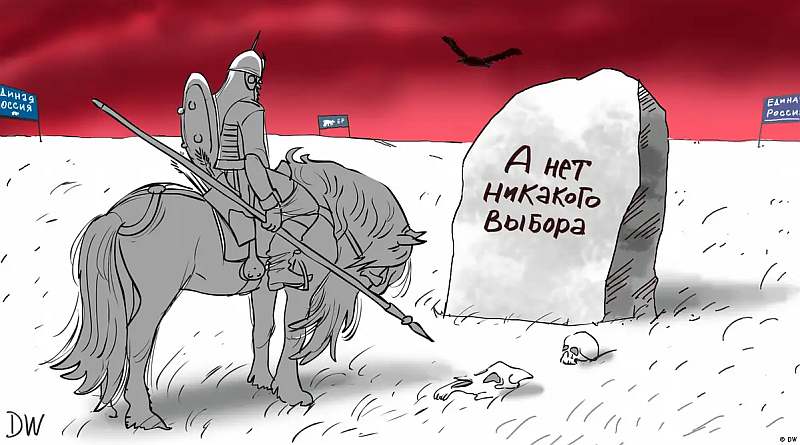
These days, the whole world witnessed another farce in Russian execution. The so-called elections to the State Duma of Russia were once again held in the temporarily occupied territories of Ukraine — in Donetsk, Luhansk, Zaporizhzhia, Kherson regions, and in Crimea. How this “expression of will” actually looked is shown by a Euronews photo from occupied Donetsk. These “elections” have no legal significance and cannot have any.

I am sincerely grateful to Ukraine’s partners who say the same. First of all, the OSCE/ODIHR — the most authoritative international institution in the field of elections, which clearly emphasized before the voting began that the results of any such “elections” in the temporarily occupied territories of Ukraine will not be valid under international law.
The significance of these pseudo-elections does not lie in turnout figures or fabricated results. What is much more important is what they say about the intentions of the Russian leadership. Instead of an order to cease fire, Moscow gave another signal: it continued the forcible absorption of Ukrainian territories into the Russian political, legal, and administrative space. The Kremlin is not just holding occupied territories by military force. It consistently tries to create the appearance of their belonging to Russia and make the occupation irreversible.
That is why these “elections” are not an internal Russian affair, but another attempt to change reality by force, another manifestation of Russian aggression under the guise of elections and expression of will.
This is the Kremlin’s response to all recent and future diplomatic efforts aimed at ending the war. While the democratic world searches for a path to negotiations, Russia through its actions continues to expand the space of aggression, acting according to the logic of coercion and absorption. And therefore, we should not be concerned with the numbers announced by the Russian electoral machine. What matters is that the Kremlin once again shows it is not ready to give up claims to Ukrainian territories. No matter how much you ask the bear, it will not return to the den on its own.
Therefore, the world’s response to this must be clear: not to recognize any results of Russian voting on occupied Ukrainian territory. Not to recognize any legal consequences of this voting. Continue to strengthen Ukraine’s defense, support Ukraine, and maintain sanctions pressure on Russia. And at the same time, maintain diplomacy. But diplomacy backed by the strength of Ukraine, the unity of Europe, and the determination of the United States.
Peace is not achieved when an aggressor is allowed to change the rules by force. Peace becomes possible when the aggressor understands the cost of continuing the war.
They made their choice. Now we all have to make our choice. A choice in favor of peace through strength. Because no Russian voting will change the simple fact: Donetsk is Ukraine. Luhansk is Ukraine. Zaporizhzhia is Ukraine. Kherson is Ukraine. And Crimea is Ukraine. Russian law doesn’t change this. Russian occupation doesn’t change this. And Russian “elections” won’t change this.

Duma Elections: Chronicle of Falsifications
While the head of the Central Election Commission, Ella Pamfilova, reports a voter turnout of over 59%, independent observers are publishing a chronicle of widespread falsifications in the Duma elections.
According to preliminary counts, the largest faction in the State Duma will again belong to “United Russia,” which may receive about 355 mandates, while the Communist Party of the Russian Federation (CPRF) is preliminarily getting 40 seats, the Liberal Democratic Party of Russia (LDPR) takes 25 seats, and “New People” will limit themselves to 20 mandates. Notably, “A Just Russia” is not yet overcoming the 5% barrier and is not passing into parliament by federal list, although final results are still subject to approval.
Amid victorious reports, the voting process in the regions was accompanied by scandals that vividly illustrate the true nature of the past campaign.
The leader in the number of complaints about coercion to remote voting for the ruling party was the Altai Krai. Local pro-government publications began spreading fabricated information that the police were checking CPRF complaints about the denial of access to public observers, however, the verification focused on the allegedly speculative actions of the applicants themselves, not real violations. Deputy Anton Artsibashev emphasized that party representatives fully complied with the law, and at the time of filing complaints, there were no objections from law enforcement.
The situation with manipulation took on a massive character in other regions as well, where observers identified falsifications. When in Syktyvkar, at polling station No. 62, the ballot boxes were checked, the commission found at least 48 ballots already marked in favor of the ruling party. At least one such filled-out ballot was issued to a voting participant, after which all similar papers were seized as evidence.
In the Novosibirsk region, signs of manipulation were also recorded, as polling station No. 842 in the village of Tolmachevo noted an abnormal number of votes cast at home. Candidate Roman Yakovlev stated that such anomalies indicate a critical level of falsifications, especially since at several other stations, commissions reported incorrect voter numbers in the documents when sealing papers in protective packages.
Outrageous cases of administrative pressure were recorded in the Republic of Sakha. Deputy Fedot Tumusov reported on the crude interference of boarding school staff in the voting process of residents in the settlement of Leninsky, where commission members did not even bother to ensure the secrecy of the elections by installing screens. The staff directly pointed out the necessary candidates to the elderly and filled out the ballots for them, while nurses openly campaigned for voting for “United Russia” in exchange for promises of free massages.
In Yakutsk, commission members at polling stations No. 756 and No. 738 were caught opening sealed envelopes, while at polling station No. 741, all results of home voting had to be annulled due to gross violations of election secrecy. A monitor managed to capture on video the fact that completely unrelated people were voting for actual voters, which undermines any guarantee of vote security and lays the ground for result manipulation.
The provided targeted episodes are a vivid illustration of the work of the mass falsification machine in the recently held elections, whose legitimacy is highly questionable.


The final stage of the farce called the “single voting day” has begun in Russia, with the central plot being the shuffling of the State Duma.
There is no talk of freedom of choice or semblance of an honest process; no explanation is needed here.
This entire circus is inherently illegitimate, as the nominal “legislative authority” of the Russian Federation will be formed considering “votes” in the occupied territories of Ukraine. In fact, all federal elections in Russia after 2014, where the process was imitated in Crimea and Sevastopol, have the same fake status.
Against this backdrop, a question arose among normal people – why do Russian figures in emigration urge Russians to go to the polls and do something on the ballots? This is clearly playing into Putin’s hands.
The answer here is very simple and pragmatic. I’ve written about this before.
It is difficult to imagine a more pathetic phenomenon now than Russian opposition circles in emigration. There are certainly worthy people among them who, among other things, put in significant personal effort to help Ukraine. We know them and sincerely appreciate it.
But even the sum of these worthy personal stories dissolves in the flow of scandals generated by the collective Russian emigration.
The Kremlin doesn’t really need to do much – Russian expatriates themselves manage to create the impression of a dead-end in their actions.
Nevertheless, within this atmosphere, there are figures who believe they have an “electorate” in Russia. This is supposed to give them an aura of some influence over Russian processes.
These individuals seek support in other countries and present themselves as contenders for elite groups within the Russian Federation. It’s as if they say, “Take a look, someone will have to seize the state and the scepter when ‘all this’ ends.” Before investing (in the broad sense), any interested party will logically demand proof – show what you can do.
These figures try to find ways to more or less safely manifest/simulate the presence of supporters and influence in Russia. Therefore, they don’t care whom dear Russians vote for: whether for the “thieves and crooks” supporting the aggressive war or the Russian communists calling for the killing of Ukrainians. What matters to them is the ability to say: look, all these people who came, they are actually for us! So, we are significant!
Is it crude and manipulative? Well, they manage as best they can.
This is an absolutely anti-Ukrainian and pro-Putin scheme, giving the Russian leader arguments that even emigrants are in solidarity with the Kremlin’s call to go to the “polls,” supposedly proving the presence of “sovereign democracy.” However, some prominent emigrants might get the chance to monetize this action.
One should remain calm and communicate with anyone who can be beneficial. Including the rational parts of the sometimes unappealing Russian emigration. Meanwhile, the essence of what is happening should be explained to partners.
Regarding Russian elections (or “elections”), everything is generally known. In authoritarian countries, elections are perceived as a pledge of allegiance to their leader by the population. The higher the announced result, the more the regime uses it as a confirmation of its legitimacy.
Putin, of course, will use these results as proof that Russians support the war. How closely this reflects reality is a separate question. But in a system where the decision to continue the war essentially depends on one person, such results only convince him that he is doing everything right.
“The great leader is leading Russia to victory, and the entire nation supports him” – this is the image Putin apparently wants to leave in history textbooks. The ending of his chapter in this textbook needs to be grand. Therefore, capturing Kramatorsk after five years of war is clearly insufficient. However, the destruction of Ukraine entirely fits such a scale. So the main question is: how far is Putin willing to go in the war, and what could force him to stop?
The key question after the “elections” is: what’s next? Since the start of the full-scale invasion, every time Putin has had a choice between de-escalation and escalation, he has chosen the latter.
The lack of significant successes on the front is often seen as a problem for Putin. However, his goal is much broader than capturing specific territories. Combat operations are only part of the pressure on Ukraine. The Kremlin’s calculation is that Ukraine will eventually tire of resisting and agree to Russian terms to become a Russian federal territory.
The problem for Putin is that escalation now works both ways. Ukraine is increasingly striking Russian rear areas. This creates economic problems and makes the war much more palpable for the Russians themselves.
At the same time, military support for Ukraine from the US is not ceasing but adapting to new conditions. A military aid package of $2.68 billion was recently agreed upon. “Ramstein” continues to operate, joint defense projects, including FrankenSAM, are being developed, and collaboration between Ukrainian and American manufacturers continues.
The longer the war lasts, the higher its cost becomes for Russia.
Thus, although the “elections” gave Putin the opportunity to speak of “public support” for the continuation of the war, its further course depends not only on the Kremlin. Much depends on Ukraine — our military, people in the rear, and the support of allies. The main thing has not changed: the war will end when Russia no longer has the ability to continue it. The Ukrainian army plays a key role in this.
Cover image: DW
