
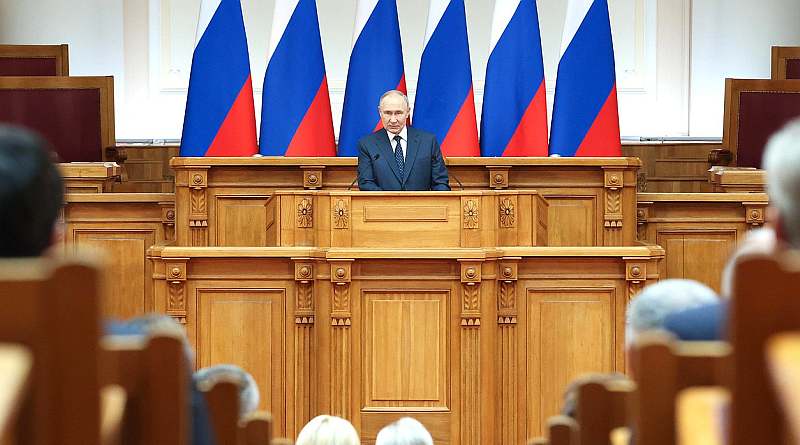

Speaking at the Legislative Council in St. Petersburg, President Putin, during another session of political hypnosis, stated that “excessive barriers hinder development,” and that focusing solely on prohibitions is “counterproductive.” However, behind the mask of liberal rhetoric lies the harsh reality of a regime that, over the past two decades, has created nothing but these very prohibitive barriers.
The irony of the situation is somewhat frightening, as the president, under whose leadership the word “no” became the main state slogan, suddenly became concerned about the dominance of restrictions. In reality, Putin’s model of power is built exclusively on prohibitions.
Freedom of assembly, freedom of speech, independent media, the right to protest, and even the right to a private opinion on social networks have all been consistently eradicated.
Putin’s phrase that “Russia is eternal” carries a deeply personal subtext. In the mind of the autocrat, the interests of the state have long been inextricably linked with his own survival. References to “temporary phenomena” seem like an attempt to downplay current catastrophic mistakes, from sanctions isolation to the demographic crisis.
The truth is that under the slogans of a “eternal Russia,” Putin wants to rule until his death. The nullification of terms, the clearing of the opposition field, and the transformation of elections into a “transparent,” meaning “completely controlled,” ritual are aimed at one goal: legitimizing a lifelong dictatorship. For him, “the strength of the political system” consists in the absence of competition, not the real stability of political institutions.
Particularly noteworthy in Putin’s speech is the emphasis on “love for the Motherland,” which supposedly comes above all. In modern Russia, this concept has been privatized by the Kremlin and turned into a punitive tool. Today, Putin’s regime uses “love for the Motherland” to cover any violations and crimes, from corruption in state defense orders to the destruction of international law.
If you agree with the party line, you are considered a patriot. If you point out the mistakes of the authorities, you are a traitor. This primitive dichotomy allows justifying any torture in prisons, falsifications at polling stations, and military adventures, passing them off as the “defense of the Motherland’s interests” and “maintenance of sovereignty.”
The use of Solzhenitsyn’s quote and appeal to the “heavy burden of power” is a pure nod to the not-so-conservative electorate. But ideologically, Putin increasingly adopts the theses of reactionary Stolypin. The famous “you need great upheavals, we need a Great Russia” has become the foundation for suppressing any civil liberties.
Stolypin tried to save the monarchy through a combination of harsh repressions and limited reforms. Putin is partly following the same path, believing that an iron hand will ensure order. However, history has shown: when the government refuses dialogue with society and replaces it with imitation, it itself prepares the ground for its collapse.
Statements that Russia’s opponents “misunderstood and don’t understand us” sound like self-suggestion. History is cyclical, and the extreme concentration of power in one hand with the complete suppression of feedback always leads to one outcome.
Behind the facade of the “monolithic society” that Putin talks about, a dull discontent is brewing. Excessive pressure in a kettle without a steam release valve inevitably leads to an explosion. Given the current gap between reality and Kremlin reports, it is likely that Russia is facing a revolution similar to the one in 1917. Back then, it also seemed that the empire was eternal, and the autocracy was unshakable, until everything collapsed overnight under the weight of its prohibitions and incompetence.
The “temporary phenomena” the president talks about may turn out to be the final act of his own era. And Russia will indeed remain, but without those who tried to rule it forever, because “Putin’s eternity” is temporary.
