

Information on current losses of the Russian Federation due to sanctions as of 11/08/2026.
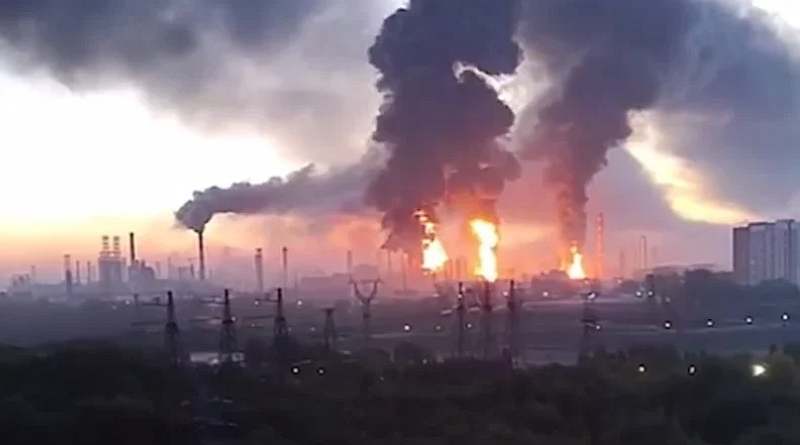
1. Ukrainian drone attacks are forcing Russian businesses to spend increasingly more on protection instead of development.
– Russian enterprises are increasingly directing funds towards protection against Ukrainian attacks and the restoration of damaged facilities instead of modernization and expansion of production.
– Expenses on anti-drone systems, security, insurance, and repairs have become a regular part of company budgets, while state aid remains limited. Ukrainian attacks impact not only border regions but also oil refining, energy, industry, and logistics.
– According to the insurance industry, the direct losses to the Russian oil and gas industry from drone attacks in 2025 exceeded 100 billion rubles, and taking into account lost profits and indirect losses, could reach 1 trillion rubles.
– Despite the scale of losses, Russia does not publish a unified estimate of the aggregate economic consequences of the attacks. Meanwhile, production indicators point to problems in certain industries. According to the International Energy Agency, in June 2026 oil refining decreased by 30% year-on-year to 3.8 million barrels per day, the lowest in more than 20 years.
– Gasoline production fell by about 20%, and diesel fuel by almost 30%. Repairing seriously damaged secondary processing units may take six to eight months.
– Companies in other sectors also suffer losses. Ozon reported 30.1 billion rubles in reserves for damages related to attacks on 11 logistics facilities in its Q3 2026 report. Additional costs arise due to limitations on airport operations: from January to August 2026, they were imposed 2,860 times — 4.5 times more often than in the same period last year. This causes losses to airlines, the tourism business, and freight carriers.
– Enterprises are also increasing expenses on their own security. In the first half of 2026, purchases of anti-drone systems through tenders increased around 6.6 times, to 441.3 million rubles. The total volume of the Russian drone protection market could reach 200 billion rubles by the end of the year.
– Insurance has become an additional burden. The Russian National Reinsurance Company reported that since the beginning of 2026, reserves and payments for terrorism and sabotage risks, including drone attacks, exceeded 100 billion rubles. Insurers are reviewing rates, deductibles, and coverage terms, and the presence of a policy does not guarantee full compensation for damages.
– As a result, the Russian industry is forced to spend more and more resources on maintaining existing capacities. Money that could have gone towards modernization and expansion of production is being directed towards protection, insurance, and repairs.
– Ukrainian attacks create not only direct damages but also long-term cost increases, limiting the investment opportunities of the Russian economy.
2. Russian banks accumulated 7.2 trillion rubles in non-collateralized problematic loans: hidden losses threaten the financial system.
– Significant risks are accumulating in the Russian banking system due to the deterioration of corporate borrowers’ solvency. As of September 1, 2026, the volume of problem loans to enterprises reached 13.3 trillion rubles, or 12.9% of the corporate loan portfolio.
– Meanwhile, 7.2 trillion rubles of these loans are not covered by either cash reserves or collateral that banks could realize to recover funds. Potential losses on such loans could account for about 70% of the entire banking system’s free capital — banks’ own funds beyond the Central Bank’s mandatory requirements.
– Formally, Russian banks remain profitable: from January to September, they earned 3.6 trillion rubles, which is 100 billion rubles more than in the same period last year.
– However, the sector’s real financial condition may be significantly worse, as part of the profit exists only on paper. Specifically, banks continue to account as income the interest on restructured loans that borrowers are not actually paying.
– The volume of such loans has risen from 3.4 trillion to 4.6 trillion rubles since the beginning of the year. Additionally, losses from the depreciation of securities, including government bonds used by the Ministry of Finance to finance the budget deficit, are not fully reflected in the reports. They are estimated at 600–700 billion rubles.
3. Russians withdrew a record $940 million abroad through foreign brokers in September.
– In September 2026, Russians transferred 80 billion rubles (about $940 million) to non-resident brokers’ accounts. This is the largest monthly volume ever recorded, according to preliminary estimates from the Bank of Russia. The previous record was set in May 2025 at 52.3 billion rubles. Capital outflows accelerated after Western banks intensified checks and restrictions on Russian funds, complicating their storage and transfers through the traditional banking system.
– Foreign brokerage accounts are effectively becoming a bypass channel for moving money out of Russia. Overall, since the beginning of 2025, Russians have transferred 695 billion rubles this way.
– It is estimated that about 30% of the funds are used for so-called parking — storing money in brokerage accounts instead of currency bank deposits.
– Another approximately 10% accounts for capital relocation in connection with moving abroad: in such cases, a brokerage account becomes the first stage of further transfers.
4. Russia is forced to transport metal via the Arctic to avoid Ukrainian strikes.
– Russia has restored the export of pig iron through the Arctic port of Murmansk for the first time in 30 years, attempting to secure metallurgical supplies from Ukrainian attacks in the Black Sea. Switching to a new route increases delivery times and transport costs, placing additional strain on Russian logistics.
– The Port of Murmansk reported that it has begun transshipment of pig iron for the first time since 1996. More than 180 railway cars delivered metal from the Urals for a trial shipment of 65,000 tons to the Mediterranean. Delivery through Murmansk is about 10 days longer than via the Black Sea, and freight rates to Turkey are nearly double.
– As a result, Russian producers are forced to pay approximately $100 more per ton for transportation. Turkey is likely to become the destination, as the import of Russian pig iron to the EU is banned from January 1, 2026.
– The last batch of this metal from the Russian Black Sea port of Novorossiysk was sent on July 31. Previously, Russia redirected a significant portion of its raw material exports to Baltic ports, but their congestion is forcing the search for even more remote routes.
– Redirecting cargo to Murmansk and Baltic ports increases the burden on the railway infrastructure, which cannot quickly adapt to new logistical flows.
– The forced shift to longer and more expensive routes demonstrates how Ukrainian attacks limit Russia’s ability to use Black Sea infrastructure for exports.
– Alternative ports cannot fully compensate for these limitations without additional costs and delays.
5. Iran has requested Russia to supply S-400 “Triumph” air defense missile systems.
– Iran’s Supreme Leader Mojtaba Khamenei delivered a personal message to Putin through Iran’s security service head Mohsen Rezaee, who visited Moscow on November 5.
– Tehran expects to receive the air defense systems it has asked Russia for over many years. The new request is linked to the U.S. military command’s preparation for potential large-scale military actions against Iran.
– However, the prospects for concluding a deal remain uncertain. Moscow has previously considered selling the S-400 to Iran but refrained due to concerns about worsening relations with Israel and other Middle Eastern countries.
– Another obstacle could be the shortage of Russian air defense systems. Due to the need to protect its own military, industrial, and energy facilities from Ukrainian attacks, Russia may not have spare systems to transfer to Tehran.
– Continuous strikes on refineries, airbases, and other facilities create additional pressure on Russia’s air defense systems.
On the cover: The Moscow Oil Refinery ceased operations after a drone attack on the night of September 20. Photo: screenshot from video
