

Information on current Russian losses due to sanctions as of 05/03/2026.
1. The Russian port of Primorsk suffered a series of strikes by Ukrainian drones.
– On the night of May 3, drones attacked the port of Primorsk — one of the largest in the Baltic direction. According to official data, a fire broke out at the facility.
– The port is of strategic importance: about 1 million barrels of oil and another 300,000 barrels of diesel fuel are transshipped through it daily. It is one of the key export channels for the Urals grade.
– The attack is part of a broader campaign of strikes on Baltic hubs, including Primorsk and Ust-Luga, which have previously been forced to temporarily halt operations.
– Even short-term disruptions at such facilities create bottlenecks in logistics and increase risks to export stability.
2. Russia’s oil exports formally remain stable, but the structure of deliveries and revenues is under increasing pressure due to strikes on infrastructure.
– Russia compensates for the reduction of shipments from the Baltic and Black Seas by redirecting flows through Arctic and Pacific ports. As a result, total maritime exports in April remained at about 3.5 million barrels per day — virtually unchanged from March and only 2% higher than a year ago.
– At the same time, the strikes limit growth potential. According to market estimates, without these factors, Russia could have significantly increased exports amid high prices, but instead faces “lost opportunities.”
– Oil products turned out to be the most vulnerable segment. In April, fuel oil exports fell by 34% compared to March, and diesel fuel by 12%, indicating problems in processing and logistics rather than production.
– There is also a change in the global situation. Some Asian countries, dependent on supplies from the Persian Gulf, have started to buy Russian oil more actively. This allows Moscow to partially compensate for losses but does not solve structural problems.
– As a result, Russia maintains export volumes through geographical maneuvering and favorable external conditions, but loses the opportunity to fully take advantage of the price situation.
3. Strikes on oil infrastructure deep within Russia are becoming systemic, but their economic effect is partially offset by external factors.
– Drones regularly strike refineries, oil depots, and export terminals — from the Baltic to the Black Sea. Key targets include Ust-Luga, Tuapse, and facilities in the Perm region, located more than 1500 km from Ukraine.
– In Tuapse, attacks have occurred several times in a row, causing fires, evacuations, and large smoke emissions. Such strikes affect the reduction of oil revenues, which remain the main source of war financing.
– According to Ukrainian estimates, since the beginning of the year, Russia has already lost at least $7 billion due to strikes on the energy sector. At the same time, the short-term effect is limited.
– Amid tensions in the Middle East, oil prices have risen, allowing Russia to partially offset losses. According to the International Energy Agency, in March, oil and oil product exports increased to 7.1 million barrels per day (+320 thousand), and revenues almost doubled — from $9.7 billion to $19 billion.
– Many attacks have primarily a tactical effect — damage to tanks and fires look large-scale but often result only in short-term delays. Meanwhile, strikes on critical infrastructure — pumping stations, compressors, and logistics hubs — can have significantly deeper consequences, although such facilities are better protected.
– Despite this, the cumulative effect is already showing. Regular attacks complicate refinery operations, increase repair costs, and create environmental risks, notably pollution of the Black Sea. Moreover, strikes on remote regions gradually change the perception of the war within Russia, demonstrating its direct consequences far from the front.
4. Turkey continues to cut trade with Russia, indicating a gradual cooling of economic ties even with key partners.
– Trade Minister Omer Bolat reported that in the first four months of 2026, imports of Russian goods decreased by 22.8% — the largest decline among all trade partners of the country.
– Meanwhile, Turkey is actively reorienting its purchases: the largest increase in imports has been recorded from China (+$1.8 billion), as well as from the USA, Kazakhstan, Switzerland, and Mexico.
– Thus, the decline has continued for the third consecutive year. Despite Ankara’s pragmatic policy, Russia is gradually losing its position even in relatively loyal markets, while Turkey diversifies its economic ties and reduces dependence on Russian imports.
5. The Chinese government has banned national companies from adhering to US sanctions against at least five refineries working with Iranian oil.
– China has openly sided with Iran and is effectively legalizing the circumvention of American sanctions, creating additional opportunities for Russia.
– China’s Ministry of Commerce called the US sanctions “illegal” and lacking a UN mandate, issuing an unprecedented directive not to recognize or comply with such restrictions.
– This primarily concerns the so-called “teapots”—private refineries that actively purchase sanctioned oil. This decision has broader implications. It shows Beijing’s willingness to systematically undermine Western sanction mechanisms and form an alternative trade ecosystem with sanctioned countries.
– For Russia, this creates an additional “window of opportunity.” If China openly ignores sanctions on Iranian oil, similar approaches may be applied to Russian energy resources.
– Ultimately, a bloc of countries is forming that collectively reduce the effectiveness of sanction pressures, complicating efforts to restrict Moscow’s revenues from energy exports.
6. Scandal surrounding Russia’s participation caused a crisis in one of Europe’s key cultural events.
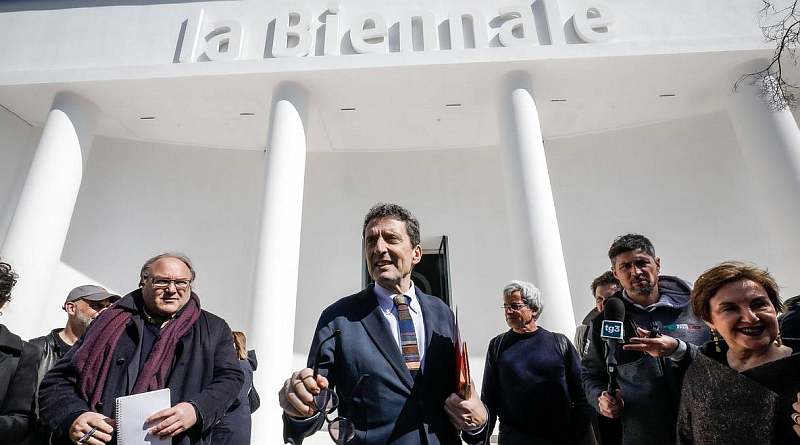
– The jury of the Venice Biennale, led by Solange Farkas, resigned en masse less than ten days before the exhibition’s opening, casting doubt on its normal proceedings. The reason was a dispute over Russia’s admission.
– Previously, the jury excluded Russia from the list of award contenders, but the organizers’ decision to restore Russia’s participation after a pause since 2022 prompted a sharp reaction.
– Additional pressure came from the Italian authorities and European institutions, which criticized this decision. Ultimately, the situation escalated into an open conflict, resulting in the jury’s resignation.
– The story demonstrates that even cultural platforms are no longer free from politics: attempts to reintegrate Russia into international events are increasingly accompanied by reputational losses and management crises.
