

Information on the current losses of Russia due to sanctions as of 09.11.2026.
1. Ukrainian drones attacked the “Kirishinefteorgsintez” refinery in the Leningrad region of Russia.
– On the night of November 9, Ukrainian drones attacked the “Kirishinefteorgsintez” (KINEF) oil refinery in the city of Kirishi, Leningrad region of Russia. According to preliminary data, possible impact zones of three primary oil processing units were recorded on the enterprise’s territory: ELOU-AVT-6, ELOU-AT-6, and ELOU-AVT-2.
– KINEF belongs to the company “Surgutneftegaz” and is one of the largest refineries in Russia. Its design capacity is about 20 million tons of oil per year. The plant produces gasoline, diesel and aviation fuel, fuel oil, and petrochemical raw materials.
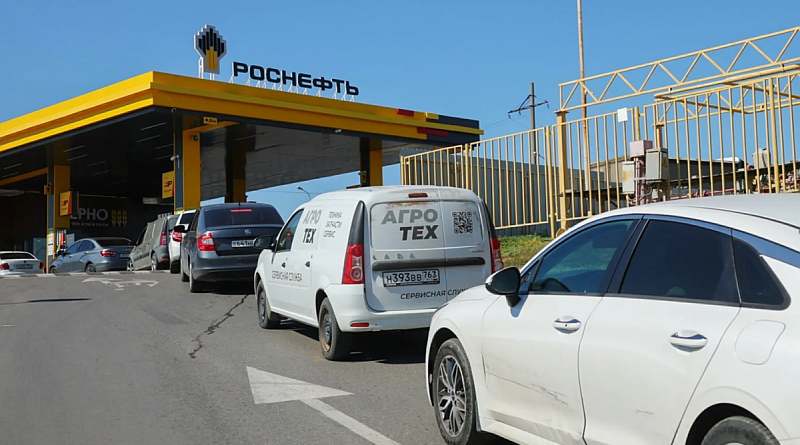
2. Fuel crisis in Russia is worsening: “Rosneft” has limited the sale of gasoline and diesel at gas stations across the country.
– A new wave of fuel restrictions has begun in Russia. The state company “Rosneft” has imposed limits on fuel sales at its gas stations in all regions of the country. The decision was made following a series of Ukrainian attacks on refineries, including enterprises that supply fuel to Moscow and St. Petersburg.
– In cities, motorists are allowed to fill no more than 30 liters of gasoline and 50 liters of diesel at a time. On highways, limits are 50 liters of gasoline and up to 200 liters of diesel. A complete ban on refueling fuel into canisters has also been introduced.
– The authorities of Karelia and the Ministry of Economic Development of the Trans-Baikal Territory have reported the restrictions, specifying that they apply to the entire “Rosneft” network in the country.
– The new wave of Ukrainian attacks affected several large refineries at once. Since October 30, the Novokuybyshevsk refinery, “Bashneft-Noyl” plant in Ufa, Yaroslavl refinery “Slavneft-YANOS”, Ryazan refinery, and the “Lukoil” refinery in Kstovo were attacked. On the night of November 9, Ukrainian drones attacked the Kirishi refinery in the Leningrad region, where a fire was recorded.
– The attacks also affected refineries involved in the supply of gasoline to the Moscow region: Ryazan and Yaroslavl plants, as well as the “Lukoil” enterprise in Kstovo. In total, since October 30, four “Rosneft” refineries and its joint venture with “Gazprom Neft” have been hit.
3. The Russian Ministry of Finance is forced to increase the national debt to cover growing budget needs.
– The Russian Ministry of Finance plans to raise 2.45 trillion rubles through federal loan bonds (FLB) in the fourth quarter of 2026; however, the legally established limit on domestic borrowing is already insufficient. Prime Minister Mikhail Mishustin signed an order allowing the department to exceed the debt limit by an additional 1 trillion rubles.
– Essentially, the government is forced to relax its debt restrictions to ensure funding for state expenditures. Over nine months, the Ministry of Finance raised 4.47 trillion rubles through FLB out of the annual limit of 6.47 trillion. By the end of the year, within the current limit, 2 trillion rubles remained, while the plan for the fourth quarter is 2.45 trillion. Therefore, at least 450 billion rubles were lacking for its fulfillment.
– The additional trillion is intended to create a buffer in case investor demand for Russian government bonds weakens at the end of the year. In the second quarter, the Ministry of Finance managed to place almost 1.7 trillion rubles of FLB in three months, but relying on the same result in the future is risky.
– Increasing borrowing is becoming increasingly expensive for the Russian budget. With a high key rate, each additional trillion rubles of debt means tens of billions of rubles in annual interest payments until the bonds are redeemed. In other words, the government is not just borrowing money to cover current needs but is creating long-term obligations that will constrain future budget capabilities.
– The cost of servicing the debt will compete with funding for other government programs. Russia is falling into a debt trap: to cover budgetary needs, more borrowing is required, and servicing the accumulated debt creates new expenses and increases pressure on the budget.
4. In Russia, there is a growing wave of company bankruptcies due to tax increases and falling demand.
– In the first nine months of 2026, nearly 5,400 Russian companies were declared bankrupt — 13.3% more than in the same period last year. In the third quarter, growth accelerated to 18.5% year-on-year: during this time, 1,800 enterprises underwent bankruptcy procedures.
– The number of new bankruptcy cases for legal entities from January to September increased by 23.6% to 4,600. At the same time, 49 external administration and financial recovery procedures were initiated, compared to 39 in the first nine months of 2025, an increase of 25%. The worsening situation is also confirmed by the rising number of filings to initiate bankruptcy.
– In the third quarter, the number of such filings by the debtors themselves increased by 35.6% year-on-year, and by creditors — by 13.6%. There was also an increase in cases opened based on the requests of the Federal Tax Service: from 15.6% to 24.2%. Companies themselves reported their insolvency in 17.2% of cases. Russian businesses are simultaneously suffering from declining consumer demand, high key rates, and increased tax pressure.
– Last year, the government raised the profit tax, and this year increased VAT to 22% and strengthened fiscal requirements for small businesses, restricting access for hundreds of thousands of entrepreneurs to the simplified tax system and lower rates.
5. Russia has reduced its plans for the production of Tu-214 passenger aircraft fivefold.
– In 2027, the Kazan Aviation Plant plans to produce only five Tu-214 passenger planes instead of the 20 promised by the Tatarstan authorities after the full-scale war against Ukraine began. Thus, from 2022–2027, the plant may build about ten such airliners instead of the originally planned 55.
– The initial federal program of 2022 envisaged the delivery of 40 Tu-214 aircraft by the end of 2027, and in the 2023 edition, the target was increased to 55. However, from 2024, the plans began to be curtailed. The actual results are even worse: since the start of the full-scale war, the Kazan Aviation Plant has built only two new planes. One was made in 2024 and delivered to Red Wings in 2025, the second, with a VIP cabin, was received by the company “Jetlet” in May 2026. Neither is used for regular passenger transportation.
– The problems are not limited to the Tu-214. After the cessation of Boeing and Airbus supplies, the Russian authorities focused on four domestic models — the Tu-214, MS-21, SJ-100, and Il-114-300. According to the 2022 program, by the end of 2027, airlines were supposed to receive 76 MS-21s, 82 import-substituted Superjets, and 34 Il-114-300s. However, as of November 2026, commercial deliveries of any of these three models have not yet begun.
– Now the plans are much more modest. In 2027, the manufacturer of the MS-21 promises to deliver eight planes to “Aeroflot,” with ten more in 2028. The start of SJ-100 deliveries has been postponed to 2027, with its certification still ongoing. As for the Il-114-300, only three machines are planned for 2026–2027, with the first promised to be delivered to the customer in December 2026. According to the 2023 plan, Russian airlines were to receive 159 planes of the four main models by the end of 2026, and 247 by the end of 2027.
– The actual lag demonstrates the inability of the Russian aviation industry to quickly replace Western planes after the imposition of sanctions and the cessation of component supplies.
6. Hungary seeks to replace Russian gas with Romanian Black Sea field gas.
– Hungary is in negotiations with Romania to purchase and transport natural gas from the Black Sea shelf in order to reduce dependency on Russian supplies. The Minister of Economy and Energy, István Kapitány, reported that the parties discussed the possibility of not only supplying gas to Hungary but also its further distribution in other Central European countries. The next round of negotiations is set to take place in Bucharest in two weeks.
– The main potential source of supply is the Neptun Deep field, which is expected to begin production in 2027. According to the project’s operator, OMV Petrom, its reserves are estimated at about 100 billion cubic meters of gas, and once at full capacity, production will reach approximately 8 billion cubic meters per year. This will almost double Romania’s gas production and transform the country into a potential net gas exporter.
– Earlier reports indicated negotiations for a potential contract to supply Hungary with 1 billion cubic meters of Romanian gas annually. This volume could cover approximately 20–25% of the country’s need to replace Russian imports. However, final volumes and terms of purchase have not yet been announced.
– Hungary plans to completely phase out Russian gas by the fall of 2027 according to the EU schedule. Besides Romania, Budapest is considering liquefied gas supplies via the terminal in Croatia, routes through Greece and Azerbaijan, as well as using infrastructure from Poland and Lithuania.
– The search for alternatives marks a departure of the new Hungarian government from the energy policy of former Prime Minister Viktor Orbán, who strengthened cooperation with Moscow and insisted on maintaining Russian supplies.
– Now Budapest is seeking other gas sources, gradually reducing Russia’s opportunities to retain the Hungarian market and political influence through energy dependency.
7. Russia used unrest in France for an information attack to discredit the government and support Ukraine.
– The Russian disinformation network attempted to exploit mass unrest in France to deepen social division, incite anti-immigrant sentiment, and portray the French authorities as unable to control the situation.
– According to European experts, the campaign was conducted by the network “Operation Overload.” In October, it spread fake videos disguised as materials from Western media. These falsely claimed that migrants were raping protesters and circulated messages about supposedly imminent terrorist attacks.
– “Operation Overload” has been active since September 2023 and targets Western politicians, institutions, and media. Its goal is to discredit them, weaken support for Ukraine, and spread claims that European governments pay more attention to helping Ukraine than their own internal problems. For this, the network forges news videos and newspaper headlines, manipulates images, and uses artificial intelligence for voice cloning.
– The European assessment covers the period from October 7 to 21. The document states that Moscow sought to depict French leadership as weak and increasingly authoritarian.
– It involves using existing unrest to promote narratives favorable to the Kremlin. The Kremlin uses internal crises in European countries to boost distrust in authorities, divide society, and weaken support for Ukraine.
