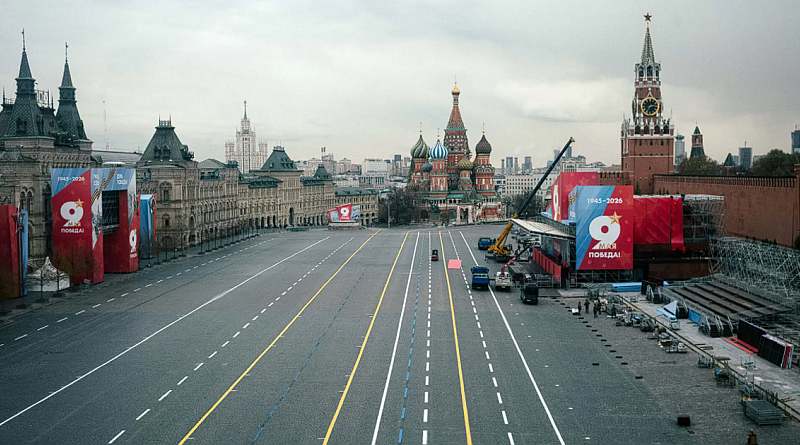
The Muscovite war against Ukraine has lasted longer than the Soviet-German one. “Repeat” is not working. Four years ago, they planned a parade in Kyiv, and now they ask Kyiv for permission to hold a festive demonstration in Moscow.
We know the cost of war not from archival footage, artistic films, and not from black-and-white photographs. But from the sound of sirens in the middle of the night. From trenches and dugouts on our land. From children’s rooms in destroyed houses. From cemeteries, which have grown in every Ukrainian city over these years.
Today the world will once again say: never again. But for us, this is not just a historical slogan. It is a question of life and death for the Ukrainian people. That is why our team once made a principled decision—to abandon the Soviet “Victory Day” and move to the European tradition of Remembrance Day. Because there is a chasm between memory and the cult of war.
At some point, “Victory Day” ceased to be a day of remembrance. And became a day of preparation for the next war. It is on this ideology that a generation of Russians has grown, who today have come to Ukrainian land as murderers.
We have given this phenomenon a precise name—Rashism. Rashism is no longer just authoritarianism. It is a mixture of imperialism, the cult of strength, hatred of freedom, contempt for human dignity, and the right of the strong to decide the fate of other nations. And the more the world sees Bucha, Mariupol, Izium, Avdiivka, the torture chambers of Kherson, kidnapped Ukrainian children, the more obvious becomes the terrible truth: rashism has become one of the closest modern forms to the evil that Europe has already seen in the form of Nazism.
“Never again” is not just words. It is a choice that Ukrainians today pay for with their blood.
Eternal memory to all who died in the struggle for the freedom of mankind. And glory to the Ukrainian heroes who continue this fight today—for the right of the world to be peaceful, free, and humane.
Glory to Ukraine!
“Never again!” – this is the wish of a world that has gone through the horrors of two world wars, mourned the fallen, and more than anything hoped it would not repeat.
Even in the USSR, they spoke of “with tears in their eyes,” and veterans were very reluctant to speak about their experiences.
But Putin, in his desire either to thrust himself among the biggest villains-conquerors or to take the world with him (“what do we need a world for, if I’m not there,” slightly altering his phrase), has ignited the war again.
It might have gone to another world war, but he stumbled over Ukraine. Both in 2014-15, when he failed to grab it quickly, and from 2022, when Ukrainians refused to capitulate, regardless of what Putin envisioned from observing the events in Ukraine.
In 2015, breaking away from the clutches of the “Russian world” and Moscow’s interpretation of history, we emerged with the slogan “We remember. We win.”
Because the return of true history, the awakening of our own memory, the rejection of swampy insinuations were and are key to liberation from the Russian monster.
We are not “one people,” we are not funny natives from the outskirts, and we are not subhumans who do not understand the benefits of a “large common Russian-speaking market and space.” Restoring our own mindset, consciousness, memory – this is the key to resilience against the foreign.
We will stand firm.
We will win.
We will restore order and astonish the world.
For the memory of those who gave their lives for this.
Glory to Ukraine and its Heroes!
We remember – we win.
That day the continent was not yet fully aware of what World War II had left behind. It would take several more months of the first silence, when the realization of reality would gradually come… how many millions of people the war had displaced, and now they need to return home… how broken the societies of Europe were… how helpless the states were… how few resources the post-war countries had for their recovery… on May 8, no one yet thought about this. Simply, in one moment, it became easier for millions of people to breathe.
We still do not know the real story of that war, cannot imagine the mood of May 1945, and it is not easy for us to adopt the worldview of a European who, upon turning on the radio, heard that the war had ended. This explosion of euphoria and hope that such a thing would never happen again…
Very few people in May ’45 understood that the world had not become safer. Few saw that the fall of one monster led to the rise of another. The irony of history – the new threat was nurtured by the West itself. There were only a few, like George Patton, who directly called the USSR evil. Churchill’s Fulton speech was ten months away.
Many historians and publicists have written – in reality, World War II in Europe did not end. The victory was incomplete. Yes, the guns fell silent, but the consequences, the aftershocks of WWII, continue and will continue until the second “co-author” of World War II falls – Moscow.
Therefore, the ultimate Victory Day in Europe is still ahead. Some of us may be lucky enough to breathe the unique air of that euphoric moment, to touch the spontaneous joy that will spill into the streets… then hear some special, entirely different silence… and finally – emptiness and fatigue. Someone will be lucky enough to feel what Europe began 81 years ago.
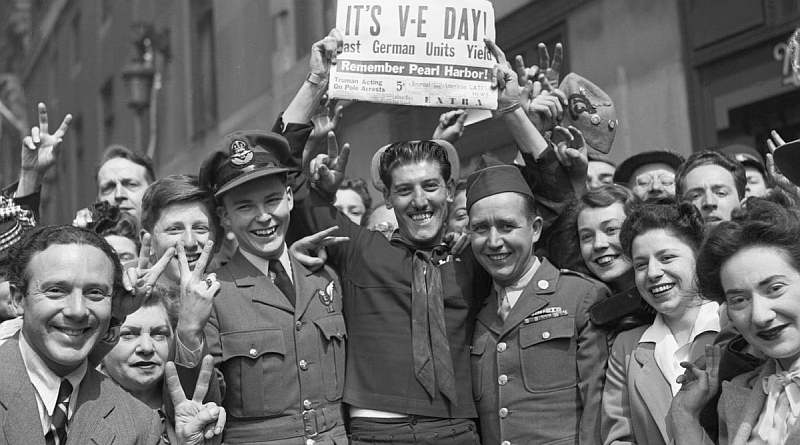

We began to mark the Day of Remembrance and Reconciliation… not to celebrate, no. To note it in our calendars. This is what we needed; we didn’t want to fight, hate, or dance on the bones of the defeated and victors. Remembrance and reconciliation, well, what more could people want after a war?
* * *
No one touched the graves. Neither Soviet nor German. Some odious monuments were removed, but the graves remained where they were. Because – remembrance and reconciliation.
* * *
I now look with disgust at “Victory Day,” which has become the Day of Eternal War. Not a word about peace from their mouths, channels, texts. War, “victory,” “not sparing the cost”: for yet another victory, a sea of blood, mountains of victims, and then war again. Into the pit go their own and others’ fates, into the pit go peace, cities, development, youth, old age, childhood. And bleach on top, and on the freshly filled pit – “eternal flame.”
* * *
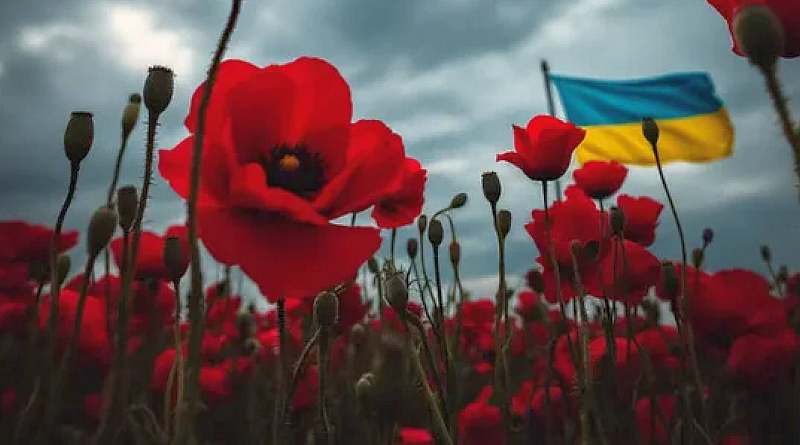
We have the poppy flower. They have fire. Not the kind that warms, or that is used for cooking. Eternal. And where does fire burn eternally? Exactly.
* * *
It’s disgusting to look back at the mess we escaped from. And we were there, well, almost.
* * *
Happy Day of Remembrance and Reconciliation (and a bit of Victory over Nazism as they now add). We defeated the brown shirts—let’s defeat the tricolor-reds. And we will remember, but with reconciliation—we’ll see.

With his efforts to seek a ceasefire for a parade on Red Square, Putin has once again drawn our attention to the holiday we were starting to forget—although before Russia’s large-scale war against Ukraine, it seemed like the day meant to unite Russians and Ukrainians across state borders. Moreover, it was meant to divide Ukrainians from “greater Ukraine” and Galicia, because “here we have” the Soviet Union, the Red Army, a common enemy, and Stalin, while “there they have” the UPA and Bandera.
All of this was a great deception, starting from the war history and ending with its last day. It’s no secret that Stalin simply “invented” May 9th, to avoid celebrating May 8th with the allies. Because the two capitulations of the Reich—the real one and the one imposed by Stalin—took place on May 8th by European time and in Germany. Even though the second ceremony ended when it was already the ninth in Moscow, the event date couldn’t change, but Stalin, the great falsifier, ignored this. And May 9th was needed to ensure the Soviet Union had its own war dates, different from the world’s, because only this way could they mask the actual alliance between the USSR and the Reich in the first two years of the war—an alliance, of course, neither Great Britain nor the United States had.
It’s also no secret that Stalin simply feared celebrating victory day: in 1945 he held a parade, but didn’t even make May 9th a holiday. This fear was understandable: on the first day of peace, Soviet citizens could look around and realize the horror they were in. Total ruins, tens of millions of victims, millions in the GULAG, hunger, hundreds of thousands of cripples on the streets, destroyed cities, villages without men… And also imperial arrogance, intensified repression, preparations for a new war. In a state that would proudly later position itself as the main victor in the war, there was simply nothing to celebrate. Khrushchev dared to hold the first parade after 1945 only 15 years later, and Brezhnev made May 9th a holiday.
The state’s interest in the victory cult increased each year with the disappearance of real war veterans. But my generation still encountered them—not the pretentious political officers and SMERSH officers who fought less with the Nazis and more with their compatriots, but those who went through the entire war and did not want to remember it, because for a soldier it was true hell, a hell of indifference to his own life.
Since childhood, I remembered how my grandmother’s cousin, a mathematics professor who went to the front from his student days and went through the whole war, would literally become enraged when he heard the then-popular song by the Russian bard Bulat Okudzhava with the main line about needing one victory, one for all, and “we will not stand the cost.” He would ask others: what do you mean by “we will not stand the cost”? How? And, of course, he could see before his eyes his classmates and university mates, almost none of whom returned from the war. Okudzhava’s song was performed by actors playing war veterans in the film “Belorussky Station.” And I understood clearly that real veterans would never sing that.
Putin’s grotesque myth – the notorious “victory frenzy” – emerged in 2005, on the 60th anniversary of the war’s end, when almost no participants remained, as the soldiers of the last conscription year, 1927, were already nearing 80 years old. Putin’s war has nothing to do not only with the real Second World War but even with the wars of Khrushchev and Brezhnev, who, even if they were political officers, were still generals who saw the real front and death. Putin’s myth is a masquerade, preparation for new wars, and an attempt to drag neighboring countries into the space of shared losses. That’s why I was so disturbed by the readiness of Ukrainians to become voluntary participants in this spectacle, which was visibly transforming from Soviet to overtly chauvinistic.
Remember how Ukrainian society resisted on May 8 and defended May 9, how the administrations of Kuchma and Yanukovych nurtured the Soviet canon, and how Yushchenko’s attempts to achieve at least reconciliation among Ukrainians themselves, who naturally found themselves in different armies during the war, faced resistance because many residents of the former Ukrainian SSR thought the president was encroaching on the sacred, that independence is independence, but how could we be without May 9?
It’s painful to think that the Ukrainian people are paying such a high price for their recovery from the darkness of Russian falsifications and myths. It’s unbearable to realize that if it weren’t for the annexation of Crimea, the war in Donbas, this great war, we would have floundered in this Soviet mire for decades, possibly without much chance of getting to clear waters.
But it is what it is. And now on May 8, we will understand that unpunished evil (and the Soviet Union, this pseudonym for chauvinistic Russia, was indeed unpunished evil) certainly returns in all its aggressiveness as soon as the memory of war victims fades. And if no conclusions are drawn from this lesson even now, wars on our “bloody lands” will repeat over and over.

Moscow celebrates victory in a war that it has turned into its main spiritual anchor. The problem is that this anchor’s expiration date has passed.
In every country’s calendar, there is a day celebrating the people’s identity. It’s the main celebration encapsulated in the formula “we achieved.” Independence Day in the USA tells the story of how American settlers won independence from royal power. Bastille Day tells the world how the French ousted the king. In Russia, May 9 has taken on an analogous role, and for long decades, this date has been more sacred than any other holiday, including the “Day of National Unity” and “Day of Russia.”
Victory over Nazism became for the Soviet Union and Russia the main “but,” which was meant to justify everything that happened in the country before that. “Mass repressions” — “but we defeated Hitler.” “People died of hunger” — “but we overcame the Third Reich.” May 9 justified deportations and exiles, executions and terror. Any attempts to reflect on the Soviet regime repeatedly encountered this argument. The date became a weight on the moral-ethical scales of the regime and the country, allowing Moscow to claim moral superiority for years.
May 9 held such a charge of moral superiority that the Soviet, and later the Russian state, decided to appropriate it. As a result, this date became not the “day of people’s identity,” but the “day of state identity.” This is not surprising when you consider that the USSR and Russia live in the logic of statism. In the Russian tradition, it is impossible to imagine anything that is not only “against the state,” but also nothing that is “outside the state.” Any activity is possible only with the regime’s approval. Any unapproved initiative is perceived as a threat. You can even be a patriot only within strictly agreed-upon frameworks, and “non-systemic patriotism” is considered no less a threat than opposition. Therefore, throughout all post-war decades, Moscow fought against those who tried to challenge its monopoly on this celebration.
In the Soviet-Russian tradition, there were two approaches to celebrating May 9. The first was state-driven. With parades, flags, loud speeches, and big stars on epaulettes. In this approach, the state and command won the war. The attributes of celebration were numbers, scales, verticality, and system.
The alternative was an intimate-personal approach, based on family memories. Lieutenant prose and diary entries. In this approach, there was not always a place for Stalin, but there was a place for someone’s grandmothers and grandfathers. And with this second approach, the Soviet-Russian system tried to fight.
Few remember, but the “Immortal Regiment” movement started in 2012 as an alternative to official grandiosity. It was invented by the opposition Tomsk TV company “TV-2”: people were invited to carry portraits of their relatives instead of flags and slogans. But already in 2015, the Russian state closed the TV company, and the “Immortal Regiment” movement was taken under its wing.
May 9 was too powerful a source of legitimacy for the Kremlin to be willing to share it with anyone. Therefore, as early as 2010, Putin declared that the war would have been won even without Ukraine’s participation. Moscow declared itself the main possessor of this asset and was ready to exchange access to it only for political loyalty. Pledge allegiance, and then we will tell you about your contribution to the victory over Germany. We will personally add you to the list of winners. If you refuse, we will declare you an ally of the losing side and the heir of those who were defeated in May 1945.
The Second World War turned into a true “civil religion” on the territory of the USSR/Russia under the name “Great Patriotic War.” It has obligatory attributes of celebration, a singular correct model of description, and a mandatory list of angels and demons. Any deviation from this canon is declared heresy and punished with anathema.
Therefore, the main criterion of independence in the post-Soviet space for a long time was not so much the presence of a national independence day, but the existence of its own version of World War II events. If you were not ready to agree with the Russian version of history, you were counted among Hitler’s allies. The longer the post-Soviet drift lasted, the more countries found themselves in Russia’s list of “traitors.”
The Kremlin sought for decades to find a source of its own ethical strength in May 9. The country’s leadership proclaimed itself the direct heir of those in whose time the Third Reich was defeated. Every ruler addressed the world on behalf of the people who signed Germany’s capitulation. May 9 gave the Kremlin the right to speak from positions of moral righteousness, and this is the exact right Russia lost after the invasion of Ukraine.
Unprovoked attack. Bombing of peaceful cities. Repressions in occupied territories. Moscow destroys every day the symbolic capital it built on its mythology of the “Great Patriotic War.” Now the past no longer outweighs the present, and it’s impossible to cover up current crimes with past victories. Fewer and fewer guests come to Moscow for the annual May ritual of communion, and attempts by Kremlin residents to speak from positions of moral superiority look absurd. Any attempt to appeal to the past now encounters the present, and thus “today” is doomed to outweigh “yesterday.”
The ideological facade created to serve as a universal justification for power has been torn apart. Through it now can be seen both old and new repressions. The Molotov-Ribbentrop Pact and the bombing of Mariupol. Since February 2022, Russia has been proving that it emulates not the victors of World War II, but the vanquished. The past war no longer outweighs the current one, and therefore cannot serve as justification and indulgence.
In recent years, the peculiarity of each May 9 is only that Russia asks Ukraine for a truce to “celebrate victory.”