
Vasyl Korotky, Berlin / Ukrinform
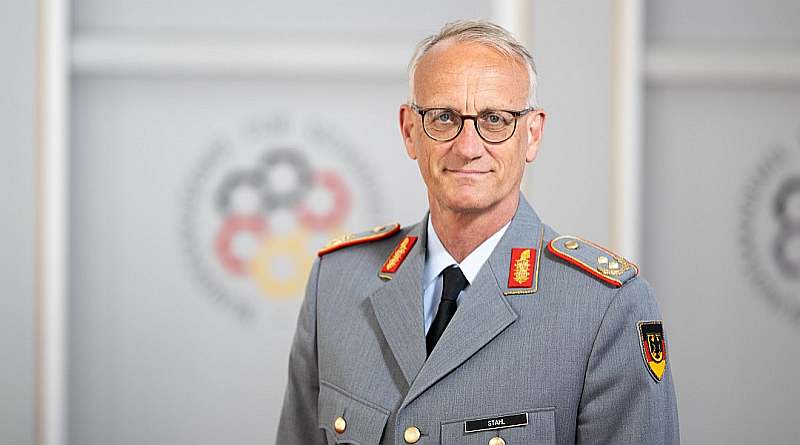
Wolf-Jürgen Stahl is the first active officer to hold the position of President of the Federal Academy for Security Policy of Germany (BAKS) – a key institution that shapes the strategic thinking of German political, military, and administrative elites. A Bundeswehr major general with many years of experience working within NATO structures, he has taken the helm of the academy at a time when Berlin is rethinking its security approaches and Germany’s role in Europe amid the threat from Russia.
The special correspondent of Ukrinform spoke with Major General Stahl about whether the “Zeitenwende” – the “turning point” proclaimed after Russia’s full-scale invasion of Ukraine – has become a real shift in Berlin’s security policy or remains largely rhetorical. The BAKS President also discussed how Berlin is countering Russia’s hybrid warfare and why it still does not supply Taurus missiles to Ukraine.
Additionally, there are insights on the risk of Moscow moving from hybrid aggression to a direct strike on NATO, the reduction of the American military presence in Europe, and Ukraine’s role in the new architecture of European security.
“READINESS FOR WAR” IS NOW AT THE CENTER OF GERMAN SECURITY DISCOURSE
– Major General, you are the first professional officer to head the Federal Academy for Security Policy. Can your appointment be seen as a signal that German security policy is becoming more militarized? Does it mean that the Bundeswehr’s expertise will carry more weight in political decision-making in Berlin?
– I am the first active officer to have the honor of holding the position of President of the Federal Academy for Security Policy. The leadership of this Academy rotates between the Ministry of Foreign Affairs and the Federal Ministry of Defense. This time, my minister decided that this function could be undertaken by an active general.
The expertise itself is not new – a retired admiral or general, when serving as president, also brought military expertise. The same applies to civil servants from the Ministry of Defense who are sent to the Academy.
What has changed is the perception of concepts such as defense capability, combat readiness, or – a term introduced by our minister – “readiness for war” (Kriegstüchtigkeit). These topics today are in significantly greater focus.
– In this context, has the so-called “Zeitenwende” – the “turning point” – occurred in the consciousness of politicians and society in Germany, or do tendencies to return to the way things were before still exist?
– First of all, the question arises whether everyone understands the same thing by “Zeitenwende”? If we go by the words of the then Federal Chancellor – “from now on, we live in a different world,” – it is clear that the security framework conditions, especially in Europe, have changed dramatically. I believe this is widely understood and accepted.
The federal government is also acutely aware: we need to become more resilient, particularly to hybrid attacks that are already occurring. We must be capable of defense so that by strengthening our defense capabilities, we can prevent an open military conflict, especially with Russia.
For the foreseeable future, Russia remains the greatest threat to security in Europe. Ukraine is experiencing this firsthand, so to speak.
THE RUSSIAN WAR AGAINST UKRAINE HAS CHANGED SECURITY POLICY PRIORITIES IN GERMANY
– Has Russia’s war against Ukraine changed the strategic culture in Germany?
– One of the tasks of the Federal Academy for Security Policy is precisely to promote strategic thinking and strategic forecasting.
I am convinced that this war has changed the security policy priorities in Germany. A striking example: for the first time, a decision was made to supply weapons to an active combat zone – Ukraine. This can be considered a concrete manifestation of a change in strategic culture.
– Is the Academy analyzing Ukraine’s experience of total resistance to Russian aggression? And if so, what has already been integrated into the training programs?
– What exactly do you mean by “total resistance”?
– I mean the combination of civilian, military, and societal resistance.
– It is impressive with what determination Ukraine can sustain the resistance of its society.
The fact that the Ukrainian people have endured this aggressive attack, which violates international law and disregards human dignity, for over four years deserves the highest respect.
And it’s important to emphasize: Ukraine is also fighting for our security.
In our 2023 National Security Strategy, for the first time in the history of the Federal Republic of Germany, the concept of “integrated security” is introduced in written form in the document.
This means that security should be understood comprehensively and provided at the level of the entire state and society. It’s not just about the military dimension but also about the economy, development, internal and external security, economic, digital, and even spiritual dimensions.
We consider security within the continuum of “peace – crisis – war.” Appropriate measures need to be prepared in peacetime to withstand a crisis and be ready for war.
TAURUS COULD HAVE AN EFFECT. BUT THE DECISION IS UP TO POLITICIANS
– I would like to ask about the situation on the battlefield in Ukraine. How do you assess the current situation on the front and how would you characterize the current phase of the war?
– For the military, it is important to see the battlefield with their own eyes to properly assess the situation. I do not currently have such direct observation.
But I can say: I am impressed by what the Ukrainian nation is demonstrating as a whole. This is not just a task for the army – it is the effort of the whole society, including the state with its civil protection structures.
– Ukraine is increasingly striking strategic targets in the Russian rear – logistics, energy, and defense industry. How do you assess these attacks? Can they significantly influence the course of the war?
– If it is not possible to neutralize the enemy directly on the front line, attempts are made to limit its ability to fight, including strikes on logistics, supply, and industrial capacities.
This corresponds to classic military principles: acting in depth, putting pressure on the system as a whole, and pushing it to the edge of functioning. If decisive breakthroughs cannot currently be achieved on the front line, this approach is entirely legitimate for Ukraine.
– Germany is also investing in the development of Ukraine’s long-range capabilities, but has not yet dared to supply its own Taurus cruise missiles. Can you explain why this decision hasn’t been made yet?
– This is a political decision made by the relevant government parties. I am not involved in these processes and cannot speculate on specific motives.
In political discourse, there are different assessments, including whether certain supplies may pose a risk of escalation.
From a military standpoint, I can say that such systems would have an effect. However, whether there is readiness to take political responsibility for this military effect is a decision that politicians alone must make.
WE CANNOT ALLOW RUSSIA TO LIMIT OUR ABILITY TO ACT
– How should Germany respond to Russian intimidation attempts without limiting its own ability to act through self-restraint?
– The key is not to succumb to intimidation. Decisions should be evaluated based on whether they are appropriate, whether they have a clear effect, and whether they are politically justified and acceptable.
You should not allow the other side to limit you in your own actions. If you are convinced that certain measures are right, they should be implemented.
– Besides threats, Russia conducts active operations against European countries, including the Federal Republic of Germany. According to your classification, is this a hybrid war?
– I will quote the federal chancellor: Russia is waging a hybrid war against us. This includes the so-called “3S”: espionage (Spionage), sabotage (Sabotage), and subversion (Subversion). These phenomena are not new, but today – especially in the cyber and information space – they have taken on a new dimension.
We regularly see espionage, especially through uncovered cases in Germany. Sabotage includes attacks on infrastructure such as railway networks or pipelines. Subversive activities are aimed at the mindset and will of society through disinformation and influence operations.
This is complemented by cyberattacks on government institutions and enterprises, including those in the defense industry.
Overall, it is difficult to unambiguously attribute such actions. But there is already considerable evidence that Russia is behind them – especially in the cyber and information space.
THE PROBLEM OF HYBRID WARFARE – IN THE DIFFICULTY OF CLEAR ATTRIBUTION
– This also includes the so-called “unknown drones” over Germany…
– Yes, this is also a manifestation of hybrid actions. I deliberately avoid the term “threat” because attacks are actually taking place. When attacks occur, it’s not just about a threat, but about the need to defend.
This includes drones, as well as simple means like the so-called “disposable agents” or low-level acts of sabotage. The range is very wide, and imagination here knows practically no bounds.
We must assume that these actions will not decrease, but on the contrary, will increase both in intensity and variety. They will increasingly disrupt and burden our system. Against this, we have to harden ourselves, become more resilient.
– Isn’t it time for Germany to act much more decisively in response to these hybrid attacks so that Moscow finally feels the consequences of its actions?
– The central question is how to effectively counter hybrid attacks? How to prevent espionage, sabotage, and subversive activities?
In the hybrid sphere, I see only limited offensive possibilities for response. This means that first and foremost we must harden ourselves against these attacks, withstand them, and in the limited possibilities we have, try to prevent such actions from Russia. Completely preventing such actions is hardly possible. You can prevent espionage from being successful, but not the attempts themselves.
– And yet – what about the “unknown drones”…
– I often can’t confidently say whether these are truly Russian drones. I have already mentioned the problem of clear attribution as fundamental.
Of course, you can consider the possibility of responding symmetrically, but for me, a fundamental question arises: if someone breaks the rules – does this justify me breaking the rules too? This does not correspond to my understanding.
– I also had an interview with Professor Tim Stuchtey, who asked: why don’t we see unknown drones over Kaliningrad? Could this be a response?
– But would this deter Putin from sending more drones here?
It’s like with espionage: agents have always been sent. Will it stop the other side from sending agents just because I also send them?
This sounds too simple, whereas I approach this more differentiated and say: there is no automatic response here.
– Does Germany currently have sufficient capabilities for such a proactive approach?
– According to our legislation, we are indeed very limited at the moment. Therefore, legislative changes are being prepared now, for example, to give the Federal Intelligence Service more capabilities. There is active discussion about this, necessary bills are in development, as it has been realized: through appropriate legal extension, additional measures can be ensured. This is understood, and work is underway on it.
PUTIN IS NOT AN ADVENTURER, BUT UNDER FAVORABLE CONDITIONS MAY ATTACK NATO
– In your opinion, is there a danger that Russia might transition from hybrid means to a kinetic phase against a NATO member country? What indicators could suggest this?
– What we must do is ensure that conditions for a military attack are not favorable. Putin is building up his armed forces, restructuring their organization, and creating new bases and barracks along NATO’s borders. He is therefore developing capabilities for a military attack, and I admit that under certain circumstances, he might have the will to use these capabilities.
If we show him that it would be very painful, that there would be a very high price to pay—key words: deterrence, defense capability—then I believe this will make an impression. After all, he is not an adventurer, but to some extent also a realist, who may conclude that an open military attack on NATO territory would be too costly for him.
THE US SHIFTS FOCUS TO THE INDO-PACIFIC REGION BUT DOESN’T LEAVE EUROPE
– The American president called NATO a “paper tiger” and said Putin perceives it the same way. You have worked in Alliance headquarters. How do you assess such statements? Is a guaranteed joint and decisive NATO reaction in case of a crisis truly assured?
– I know NATO as a fully capable alliance.
NATO has integrated command structures, established procedures, and decision-making mechanisms where each country has a voice. In this sense, I see NATO as an effective alliance.
And now, with new defense planning, especially along the northeastern flank, I also see NATO as well-prepared.
The question usually arises: what about the Americans? My answer: yes, the United States has defined a new priority in the military sphere—not just Europe, but also the Indo-Pacific region. This is their decision. But it does not mean that they are completely leaving Europe. Priority means that the main forces are concentrated there, but they also remain in Europe.
And the Europeans themselves, in my assessment, have the potential to fill significant gaps. It takes time, but I am firmly convinced that Europeans can assume more responsibility for security in Europe. And let’s not forget: a stable and secure Europe is also in the interest of the United States.
– How much time do Europeans need to close these gaps?
– This largely depends on how quickly European states reach political consensus and implement relevant measures.
However, experience shows: creating complex military capabilities takes years, and often decades.
– How do you assess the announced reduction of American troops in Germany? And do you consider this partial withdrawal just the first step towards a complete withdrawal of the US from Germany? What geopolitical signal does Washington send with this decision to European allies and Moscow?
– This decision is generally not unexpected given the American strategic focus on the Indo-Pacific region, but the timing is certainly political.
Against this backdrop, Europe must more decisively take its defense against the direct threat from Russia into its own hands. Europe has the potential for this and is increasingly ready to move toward greater independence. Taking more initiative here is in the interests of both Europe and the United States.
However, I do not expect the US to fully withdraw its forces from Europe. Stability on both the Pacific and Atlantic coasts is a matter of national security for Washington and a joint task with regional partners.
EUROPE DOESN’T NEED A NEW NATO, BUT A MORE “EUROPEAN” NATO
– What is your stance on the idea of a European Defense Union?
– I am not sure if we need a separate purely European union alongside NATO. In my opinion, it’s rather about “Europeanizing” NATO – significantly strengthening the role of Europeans within the existing alliance.
This can be achieved within the frameworks of NATO’s established and tested structures, without creating anything fundamentally new. Defining this politically as a “European Defense Union” is a matter of terminology. The main thing is that Europeans should take more responsibility and invest more resources in common defense.
– Regarding the European nuclear shield: discussions are taking place between Germany and France. How realistic is this idea in practice?
– First of all, I see no signs that the US will withdraw its nuclear protection from Europe or that extended deterrence is being questioned. I also do not believe it would be in American interests, particularly because such a move could spawn new nuclear states.
In this context, the current dialogue pertains to the question of whether and to what extent the European contribution in the nuclear domain within NATO can be enhanced.
The signal from Europeans is as follows: we are ready to contribute together with the US.
At the same time, it is clear: what Europeans possess – namely France and the United Kingdom – will never replace the American nuclear arsenal. One does not replace the other. But European potential can be used more actively to complement American capabilities – together with the US, not instead of it.
NATO LEARNS FROM UKRAINE’S EXPERIENCE TO TRANSFORM ITS CAPABILITIES
– Today, Ukraine has unique experience in conducting large-scale conventional warfare, which no NATO country has. What role, in your opinion, should Ukraine play in the new European security architecture?
– From a purely military standpoint, Ukraine is already playing a very noticeable role. NATO has initiated a process to learn from the experience your country has been compelled to endure at such cost, and on this basis, shape its own capabilities and structures.
In the civilian sphere, I also know that many institutions, including the Federal Office of Civil Protection and Disaster Assistance, are engaged in intensive dialogue with the relevant Ukrainian structures to understand how civil protection functions under such conditions.
Thus, Ukraine is already making a contribution from which other countries benefit.
In this sense, much is already happening. Most of all, I would like you not to have to experience this, and for us not to have to use it – that would be an ideal world. But it doesn’t exist.
In the long term, it is obvious to me:
Ukraine is a sovereign state whose territorial integrity must be respected – without any “buts”.
This principle is the foundation of any stable international order.
In the future architecture of European security, I see Ukraine as an integral part of Europe.
The issue of possible membership in the EU or NATO is subject to formal procedures, but politically it is clear to me: Ukraine belongs to the European community of states.
– Within the Coalition of the Willing, mandatory security guarantees for Ukraine are being discussed, including a joint military contingent. Federal Chancellor Merz did not rule out the deployment of Bundeswehr units on neighboring NATO territory. How realistic do you consider such a mission and the participation of German troops?
– The key prerequisite is the cessation of hostilities. The President of Ukraine essentially said he is ready to accept a ceasefire along the current front lines. Thus, it largely depends on Putin – whether he says “end the fighting” or not.
Then the second question arises: how to ensure that it does not ignite again? In my opinion, this is only possible through convincing deterrence. Russia must be clearly shown that a renewed attack will be extraordinarily costly for them.
How exactly such security guarantees could look is the subject of political negotiations in which I do not participate. However, a significant factor will be that Ukraine itself – with its battle-hardened Armed Forces – continues to be able to defend itself effectively, with a clear proclamation that other states will treat another Russian attack as an attack on themselves.
– Finally, Major General: if you could give one piece of advice to the Ukrainian General Staff and the German government this year, what would it be?
– I generally approach advice cautiously.
Regarding Ukraine, I can say: it is impressive with what inner determination, mindset, and resolve Ukraine – people, economy, state – is engaged in this existential struggle. I wish you continued strength to endure.
To my own government, I would say: we should take this spirit and determination as an example to some extent.
Photo: BAKS/Stollberg and M. Hurek for FOCUS
